Showing posts with label telescopes. Show all posts

20200304

Astronomy quiz archive: telescopes

Astronomy 210 Quiz 3, spring semester 2020
Cuesta College, San Luis Obispo, CA

Section 30674, version 1
Exam code: quiz03n1g6


Section 30674
0- 8.0 :   * [low = 0.5]
8.5-16.0 :   *******
16.5-24.0 :   ******** [mean = 22.5 +/- 9.9]
24.5-32.0 :   *****
32.5-40.0 :   ****** [high = 40.0]


Section 30676, version 1
Exam code: quiz03smGL


Section 30676
0- 8.0 :   ** [low = 8.0]
8.5-16.0 :   ******
16.5-24.0 :   *************** [mean = 24.0 +/- 9.3]
24.5-32.0 :   ********
32.5-40.0 :   ********** [high = 40.0]

20200227

Physics quiz archive: lenses, optical instruments

Physics 205B Quiz 2, spring semester 2019
Cuesta College, San Luis Obispo, CA
Sections 30882, 30883, version 1
Exam code: quiz02B3rD


Sections 30882, 30883 results
0- 6 :  
7-12 :   *** [low = 7]
13-18 :   *****
19-24 :   ********************* [mean = 21.5 +/- 5.2]
25-30 :   ****** [high = 30]

20200219

Online reading assignment: atmosphere problems, Earth, the moon, Mercury (SLO campus)

Astronomy 210, spring semester 2020
Cuesta College, San Luis Obispo, CA

Students have a weekly online reading assignment (hosted by SurveyMonkey.com), where they answer questions based on reading their textbook, material covered in previous lectures, opinion questions, and/or asking (anonymous) questions or making (anonymous) comments. Full credit is given for completing the online reading assignment before next week's lecture, regardless if whether their answers are correct/incorrect. Selected results/questions/comments are addressed by the instructor at the start of the following lecture.

The following questions were asked on reading textbook chapters and previewing presentations on problems caused by the atmosphere for telescope observing, Earth, and the impacted worlds: the moon, and Mercury.
Selected/edited responses are given below.

Describe something you found interesting from the assigned textbook reading or presentation preview, and explain why this was personally interesting for you.
"That light waves can be affected by our atmosphere. I just found it interesting because it was something that I never considered."

"How light pollution can affect so many things in our environment, such as animals."

"That light pollution interferes with the view of the stars/planets. People would then need go to hilltops far away away from the light pollution just to look at the clear stars and planets."

"I found light pollution very interesting and did not think it was a very big problem until I read into it some more."

"Something I found interesting was that if you were to go to a rural town with not very many lights you could see a faint Milky Way. I found that interesting because we do not get that many chances to see it if you do not leave your hometown."

"Comparing the atmosphere to rippling water was a good analogy. I found this part interesting because I knew that the atmosphere made it more difficult to view view things using a telescope, but this comparison made it easier to understand why."

"I found the comparison between sitting under a pool of water and looking up to sitting under a 'pool' of air really interesting. I never thought about how movement in the sky, such as turbulence, could create such a problem for astronomers or anyone interested in the views of the sky."

"I found learning about how atmospheric turbulence and opacity affect our ability to use telescopes and the ways we combat those effects interesting. I never understood why it was better to have telescopes at a higher altitude and now I do."

"I found the readings about different ways that astronomers have to go about collecting different types of electromagnetic radiation. I found this interesting because it forces them to find new and interesting ways to collect data, which leads to a deeper understanding of our known universe."

"I thought that it was very interesting that telescopes in space can be the size of a bus. This is crazy to me how they can be that and still be be able to function in space."

"Airborne and space telescopes (airplanes, balloons, rockets and satellites), because it is such an interesting perspective to think about."

"I liked reading about all the different atmospheres on the different planets and I liked how it got into global warming. I was also interested by the stages that earth has gone through to and how we'll basically always be in stage three because Earth's surface is constantly changing."

"The greenhouse effect of how an atmosphere traps heat and raises the temperature of a planetary surface. It's crazy how the atmosphere has such an effect on planets--without it, Earth would be a lot different."

"The large impact hypothesis, stating the bulk of two objects will combine to form Earth (and the moon), with most of their cores and the surrounding crust melting, then coalescing."

"I was interested particularly in the geology comparing the planet Mercury to our own moon. Both involved the formation of craters followed by partial filling of lava. I found it fascinating that both bodies were strikingly similar and figured that this could help us learn more about the formation of other planets."

"When learning about the history of Earth's moon, I really enjoyed reading about the magma ocean, it just sounds super awesome to picture."

"I thought the different sizes of the moon's core versus Mercury's core was interesting because you would expect them to remotely similar but are different and you can determine this by the gravitational pull."

"I really liked looking at the pictures of the moon's and Mercury's surfaces. It is cool looking at the ridges and craters shown in the pictures."

"I think it's increasingly interesting how much we think we know about other planets that is primarily based on extrapolation. All of this could change as soon as new evidence presents itself."

"Super-hectic weekend and wasn't able to get to the reading but I will before class!"

Describe something you found confusing from the assigned textbook reading or presentation preview, and explain why this was personally confusing for you.
"I do not understand the electromagnetic spectrum graph or how to use it."

"I did not quite get what the difference between radio astronomy and light astronomy was. I wanted to know, but was just lost by the name drop."

"I don't understand how atmospheric turbulence occurs."

"I'm still catching up on the history stuff, I'm really bad at remembering names and related numbers and just putting it all together in the right way."

"The greenhouse effect."

"How carbon dioxide enters and leaves the atmosphere and everything about it, mainly confusing because I thought I already had an idea and now I am jumbled up."

"I was confused about how an asteroid wouldn't be able to break the moon's structure or crack it, it would only leave a crater."

"Something I found confusing was trying to determine which craters were oldest to youngest. Personally because when I was reading the information I just could not retain it."

"That the four inner planets were composed of rock when the outer planets are not."

"The atmosphere on Venus. Why is it so cloudy and thicker than Earth's? It's confusing for me because I thought all the planets had the same amount of atmosphere."

A large modern optical telescope in outer space would have images with better __________ than a comparable ground-based telescope.
brightness.   ******** [8]
resolution.   ************************ [24]
magnification.   * [1]
(Unsure/guessing/lost/help!)   *** [3]

Stars to appear to "twinkle" in the night sky because of...
"The stars twinkle in the night sky because of the effects of our atmosphere. When starlight enters our atmosphere it is affected by winds in the atmosphere and by areas with different temperatures and densities. This causes the light from the star to twinkle when seen from the ground."

"Movement within the atmosphere causing the images of the stars to move and blur."

"Stars appear to twinkle in the night sky because of the effects of our atmosphere. When the light from the stars enter our atmosphere, it experiences turbulence. This causes the stars to look like they 'twinkle.'"

"Living in at the bottom of an 'ocean of air,' turbulence disturbs the air in the atmosphere, making our view disrupted."

"The way our atmosphere moves and shakes."

"I'm not sure, I don't remember this part of the reading."

"Unsure."

Identify how carbon dioxide enters and how it is taken out of Earth's atmosphere.
(Only correct responses shown.)
Enters atmosphere from: volcanoes [44%]
Taken out of atmosphere by: oceans [57%]

Identify the oldest (longest ago) to the youngest (most recent) features on the moon.
(Only correct responses shown.)
Craters partially filled in with flat lava plains: oldest (formed longest ago) [31%]
Flat lava plains: middle [22%]
Craters on top of flat lava plains: youngest (formed most recently) [53%]

Identify the oldest (longest ago) to the youngest (most recent) features on Mercury.
(Only correct responses shown.)
Large crater basins: oldest (formed longest ago) [39%]
Lava-filled lowlands: middle [61%]
Long curving ridges: youngest (formed most recently) [58%]

Ask the instructor an anonymous question, or make a comment. Selected questions/comments may be discussed in class.
"I was unsure about why the segmented mirrors might be beneficial. The textbook said that the thin mirrors weigh less and cool faster?" (Yes, saving weight is important when there are so many mirror segments in a large telescope, and having the mirrors be able to cool down (or warm up) quickly is good, because any temperature differences will make a "mirage" effect from thermal air currents around the mirror segments.)

"I found understanding the order that the features formed on the moon and mercury difficult to grasp, the moon a little more so than Mercury. To me, neither the textbook or online presentations presented a clear order and explanation of how we can tell which order they came in."

"I was confused about the order that things occurred on moon because I searched pretty hard and couldn't really find the definitive answer." (We'll be sure to cover this in class this week.)

"What is the significance of knowing the surface features of the moon? Those are just the way it formed, but I would want to know why it's so important to study the moon." (We brought back an abundance of samples from different parts of the moon for thorough laboratory analysis, so we have a very good idea of how the moon formed. Since we do not have samples from other planets (yet) that we can analyze back here on Earth, then the best way to understand those outer planets is to compare their similar/different features compared to the moon's features.)

"I thought the large impact theory in reference to the moon and Earth colliding would have ruined the round structure of both, but I assume over time the gravitational pull at the core would reshape the round sphere?" (Yes, the impact would melt/vaporize both, but as that material cooled gravity would bring everything back together similar to how they first formed by themselves, but now they'll form side-by-side, with the current moon made mostly of the vaporized outer layers of both.)

"I don't totally understand how the large impact theory for the moon's formation is supported when there's contradictory evidence." (Well, it is the best supported and also least contradicted theory given the evidence available.)

20200218

Online reading assignment: atmosphere problems, Earth, the moon, Mercury (NC campus)

Astronomy 210, spring semester 2020
Cuesta College, San Luis Obispo, CA

Students have a weekly online reading assignment (hosted by SurveyMonkey.com), where they answer questions based on reading their textbook, material covered in previous lectures, opinion questions, and/or asking (anonymous) questions or making (anonymous) comments. Full credit is given for completing the online reading assignment before next week's lecture, regardless if whether their answers are correct/incorrect. Selected results/questions/comments are addressed by the instructor at the start of the following lecture.

The following questions were asked on reading textbook chapters and previewing presentations on problems caused by the atmosphere for telescope observing, Earth, and the impacted worlds: the moon, and Mercury.

Selected/edited responses are given below.

Describe something you found interesting from the assigned textbook reading or presentation preview, and explain why this was personally interesting for you.
"It's so cool to think about infrared light with longer wavelengths than visible versus ultraviolet with shorter wavelengths than visible light."

"How in a telescope's tube there can be a mirror at the back and the light can bounce back and forth inside the tube and project the image to the eyepiece. To be honest I found it interesting just as to the fact it's sort of simple, but also complex at the same time."

"I found that the "Keck in Motion" video was the interesting part for me because I personally thought it was cool on how they basically work together to find stuff out with the stars and how they move."

"I thought that light pollution was interesting. I was always wondering why telescopes are in the middle of nowhere, but I never looked into why they are so far away from civilization. The reason being light pollution makes complete sense and it makes me want to go to the middle of the desert somewhere at night and observe all the stars that I can't see in the city because of light pollution."

"After reading the textbook, I thought learning about light pollution was interesting because some places have more light pollution like big cities. This makes sense to me because I feel like people who live in the country enjoy looking up at the sky and soaking in its beauty. People who live in the cities might think the sky is pretty but may not think it's as pretty as people who live in areas with less light pollution because they are able to see more."

"I liked reading about sidereal tracking. I never thought about how telescopes would need to move continuously to continue to look at a certain point in space."

"What I found most interesting was the explanation for why stars appear to 'twinkle,' because stars don't actually twinkle but due to turbulence in Earth's atmosphere."

"It was very interesting to hear about different places where telescopes are placed."

"That the planets and the sun both start from a nebula."

"That we are capable of finding data on the formations, compositions, and histories of other planets despite there not being any humans that set foot on any of them."

"That the ocean absorbs the CO2 in the atmosphere and filters it down to be trapped in sedimentary rocks. You only hear that plants use CO2 in photosynthesis but never that the ocean could use it to make rocks. I found that really interesting."

"I did not know how hot Earth's core is compared to other terrestrial planet cores in our solar system."

"I thought the geological structures of Mercury being so similar to those of the moon to be very interesting."

Describe something you found confusing from the assigned textbook reading or presentation preview, and explain why this was personally confusing for you.
"The big interferometer in the presentation slides, I was just confused in its entirety and how it works."

"The textbook's explanation of how carbon dioxide is removed by oceans."

"The creation of Earth's secondary atmosphere, because of the steps it took to create it--I wasn't familiar with carbon dioxide being soluble in water which helped remove CO2 from the atmosphere."

"The history of the planets seemed to confuse me more than most of the reading. It just seemed like a blob of information to me and it was really hard to try to remember which fact was relative to which planet."

"I was confused on the features for the moon, the reading wasn't very specific."

"I still don't completely understand which craters are older or younger when it comes to the moon and Mercury. It's just not making sense to me."

"The large impact hypothesis for the moon's origin."

A large modern optical telescope in outer space would have images with better __________ than a comparable ground-based telescope.
brightness.   ******** [8]
resolution.   ************ [12]
magnification.   **** [4]
(Unsure/guessing/lost/help!)   *** [3]

Stars to appear to "twinkle" in the night sky because of...
"The twinkles are caused by turbulence in Earth's atmosphere. A star near the horizon will twinkle more than a star overhead."

"The light from the star travels through our atmosphere and by the time the light gets to earth its path will have bounced around a bit."

"The stars twinkle in the night sky because of the effects of our atmosphere. When starlight enters our atmosphere it is affected by winds in the atmosphere and by areas with different temperatures and densities."

"The way our atmosphere is."

Identify how carbon dioxide enters and how it is taken out of Earth's atmosphere.
(Only correct responses shown.)
Enters atmosphere from: volcanoes [48%]
Taken out of atmosphere by: oceans [52%]

Identify the oldest (longest ago) to the youngest (most recent) features on the moon.
(Only correct responses shown.)
Craters partially filled in with flat lava plains: oldest (formed longest ago) [37%]
Flat lava plains: middle [26%]
Craters on top of flat lava plains: youngest (formed most recently) [44%]

Identify the oldest (longest ago) to the youngest (most recent) features on Mercury.
(Only correct responses shown.)
Large crater basins: oldest (formed longest ago) [56%]
Lava-filled lowlands: middle [41%]
Long curving ridges: youngest (formed most recently) [56%]

Ask the instructor an anonymous question, or make a comment. Selected questions/comments may be discussed in class.
"Telescopes are pretty rad."

"How did science first figure out stars twinkle because of our atmosphere?" (The amount of twinkling is noticeably related to how windy it is. Less wind = less twinkling.)

"After doing the reading, what struck me the most was how there's atmospheric turbulence. The presentation talks how to solve this problem by placing the telescope as high as possible, where the thin air is. My question how do they know where the thin air is?" (Basically the higher up in elevation you are, the thinner the air--if you've driven or hiked up a high enough mountain, you may be literally "out of breath" because there is less oxygen up there for your lungs to take in. Also, yes, there would be less twinkling because there is less atmosphere up there.)

"Can a core of a planet reach the same intense heat of the sun?" (No. While Earth's core is pretty hot, the core of the sun is hella hot.)

"I'm completely lost on memorizing the terrain and the order it comes in, is there any shortcuts to remembering?"

"How can you tell which crater is younger and older and in the middle? Would smooth areas be considered youngest because it looks seemingly untouched since the planet formed?" (We'll go into further detail on this in class.)

"Can the moon die?" (It's already dead.)

"In the readings it is said that a large-scale collision may not have been responsible for Mercury's larger than expected iron core. It then just moves to the next stage of Mercury's expected history. Were no other theories developed on the planet's creation?" (There are many theories for Mercury's formation, but until a probe can land on its surface and analyze its rocks, then there really isn't much evidence to go on right now, and the limited evidence we have from looking at its surface from above is somewhat contradictory.)

"What's the oldest planet in our solar system?" (They're all the same age, in that they all formed at the same time as the sun from the same nebula. However, their surfaces will be different ages, because we think of rocks as "old" or "new" depending on how long it's been since they first hardened from being molten lava.)

"Will we have any opportunities for extra-credit? And when?" (Yes, typically in class just before/after each midterm, which is when most of you really need some extra-credit points.)

20200212

Online reading assignment: history of astronomy, telescope powers (SLO campus)

Astronomy 210, spring semester 2020
Cuesta College, San Luis Obispo, CA

Students have a weekly online reading assignment (hosted by SurveyMonkey.com), where they answer questions based on reading their textbook, material covered in previous lectures, opinion questions, and/or asking (anonymous) questions or making (anonymous) comments. Full credit is given for completing the online reading assignment before next week's lecture, regardless if whether their answers are correct/incorrect. Selected results/questions/comments are addressed by the instructor at the start of the following lecture.

The following questions were asked on reading textbook chapters and previewing presentations on reviewing the history of astronomy, Kepler's and Newton's laws, and telescope powers.


Selected/edited responses are given below.

Describe something you found interesting from the assigned textbook reading or presentation preview, and explain why this was personally interesting for you.
"The progression of ideas and theories and how astronomers figured them out through time."

"The different ancient astronomers' ideas about how the universe worked was very interesting, how some were based on science but some were completely not science-based, but were still believed since they were based on first principles."

"I enjoyed reading about the history of each of the early astronomers and the contributions they made to helping demystify the universe. It was interesting to me personally because I am a storyteller, so hearing peoples stories is far more engaging for me than reading the theories."

"I found it interesting that all the astronomers were a part of the Renaissance. We typically look at the Renaissance as a time of art, but it also was a time for questioning the foundation of what we had."

"The way planets orbit and how Kepler and Newton managed to figure out how and why planets move in certain way, and why planetary motion could tell us do much about the laws of the gravity apply to Earth folks and the notion of outer space. "

"I found Newton's laws and Kepler's laws to be very interesting. I think it is crazy how they came up with all these theories regarding the planets and motion."

"I found the history of astronomy interesting, because it makes it more applicable to everyday life. A lot of times learning about science makes it seem like the scientists who discovered what we know today were less human because of all the things they discovered. But reading about how long it took and how many revisions it took for astronomers to get it right, makes it easier to follow."

"Kepler's second and third laws, it reminded me of how when I play video games like Mario Cart I try to find the closest spot to the inner track so that I can take the fastest route."

"The visuals for Kepler's laws, because the orbit of the plants seemed random before I took this class."

"Galileo's observation that added to the understanding of Earth's revolution is interesting. The fact that other planets like Venus and Jupiter go around the sun aids in the understanding that Earth can revolve around the sun without losing the moon as well."

"That basically everything I had known about Galileo was wrong. He wasn't the first person to invent or even use a telescope. He just built it himself, and got credit for it."

"That before the technology like telescopes and cameras, astronomers dedicated their lives to studying and tracking the motion of the plants with just their naked eye. It is incredible to think about how much work was necessary to understand what we do now, and more so how the studies were so in-depth that the teachings were passed through lifetimes, such as Kepler picking up where Tycho left off."

"When an object orbits earth, it's like they are constantly falling around Earth because Earth's gravity is pulling them in, but they are traveling fast enough to not fall into the ground."

"Learning about telescopes from the textbook. I own a telescope and have always been interested in them and wanted to know how they worked and how you use them. And learning about the different pieces and how they are used and what they are used for was very helpful. Learning about the mirrors, the way light reflects and the primary lens was very helpful and I can apply that in my life which is great for me."

"I thought learning about how telescopes work was interesting. Like how, rather then just zooming into the sky, it captures light."

"One of the many things I personally found interesting was that magnifying power isn't as important as I thought it was for telescopes. I believed that magnifying power was very important because of the close view we got to see when seeing the moon through the telescope."

"It was interesting learning what to look for when picking out a telescope. I always thought the bigger the telescope the better, but it's more like the bigger the primary lens or mirror the better."

Describe something you found confusing from the assigned textbook reading or presentation preview, and explain why this was personally confusing for you.
"Retrograde motion was confusing for me."

"I find the history portion of this week's readings a little confusing because history is not my best subject."

"I think trying to remember the different ideas and models of each astronomer and also how others incorporated or used the ideas of others and formed their own work out of it will be something that I need to focus and study on."

"I had a very difficult time understanding the theories and laws. For instance Kepler's laws: ellipses, semi-major axes and eccentricities--I couldn't begin to explain what those are about. It has to do with how I learn, I have a difficult time understanding concepts like this just by reading them. I need them explained, broken down, pictures, example, etc."

"Kepler's laws and how they work."

"I found Kepler's second law confusing. I read the explanation in both the book and online presentation and I'm still not quite getting it. I feel like I almost understand, but not enough to explain it to someone else."

"I think I am struggling most with grasping Kepler's second and third laws. My understandings from the text itself are very vague, but I am hoping the topic will be clarified during lecture or in assignments. The diagrams for the first law helped me understand better, so not having visuals for the second and third are what I believe is causing me confusion."

"Newton's cannon kind of confused me, like the paths the cannonball takes."

"The electromagnetic spectrum a bit confusing. It is just very hard for me to conceptualize everything and understand the vocabulary terms."

"I feel like I will struggle to remember everything about the telescopes."

"The telescope stuff! So much terminology and it's hard just reading straight from the book, without being able to visualize it in person."

"I'm having a hard time understanding all of the parts of a telescope and how they work together so we can see a magnified version of a far away object. I'm sure once we're in class and actually using telescopes I'll understand them because I'm more of a kinetic learner."

"I don't really understand the difference between D, fprimary, and feyepiece. They all seem pretty similar to me and I get a little confused trying to figure out which is which."

"I didn't find anything confusing, I actually understood the chapters."

"There wasn’t anything confusing to me."

"I will read it all tomorrow before class."

When a planet is undergoing retrograde motion, over several nights it moves __________ with respect to the background stars.
east to west.   ***************** [17]
west to east.   *********** [11]
(Unsure/lost/guessing/help!)   ******* [7]

When a planet is undergoing prograde motion, over several nights it moves __________ with respect to the background stars.
east to west.   ********** [10]
west to east.   **************** [16]
(Unsure/lost/guessing/help!)   ********* [9]

Categorize each of Kepler's laws.
(Only correct responses shown.)
Kepler's first law: describes the shape of a planet's orbit. [80%]
Kepler's second law: describes the speed of a planet along its orbit. [77%]
Kepler's third law: describes the speed of a planet along its orbit. [51%]

Categorize each of Newton's laws.
(Only correct responses shown.)
Newton's first law: relates forces with changes in motion. [57%]
Newton's second law: relates forces with changes in motion. [69%]
Newton's third law: describes a property of forces. [63%]

The __________ power of a telescope depends on the: (Only correct responses shown.)
light-gathering: diameter of the primary lens/mirror [54%]
resolving: diameter of the primary lens/mirror [63%]
magnifying: both the focal lengths of the primary lens/mirror and eyepiece: [69%]

The least important feature to consider when purchasing an optical telescope is the __________ of its images.
brightness.   *** [3]
resolution.   * [1]
magnification.   ********************** [22]
(Unsure/lost/guessing/help!)   ********* [9]

Briefly explain your answer for the least important feature to consider when purchasing an optical telescope.
"Magnification is the least important feature to consider when purchasing an optical telescope because higher magnifying power does not mean that there is more detail."

"I think the magnification feature is the least important feature. The magnification feature only enlarges the images after the fact. If the telescope doesn't have good brightness or resolution feature, then dim, fuzzy pictures will be enlarged."

"Just because you make something bigger, doesn't mean that it provides a clearer picture."

"Not sure."

Ask the instructor an anonymous question, or make a comment. Selected questions/comments may be discussed in class.
"Can you please explain what prograde motion is? Is it just once a planet is no longer in retrograde it goes back to prograde and does that mean it moves the normal west to east direction in the sky? Or something else?" (Yes, and Yes.)

"Why don't we feel the movement of Earth?" (You can--you would need very sensitive and/or large-scale experiments to detect Earth's motions. The sway of a long pendulum will drift over several hours, which measures the rotation of Earth about its own axis; and the directions of starlight changes slightly over many months, which measures the revolution of Earth around the sun.)

"Why can't the sun be at the center of an ellipse?" (A flattened circle would just have one "center"; but an ellipse officially has two foci, or two "centers," with the sun located at one focus (while the other focus is empty!).)

"Newton's second law: exerting a force (such as gravity) on an object (such as a planet) will change its motion. The more force you exert, then the object's motion will change more. I found this to be interesting because in sci-fi movies there's always some catastrophe happening in space and I always wonder if that was accurate or not. Is there gravity in space?" (Yes, there is gravity in space, which changes the motion of objects. If you're near a planet or a star, then the gravity will affect your motion by pulling you in, and/or forcing you into a closed/open orbit. Only if you are really far away from any planet or star will there be no gravity (or a negligible amount) to affect your motion.)

"Is a telescope's size measured by focal length or by lens diameter. The text doesn't appear to say." (Both "sizes" are important. We'll be sure to carefully distinguish between them in class.)

"Do you own a telescope at home? If so, how often do you use it?" (No, because I can use Cuesta College telescopes whenever I feel like it.)

"Struggling in this class because everything makes sense in lecture, and then nothing makes sense when I'm home...I'd benefit from reviewing things again. It's also hard to conceptualize these ideas (stars, moon phases, etc) and not be able to make it make sense in real life." (I think that's pretty normal. Just keep letting me know in these reading assignments what you're having problems with, so we can get these cleared up when we're in class. Also, email me or come into office hours if you have specific questions, and you can also drop in and see the embedded tutor at the Student Success Center.)

"I feel I can only partly understand topics through the textbook itself, and instead am relying on class lecture for clarification. Do you have any tips for reading that would help make the topics more clear?" (The textbook does make for some pretty thick reading. Don't worry if it all doesn't make sense the first time you go through it; also look at the blog presentations (which emphasize the important topics) and the quiz question packets (which are examples of what you are responsible to know for the quizzes) and then go back through the textbook chapter again. Multiple read-throughs are going to be typical for a lot of these chapters, but hopefully they will make more sense each time you go through them again. Just allow yourself time to visit the textbook multiple times.)

"Do astronomers know when precession will change the north star again and what star will be the new north star after Polaris?" (Because of precession, after Polaris, in a few thousand years Gamma Cephei will be the next official north star.)

"Do you believe the Mercury retrograde can affect how people act and feel?" (I'm going to defer to what my Magic 8-Ball® says.)

"I had no idea that it was the phases of the moon that primarily controls the tides. I honestly did not know how any of it worked. Will we learn more about how gravity from the sun and moon affects the tides?" (Actually that would be a very technical topic we don't have time for in this class, but the textbook gives a nice graphical summary of the concepts involved. Instead concentrate on how Newton's laws and gravity are used to explain planetary motion (although Newton's laws and gravity can be used to explain lots of other things such as tides).)

"No comment." (You just did.)

20200211

Online reading assignment: history of astronomy, telescope powers (NC campus)

Astronomy 210, spring semester 2020
Cuesta College, San Luis Obispo, CA

Students have a weekly online reading assignment (hosted by SurveyMonkey.com), where they answer questions based on reading their textbook, material covered in previous lectures, opinion questions, and/or asking (anonymous) questions or making (anonymous) comments. Full credit is given for completing the online reading assignment before next week's lecture, regardless if whether their answers are correct/incorrect. Selected results/questions/comments are addressed by the instructor at the start of the following lecture.

The following questions were asked on reading textbook chapters and previewing presentations on reviewing the history of astronomy, Kepler's and Newton's laws, and telescope powers.


Selected/edited responses are given below.

Describe something you found interesting from the assigned textbook reading or presentation preview, and explain why this was personally interesting for you.
"I find the strange patterns we see in the moment of planets when viewed from an also moving Earth to be fascinating."

"That planets go through retrograde because before this class I had no idea that the planets can go the opposite way for a bit of time."

"The phases that Venus undergoes, when it's going between the sun and Earth."

"Kepler's laws and Newton's laws--I think it's interesting overall to read about how much astronomy has evolved and to learn about those who affected astronomy in large ways and how they affected science."

"Newton's cannon was super-interesting, because it could debunk the theory of flat Earth."

"What I thought was cool was learning about Galileo in this text versus in my philosophy class. I was told he invented the telescope but as I just read that is not true."

"I didn't know that light could travel through a vacuum. I thought this was interesting because I thought it would behave like sound and not be able to travel through it."

"How magnifying power was the least important power for a telescope."

Describe something you found confusing from the assigned textbook reading or presentation preview, and explain why this was personally confusing for you.
"Retrograde motion and prograde motion. I just hard time remembering which one goes west and which one goes east."

"The concept of ellipses remains a bit confusing to me."

"I liked learning about telescopes, but there were some things I didn't really understand."

"How to identify whether or not a telescope was a refractor or reflector, and how to measure the fprimary, and I was wondering if that would be the same for those two types of telescopes."

"What I found a bit confusing was the types of telescopes. I think I found this confusing because there are so many new terminological definitions to remember and having to distinguish them from one another. Mainly, it's new terminology to get used to that I might have to go over more."

"Honestly, all the reading was confusing because there was a lot of info being thrown at once."

"There was no content that I found confusing from this assigned reading or presentation."

When a planet is undergoing retrograde motion, over several nights it moves __________ with respect to the background stars.
east to west.   ************ [12]
west to east.   ********** [10]
(Unsure/lost/guessing/help!)   *** [3]

When a planet is undergoing prograde motion, over several nights it moves __________ with respect to the background stars.
east to west.   ************ [12]
west to east.   ********* [9]
(Unsure/lost/guessing/help!)   **** [4]

Categorize each of Kepler's laws.
(Only correct responses shown.)
Kepler's first law: describes the shape of a planet's orbit. [88%]
Kepler's second law: describes the speed of a planet along its orbit. [80%]
Kepler's third law: describes the speed of a planet along its orbit. [56%]

Categorize each of Newton's laws.
(Only correct responses shown.)
Newton's first law: relates forces with changes in motion. [32%]
Newton's second law: relates forces with changes in motion. [56%]
Newton's third law: describes a property of forces. [52%]

The __________ power of a telescope depends on the: (Only correct responses shown.)
light-gathering: diameter of the primary lens/mirror [52%]
resolving: diameter of the primary lens/mirror [64%]
magnifying: both the focal lengths of the primary lens/mirror and eyepiece: [56%]

The least important feature to consider when purchasing an optical telescope is the __________ of its images.
brightness.   **** [4]
resolution.   [0]
magnification.   ****************** [18]
(Unsure/lost/guessing/help!)   *** [3]

Briefly explain your answer for the least important feature to consider when purchasing an optical telescope.
"Magnification will make the image larger and becomes much more faint."

"Magnification enlarges any distortions due to the telescope and atmosphere."

"Optical telescopes are meant to gather visible light, so it makes sense that brightness and resolution are needed in order to see that, I'm not sure if magnification is as important, but I'm also not 100% that my answer is correct."

"Magnification because it might make an image larger, but not clearer."

"Magnification only causes images to get large but don't give any clarity."

"Without the brightness and resolution for a telescope you will see no image, making magnification useless because their would be nothing to magnify."

"Doesn't matter how big/close you can make something if you can't see it."

Ask the instructor an anonymous question, or make a comment. Selected questions/comments may be discussed in class.
"I enjoy doing the in-class activities, I feel that it will help me to improve my learning."

"Can you go over the ellipses? I was super-confused."

"Could you go over retrograde and prograde motions?"

"What are key differences between Kepler's laws and Newton's laws."

"How does gravity pull things into an orbit so it actually moves around the planet and not fall right into it?"

"This section has been rough due to the different terminology. It's hard to remember specific definitions."

"Can you clarify more about telescopes?"

"Do you personally own a telescope? (No, because I use Cuesta College telescopes whenever I feel like it.)

20191022

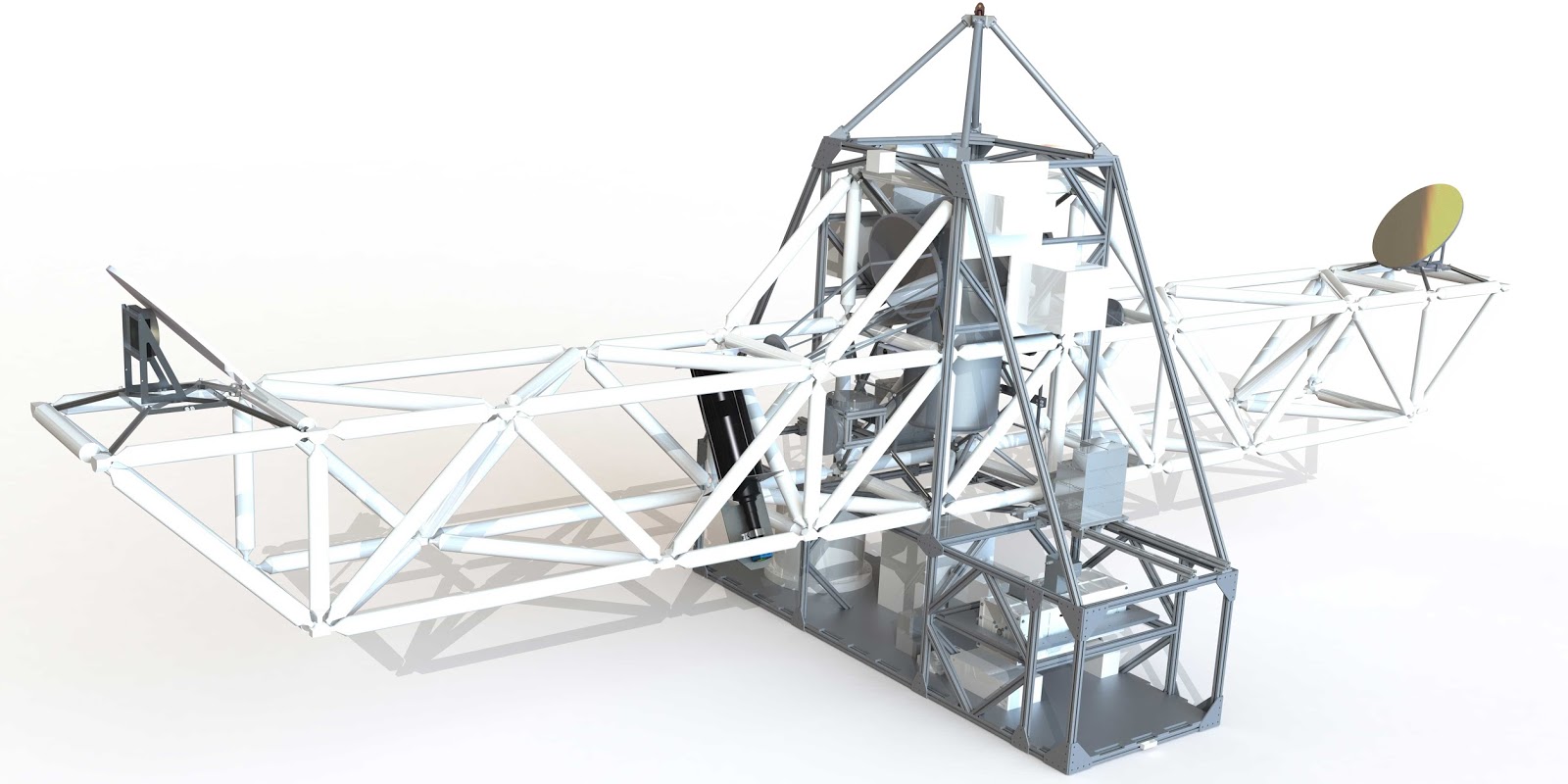
Astronomy quiz question: Balloon Experimental Twin Telescope for Infrared Interferometry (BETTII)

Astronomy 210 Quiz 3, fall semester 2019
Cuesta College, San Luis Obispo, CA

"BETTII3_low.jpg"
NASA Goddard Space Flight Center
asd.gsfc.nasa.gov/bettii/

The two far-infrared reflector telescopes of the Balloon Experimental Twin Telescope for Infrared Interferometry (BETTII)[*] have the same 0.50 m (1.6 ft) diameter, and are separated by a distance of 8.0 m (26 ft) between them. This telescope system is attached to a balloon that ascends to an altitude of 40 km (25 miles) in the upper atmosphere.[**] Taking this far-infrared telescope system into the upper atmosphere improves the light-gathering power due to less __________ at high altitudes.
(A) absorption.
(B) turbulence.
(C) light pollution.
(D) temperature fluctuations.

[*] S. A. Rinehart ; R. B. Barclay ; R. K. Barry ; D. J. Benford ; P. C. Calhoun, et al., "Design and status of the Balloon Experimental Twin Telescope for infrared interferometry (BETTII): an interferometer at the edge of space," Proc. SPIE 8445, Optical and Infrared Interferometry III, 844508 (September 12, 2012), dx.doi.org/10.1117/12.926376.
[**] asd.gsfc.nasa.gov/bettii/.


Correct answer (highlight to unhide): (A)

Far-infrared light entering the top of the atmosphere from space does not make it down to sea level (the bottom edge of the graph), due to absorption of this wavelength by the atmosphere. However, it can still be detected in the upper atmosphere, as has traveled a shorter distance through the atmosphere, where there was less absorption (primarily due to water vapor).

Section 70158
Exam code: quiz03St3M
(A) : 3 students
(B) : 11 students
(C) : 17 students
(D) : 1 student

Success level: 15% (including partial credit for multiple-choice)
Discrimination index (Aubrecht & Aubrecht, 1983): 0.25

Section 70160
Exam code: quiz03Nz6L
(A) : 0 students
(B) : 8 students
(C) : 12 students
(D) : 2 students

Success level: 5% (including partial credit for multiple-choice)
Discrimination index (Aubrecht & Aubrecht, 1983): 0

20191008

Astronomy quiz question: Balloon Experimental Twin Telescope for Infrared Interferometry (BETTII)

Astronomy 210 Quiz 3, fall semester 2014
Cuesta College, San Luis Obispo, CA

"BETTII3_low.jpg"
NASA Goddard Space Flight Center
asd.gsfc.nasa.gov/bettii/

The two far-infrared reflector telescopes of the Balloon Experimental Twin Telescope for Infrared Interferometry (BETTII)[*] have the same 0.50 m (1.6 ft) diameter, and are separated by a distance of 8.0 m (26 ft) between them. This telescope system is attached to a balloon that ascends to an altitude of 40 km (25 miles) in the upper atmosphere.[**] If the two mirrors of this telescope system were instead combined into a single mirror with the same total surface area, the resolving power would:
(A) decrease.
(B) remain the same.
(C) increase.
(D) (The telescope would no longer be able to function.)

[*] S. A. Rinehart ; R. B. Barclay ; R. K. Barry ; D. J. Benford ; P. C. Calhoun, et al., "Design and status of the Balloon Experimental Twin Telescope for infrared interferometry (BETTII): an interferometer at the edge of space," Proc. SPIE 8445, Optical and Infrared Interferometry III, 844508 (September 12, 2012), dx.doi.org/10.1117/12.926376.
[**] asd.gsfc.nasa.gov/bettii/.

Correct answer (highlight to unhide): (A)

Increasing the distance between telescopes creates a much larger effective diameter to increase resolving power. Thus decreasing this separation distance would decrease resolving power.

Section 70158
Exam code: quiz03s8tE
(A) : 27 students
(B) : 8 students
(C) : 5 students
(D) : 0 students
(No response: 1 student)

Success level: 66% (including partial credit for multiple-choice)
Discrimination index (Aubrecht & Aubrecht, 1983): 0.45

Section 70160
Exam code: quiz03n6n4
(A) : 24 students
(B) : 7 students
(C) : 4 students
(D) : 0 students

Success level: 72% (including partial credit for multiple-choice)
Discrimination index (Aubrecht & Aubrecht, 1983): 0.60

20190926

Astronomy quiz archive: telescopes

Astronomy 210 Quiz 3, fall semester 2019
Cuesta College, San Luis Obispo, CA

Section 70158, version 1
Exam code: quiz03St3M


Section 70158
0- 8.0 :   * [low = 6.5]
8.5-16.0 :   **
16.5-24.0 :   ************** [mean = 23.8 +/- 7.3]
24.5-32.0 :   **********
32.5-40.0 :   ***** [high = 36.0]


Section 70160, version 1
Exam code: quiz03Nz6L


Section 70160
0- 8.0 :   ** [low = 7.0]
8.5-16.0 :   *******
16.5-24.0 :   ***** [mean = 20.9 +/- 8.5]
24.5-32.0 :   ******
32.5-40.0 :   ** [high = 36.0]

20190911

Online reading assignment: atmosphere problems, Earth, the moon, Mercury (SLO campus)

Astronomy 210, fall semester 2019
Cuesta College, San Luis Obispo, CA

Students have a weekly online reading assignment (hosted by SurveyMonkey.com), where they answer questions based on reading their textbook, material covered in previous lectures, opinion questions, and/or asking (anonymous) questions or making (anonymous) comments. Full credit is given for completing the online reading assignment before next week's lecture, regardless if whether their answers are correct/incorrect. Selected results/questions/comments are addressed by the instructor at the start of the following lecture.

The following questions were asked on reading textbook chapters and previewing presentations on problems caused by the atmosphere for telescope observing, Earth, and the impacted worlds: the moon, and Mercury.

Selected/edited responses are given below.

Describe something you found interesting from the assigned textbook reading or presentation preview, and explain why this was personally interesting for you.
"I found light pollution bouncing off the atmosphere interesting because without the atmosphere, all the stars would be perfectly visible."

"I never knew what the reason behind the twinkling of the stars was. I thought it was pretty cool that air can kind of ripple like water."

"What I found interesting (since this is new to me) was how electromagnetic waves can penetrate our atmosphere (or not) depending on their wavelengths. For example, smaller-wavelength UV rays and some microwaves don't get very far when traversing our atmosphere. So what do we do? We put an big infrared telescope on a refurbished airliner (SOFIA) that can fly close to the threshold where these EM waves can reach. Awesome."

"The deeper we get into space the more I enjoy and find the topics interesting. I find the history of different planets and the moon very interesting."

"I would have never thought that Earth's core would have been the hottest, I would have guessed that Mercury or planets closer to the sun would have had hotter cores because they are hotter in general."

"That smaller planets are more geologically dead. We have all been exposed to the possibility of man inhabiting Mars thanks to studies and movies like 'The Martian.' It makes me question whether we really can inhabit Mars since the planet is technically geologically deficient."

"Describing continental drift like gravy skin. This is an easy way to remember definitions, when you relate it to things you are common with."

"Tectonic plates were pretty interesting and how volcanoes, trenches, mountains, and islands are made by the plates pushing together or pulling away from each other."

"The cause of natural greenhouse gases and how both volcanoes and oceans have an effect on it, as well as man-made greenhouse gases."

"I didn't know that carbon dioxide is absorbed by our oceans and found that aspect of the carbon cycle to be fascinating."

"The large impact hypothesis, because I have never really thought much about how Earth and the moon came to be."

"It's fascinating to imagine that our Earth was created by two clashing objects, and that the vaporized crust from these planetesimals formed the moon."

"To learn how similar the moon and Mercury are. I always knew they were alike, but didn't quite realize exactly in what ways."

"Similarities between the moon and Mercury's formation."

Describe something you found confusing from the assigned textbook reading or presentation preview, and explain why this was personally confusing for you.
"Reading about the telescopes was a little bit confusing, but maybe because my motivation to learn about telescopes was not too high."

"I find atmospheric turbulence confusing, mostly why it happens."

"Why divide the planets into two different groups?"

"What I found most confusing was the topic of the different cores being bigger and cooling off at different rates depending on size."

"Honestly the core of Earth being the hottest was weird to me, it was the most interesting but also the most confusing to me."

"Plate tectonics. Even when I learned about it in elementary school, I couldn't understand it just by reading about it."

"The greenhouse effect and how carbon dioxide works."

"Regarding the surface details of Mercury and the moon, I don't quite understand how the highlands and lowlands work. For the moon I am wondering if the lowlands have the higher impact craters on the surface and the highlands are filled with small impact craters higher above the surface. I wonder what the greatest depth is from a highland area to a lowland area on either Mercury or the moon."

"The video from one of the presentations. It was supposed to show the difference between the youngest and older features of Mercury, but I wasn't able to tell."

"The progression of the moon and Mercury's features."

"It is all rather confusing, but the more I read the clearer it becomes."

A large modern optical telescope in outer space would have images with better __________ than a comparable ground-based telescope.
brightness.   *** [3]
resolution.   ************* [13]
magnification.   * [1]
(None of the above choices.)   * [1]
(Two of the above choices.)   **** [4]
(All of the above choices.)   ****** [6]
(Unsure/guessing/lost/help!)   * [1]

Stars to appear to "twinkle" in the night sky because of...
"Our atmosphere distorting the light coming to us."

"The atmosphere's turbulence, light gets refracted in different directions when passing through."

"Ripples in atmospheric air, atmosphere turbulence, causes 'twinkling.'"

Identify how carbon dioxide enters and how it is taken out of Earth's atmosphere.
(Only correct responses shown.)
Enters atmosphere from: volcanoes [66%]
Taken out of atmosphere by: oceans [59%]

Identify the oldest (longest ago) to the youngest (most recent) features on the moon.
(Only correct responses shown.)
Craters partially filled in with flat lava plains: oldest (formed longest ago) [34%]
Flat lava plains: middle [31%]
Craters on top of flat lava plains: youngest (formed most recently) [44%]

Identify the oldest (longest ago) to the youngest (most recent) features on Mercury.
(Only correct responses shown.)
Large crater basins: oldest (formed longest ago) [62%]
Lava-filled lowlands: middle [52%]
Long curving ridges: youngest (formed most recently) [62%]

Ask the instructor an anonymous question, or make a comment. Selected questions/comments may be discussed in class.
"I feel a lot more informed in the world of telescopes, and I like now knowing what makes a telescope good or not. We go through a lot of crazy measures just to be able to clearly look at objects in outer space!"

"Should I believe what I read on the textbook? About the moon, the planets, etc. (I can't tell you what to believe (or not believe) about what we know in astronomy, but I can test you on understanding how we know what we know in astronomy.)

"How soon do you think greenhouse gases will warm our planet to the point that it is unlivable?" (I think we still have time to fix things, as long we don't keep ignoring Earth's "check engine" light for much longer.)

"Is the heat from Earth's molten core retained purely because of 'insulation' from the crust, or is there some interior heating (from sun, or radioactive materials in the core) contributing to Earth maintaining core temperature for so long?" (Both the insulation from the crust, and radioactive decays inside the core keep Earth's interior warm. The sun doesn't do anything except heat up the outside of Earth.)

Can you discuss a little more about the large-impact hypothesis? How was the hypothesis formed, how did the Apollo 11 mission, etc."

"I need more clarification on how to figure out which parts of the moon/Mercury are older/younger."

"How can you tell the age of the surface of a terrestrial planet based on surface features?" (Generally stuff on top is the newer than the stuff beneath. Like all the stuff stacked on the desk on my office.)

"The large impact hypothesis was confusing because it honestly just didn't make any sense or seem very logical to me. If there was a large explosion from two planets impacting how would have life on Earth been able to occur and evolve. An impact like that would most likely have killed off any organism that was alive (if there were any at that time) and also probably would have prevented any life-sustaining factors." (At that time the surfaces of the forming planets were still molten, so life definitely would not have started yet.)

"How do the stars look on the moon?" (Pretty awesome, as long as you aren't on the sunlit side of the moon, as the reflected glare from the surrounding moonscape would then be too bright.)

"I think my knowledge of moon phases is waning." (That's okay, just make sure you time the next waxing cycle of moon phase knowledge for the midterm.)