Showing posts with label energy conservation. Show all posts

20191021

Physics quiz archive: energy conservation, momentum conservation

Physics 205A Quiz 4, fall semester 2019
Cuesta College, San Luis Obispo, CA
Sections 70854, 70855
Exam code: quiz04JuR4


Sections 70854, 70855 results
0- 6 :   ** [low = 6]
7-12 :   ****
13-18 :   *******
19-24 :   ********************** [mean = 21.9 +/- 6.1]
25-30 :   ***************** [high = 30]

20181023

Physics quiz archive: energy conservation, momentum conservation

Physics 205A Quiz 4, fall semester 2018
Cuesta College, San Luis Obispo, CA
Sections 70854, 70855, version 1
Exam code: quiz04W3rK


Sections 70854, 70855 results
0- 6 :   * [low = 3]
7-12 :   ********
13-18 :   **************
19-24 :   ****************** [mean = 19.6 +/- 6.4]
25-30 :   ********** [high = 30]

20171031

Physics quiz archive: energy conservation, momentum conservation

Physics 205A Quiz 4, fall semester 2017
Cuesta College, San Luis Obispo, CA
Sections 70854, 70855, version 1
Exam code: quiz04w33N


Sections 70854, 70855 results
0- 6 :  
7-12 :   ***** [low = 9]
13-18 :   ****************
19-24 :   **************** [mean = 20.8 +/- 5.7]
25-30 :   *********** [high = 30]

20170930

Presentation: work and energy

Tarp-lined ramp leading down to a pond? Check. All-terrain vehicle? Check. Pulling a cord attached to a raft and rider? Whee! (Video link: "Human Slingshot Slip and Slide - Vooray.")

In this presentation we will introduce a new connection between forces and motion, in terms of how forces can do work on or against an object in order to speed up or slow down its motion. This is a new approach to connecting forces and motion, compared to the previous discussion in this course of using Newton's laws to relate how forces on an object result in a net force that may or many not change its motion.

First, defining the "amount of motion" of an object in terms of its translational kinetic energy, and then expressing how a force may do work on or against the motion of an object.

Translational kinetic energy KEtr is the energy of motion. (We'll deal with rotational kinetic energy KErot later on.)

Translational kinetic energy KEtr depends on the mass m and the square of the speed v of the object, and the resulting units of kg·m2/s2 are also expressed as joules. A stationary object has no translational kinetic energy, and the faster an object moves, the more translational kinetic energy it has.

Instead of finding out how much translational kinetic energy KEtr an object has, often we are more concerned with its initial-to-final change ∆KEtr, which is the final amount of translational kinetic energy minus the initial amount of translational kinetic energy. Notice how the common factors of (1/2) and mass m (which is presumed to be constant) are pulled out, leaving a "difference of squares" for the final and initial speeds in the parenthesis.

In order to change the translational kinetic energy of an object (speeding it up or slowing it down), a force (such as that exerted by the horses) must do a certain amount of work W either on, or against the motion of the object (here the loaded sledge the horses are pulling).

Work is accomplished by exerting a force on an object, but in such a way that the object moves through a displacement s (note the unusual use of "s" for a generic ∆x, ∆y, or other direction displacement!), and the "tail-to-tail" angle θ between the force and displacement vectors (when their "bases" are drawn touching together) is anything besides 90°. The units of work are given in N·m, or yet again, joules, so keep in mind that work can be done on or against any mechanical energy form or forms.

Second, let's now explicitly make the connection between the work done by a force acting on or against the motion of an object, and the resulting changes in translational kinetic energy of the object.

This is an incomplete form of the total energy conservation equation we will utilize later, but this "work-energy theorem" shows how the transfer of energy (as work is done by a force acting on or against the motion of the object) causes a corresponding change in the translational kinetic energy of the object.

If the force does work on the object (by being exerted along the direction of its motion), then the work will have a positive sign, and the translational kinetic energy of the object will increase, making the sign of the ∆KEtr term positive. Note for this case how the left- and right-hand sides of this equation must have the same positive sign.

If the force does work against the object (by being exerted opposite to the direction of its motion), then the work will have a negative sign, and the translational kinetic energy of the object will decrease, making the sign of the ∆KEtr term negative. Note for this case how the left- and right-hand sides of this equation must have the same negative sign.

Squirrel. Catapult! Squirrel catapult! (Note the person behind the sliding glass door, cutting the release cord with a scissors to launch the squirrel.) (Video link: "squirrelcatapult.gif.")

To keep things simple, let's consider a strictly horizontal version of this contraption, which would make the work done by any vertical forces (such as the weight force of Earth on the squirrel) zero, as the angle between these vertical forces and the horizontal direction of motion is 90°.

The bungee cord (and basket) exerts a force on the squirrel directed to the right, along the direction of motion, so the bungee cord does work on the squirrel. As a result, the squirrel picks up speed (starting from rest), and since translational kinetic energy depends on the square of the speed, since speed increases, then the squirrel's translational kinetic energy increases.)

In the work-energy theorem equation:

W = ∆KEtr,

the work will have a positive sign (as work was done on the squirrel by the bungee cords), causing the squirrel's translational kinetic energy to increase (and also have a positive sign), so the +/– signs of both the left-hand side and the right-hand side of the equation are consistent with each other:

(+) = (+).

(If you were to calculate the numerical values for the work done (in J) and the resulting numerical value for the increase in translational kinetic energy (in J), then they would have to be equal to each other (along with having the same sign).
For the catapulted squirrel, the bungee cord force does work __________ the squirrel, which __________ the squirrel's translational kinetic energy.)
(A) on; increases.
(B) against; decreases.
(C) (Unsure/lost/guessing/help!)

Note as this car stops, the brakes glow from the heat generated! (Video link: "McLaren SLR review - Top Gear - BBC.")
For the braking car, the brakes do work __________ the car, which __________ the car's translational kinetic energy.
(A) on; increases.
(B) against; decreases.
(C) (Unsure/lost/guessing/help!)

Don't blink, or you'll miss Mrs. P-dog in action! (Video link: "110530-1230869-excerpt.")
For Mrs. P-dog being catapulted upwards, the bungee cords do work __________ Mrs. P-dog, while the weight force does work __________ Mrs. P-dog.
(A) on; on.
(B) on; against.
(C) against; on.
(D) against; against.
(E) (Unsure/lost/guessing/help!)

For Mrs. P-dog's translational kinetic energy to be increased while being catapulted upwards, the amount of work from the bungee cords must be __________ the amount of work from the weight force.
(A) less than.
(B) the same as.
(C) greater than.
(D) (Not enough information is given.)
(E) (Unsure/lost/guessing/help!)

20161025

Physics quiz archive: energy conservation, momentum conservation

Physics 205A Quiz 4, fall semester 2016
Cuesta College, San Luis Obispo, CA
Sections 70854, 70855, 73320, version 1
Exam code: quiz04th1R


Sections 70854, 70855, 73320 results
0- 6 :  
7-12 :   **** [low = 9]
13-18 :   ****************
19-24 :   *********************** [mean = 20.5 +/- 4.8]
25-30 :   ******** [high = 27]

20151031

Physics quiz archive: energy conservation, momentum conservation

Physics 205A Quiz 4, fall semester 2015
Cuesta College, San Luis Obispo, CA
Sections 70854, 70855, 73320, version 1
Exam code: quiz04w04K


Sections 70854, 70855, 73320 results
0- 6 :   ** [low = 6]
7-12 :   *******************
13-18 :   ************************
19-24 :   ****************************** [mean = 18.1 +/- 5.6]
25-30 :   *** [high = 30]

20151018

Physics midterm problem: categorizing a cart collision

Physics 205A Midterm 2, fall semester 2009
Cuesta College, San Luis Obispo, CA

Cf. Giambattista/Richardson/Richardson, Physics, 2/e, Problem 7.47

A 0.300 kg cart traveling in the +x direction at 0.20 m/s collides with a 0.500 kg cart that is initially at rest. The carts are not stuck together after the collision. After the collision, the 0.500 kg cart (that was initially at rest) travels in the +x direction at 0.10 m/s. Ignore friction, drag and other external forces during this brief collision. Find (a) the final velocity of the 0.300 kg cart, and (b) classify this collision as elastic, inelastic, or completely inelastic. Show your work and explain your reasoning using properties of collisions, energy (non-)conservation, and momentum conservation.


Solution and grading rubric:
  • p:
    Correct. Finds final speed of the 0.300 kg cart, using conservation of momentum (as there is negligible drag/friction for this brief collision), vf1 = +0.033 m/s. It is not known whether the carts are permanently deformed and/or energy was lost to thermal/sound systems, so collision could be either inelastic or elastic (but cannot be completely inelastic because the carts are not stuck together after the collision). Explicitly tests for whether or not kinetic energy is conserved, and finds that since kinetic energy is not conserved, this collision must be inelastic.
  • r:
    Nearly correct, but includes minor math errors. As (p), but misinterprets collision as being completely inelastic, but at least applies momentum conservation to find the correct vf1 for the case where the carts are stuck-together, then shows that kinetic energy was not conserved for this collision.
  • t:
    Nearly correct, but approach has conceptual errors, and/or major/compounded math errors. Has correct vf1 (may have magnitude only) from momentum conservation, but does not explicitly test for energy conservation, and attempts to identify collision as elastic or inelastic solely on the basis of no visible deformation, which is not explicitly stated.
  • v:
    Implementation of right ideas, but in an inconsistent, incomplete, or unorganized manner. Application of momentum conservation, but vf1 is incorrect, with little or no test of kinetic energy conservation.
  • x:
    Implementation of ideas, but credit given for effort rather than merit. Discussion based on stated characteristics of collision, with no application or test of appropriate conservation laws.
  • y:
    Irrelevant discussion/effectively blank.
  • z:
    Blank.

Grading distribution:
Section 72177
p: 4 students
r: 2 students
t: 7 students
v: 0 students
x: 0 students
y: 0 students
z: 0 students

20141128

Physics midterm problem: upwards bullet embedding in block

Physics 205A Midterm 2, fall semester 2014
Cuesta College, San Luis Obispo, CA

Cf. Giambattista/Richardson/Richardson, Physics, 2/e, Problem 7.43

"Bullet Block Experiment"
Veritasium
youtu.be/vWVZ6APXM4w

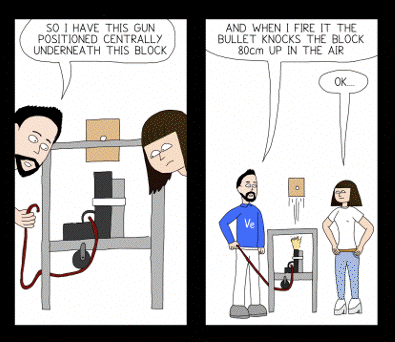
A real-life experiment[*] (illustrated in webcomic format at right[**]) shot a bullet upwards that embedded in a wood block, and the block (with the bullet inside) was free to move upwards to a maximum height of 0.80 m.

An independent analysis[***] assuming a bullet mass of 2.3×10⁻³ kg and a block mass of 0.222 kg estimates that the bullet speed just before entering the block was 384 m/s. Ignore friction, drag, and external forces for this brief collision. Determine whether this claim for the bullet's speed is plausible. Show your work and explain your reasoning using properties of collisions, energy (non-)conservation, and momentum conservation.

[*] Derek Muller (Veritasium), "Bullet Block Explained!" youtu.be/BLYoyLcdGPc.
[**] Ben Dickson (Random Perspective Comic), "Problem Solving," randomperspective.com/comic/80/.
[***] John Rowe, "Bullet in the Block Mystery," compadre.org/IVV/docs/Bullet-Block_Recitation_Tutorial.pdf.

Solution and grading rubric:
  • p:
    Correct. Momentum is conserved when bullet embeds in block in a perfectly inelastic collision, then as the bullet-embedded block travels upwards, the translational kinetic energy is converted into gravitational potential energy, and determines that the independent analysis claim of the bullet's initial speed is plausible (to two significant digits) or implausible (due to the very small discrepancy in comparing values) by either:
    1. working backwards to determine expected initial speed of bullet, and compares it to the given value of 384 m/s;
    2. works forwards to determine expected maximum height of bullet-embedded block, and compares it to the given value of 0.80 m;
    3. comparing speed (or translational kinetic energy) of bullet-embedded block just after the perfectly inelastic collision, with the expected speed (or translational kinetic energy) of the bullet-embedded block to travel upwards to a maximum height 0.80 m.
  • r:
    Nearly correct, but includes minor math errors. May not have squared translational kinetic energy velocity terms, or simple arithmetic errors, but makes a sound argument based on the numerical values resulting from these errors.
  • t:
    Nearly correct, but approach has conceptual errors, and/or major/compounded math errors. Certain parameters are misplaced or misidentified, but at least successfully applied momentum conservation to the perfectly inelastic collision of bullet and block, but mechanical energy conservation of upwards-moving bullet-embedded block has multiple issues.
  • v:
    Implementation of right ideas, but in an inconsistent, incomplete, or unorganized manner. At least one conservation law is correct (or nearly correct), other is garbled.
  • x:
    Implementation of ideas, but credit given for effort rather than merit. No clear attempt at applying conservation laws.
  • y:
    Irrelevant discussion/effectively blank.
  • z:
    Blank.
Grading distribution:
Sections 70854, 70855, 73320
Exam code: midterm02veR1
p: 26 students
r: 5 students
t: 7 students
v: 16 students
x: 10 students
y: 2 students
z: 0 students

A sample "p" response (from student 9178) comparing the calculated initial speed of the bullet (given the maximum height of the bullet-embedded block) with the given value of 384 m/s:

A sample "p" response (from student 0000) finding the predicted height that the bullet-embedded block would rise up to, comparing it to the observed 0.80 m height:

A sample "p" response (from student 3918) comparing the translational kinetic energy of the bullet-embedded block (just before rising upwards after the collision) with the gravitational potential energy at its highest point:

A sample "p" response (from student 7007) comparing the speed of the bullet-embedded block (just before rising upwards after the collision) with the speed required to make it up to a height of 0.80 m:

20141101

Physics quiz archive: energy conservation, momentum conservation

Physics 205A Quiz 4, fall semester 2014
Cuesta College, San Luis Obispo, CA
Sections 70854, 70855, 73320, version 1
Exam code: quiz04w3Rc


Sections 70854, 70855, 73320 results
0- 6 :   **** [low = 3]
7-12 :   ********
13-18 :   ******************
19-24 :   ************************ [mean = 19.5 +/- 6.6]
25-30 :   *********** [high = 30]

20141025

Physics presentation: static fluids

In this scene from Man from Atlantis, Mark Harris (played by Patrick Duffy) is put into a water pressure chamber that simulates different depths, and watches as test canisters are crushed by pressures equivalent to 20,000 ft, 25,000 ft, and 30,000 ft below sea level.

On a more reality-based aside, consider tourists who float in the high salinity waters of the Dead Sea.

We'll discuss these two different aspects of static fluids here: pressure, and buoyancy.

First, pressure--as a force per unit area density, then reinterpreted as a pressure per unit area density.

Pressure can be consider as the amount of force exerted over a certain area on a surface, whether by a macroscopic object, or by the random bombardment by atoms/molecules of gases or liquids. If you don't wear snowshoes, the force of your weight, distributed over the area of your feet will create a pressure that cannot be supported by soft, unpacked snow, and your feet will sink in.

However, the force of your weight distributed over a much larger snowshoe area will reduce the pressure exerted on the snow, and you will not sink in much, if at all.

From the definition of pressure as a force per area density, the unit of pressure is pascals (Pa), equivalent to N/m2.

A more useful interpretation of pressure, especially in regards to fluids (gases and liquids) is to think of it as an energy per unit volume. Notice how the units of pascals equals N/m2, and when both numerator and denominator by are multiplied by meters (m), these units become N/m2 = (N·m)/(m3) = J/m3.

By interpreting pressure as a form of energy per unit volume, we can connect it to gravitational potential energy per unit volumeUgrav/V = m·g·y/V = (m/Vg·∆y = ρ·g·∆y, which also has units of J/m3.

Pressure and gravitational potential energy per unit volume are then terms in an energy density "conservation" equation, and they are allowed to "exchange" Pa provided the fluid is static and there is no external work being put in or taken out of the fluid. In this form, then by picking two locations in the same static fluid, an increase or decrease in the ρ·g·∆y must have a corresponding decrease or increase in pressure (∆P).

A weather balloon that is partially filled at ground level will rise, and will seemingly inflate and eventually explode at very high elevations.

To explain what's going on here, we are going to analyze the static fluid that exists at both ground level and at a higher elevation: the air surrounding the balloon (i.e., the entire atmosphere), and not the contents of the balloon, which do not simultaneously exist at both locations (as it is "transported," and technically not a "static" fluid.)

Let's compare the air surrounding the balloon at ground level, and compare it to the air at the final higher elevation. Since the gravitational potential energy density depends on elevation, as the elevation of the balloon increases, the gravitational potential energy density of the surrounding air increases.

Looking at the energy density "conservation" equation for static fluids:

0 = ΔP + ρ·g·∆y,

Since the gravitational potential energy density of the air surrounding the balloon increases as it moves to higher elevations, then ρ·g·∆y is positive. In order to balance out this equation to equal zero on the left-hand side, the pressure of the air surrounding the balloon must have a corresponding decrease, making ΔP negative, such that:

0 = (–) + (+),

meaning that there is more air pressure at ground level than at a higher elevation. Essentially the pressure within the balloon remains constant, and because it is surrounded with lower pressure air at a higher elevation, the balloon will expand in size, and eventually "pop."

Notice the full-sized Styrofoam™ cup in the back, compared to other cups that were carried in the outside storage compartment of a submarine, where the air pockets inside these cups were collapsed by the surrounding water, effectively permanently shrinking the sizes of these cups. During this process, did the ρ·g·∆y increase or decrease? Did the water pressure surrounding the cups increase or decrease?

Second, buoyancy.

The buoyant force on an object depends on the density ρ of the fluid, and the volume of the object that is actually submerged in the fluid. While this is a simple definition, knowing the appropriate amount of volume to use in this equation is key to understanding buoyancy.

For a fully-submerged object, the volume used in calculating the buoyant force is the volume of the entire object, such that the buoyant force is given by:

FB = ρ·g·V,

where ρ is the density of the surrounding fluid (water), and volume V is the entire volume of the diver, as he is fully submerged.

Here, since the object (the submerged diver) is floating underwater, Newton's first law applies, and the downwards weight force and the upwards buoyant force balance out.

For a partially-submerged object like this red ship, the volume used in calculating the buoyant force is not the volume of the entire object, but only the portion of the object that is actually submerged.

For the red ship, which Newton's law applies to its motion? How do the magnitudes of the downwards weight force and the upwards buoyant force compare? What fluid density should be put into the ρ in the buoyant force calculation?

20140721

Collision type flowchart

"Collision type flowchart"
http://flic.kr/p/o8oHFG
Originally uploaded by Waifer X

Flowchart by Cuesta College Physical Sciences Division instructor Dr. Patrick M. Len.

20131031

Physics quiz archive: energy conservation, momentum conservation

Physics 205A Quiz 4, fall semester 2013
Cuesta College, San Luis Obispo, CA
Sections 70854, 70855, 73320, version 1
Exam code: quiz04iSs5


Sections 70854, 70855, 73320 results
0- 6 :   ** [low = 6]
7-12 :   ***********
13-18 :   ************************* [mean = 18.6 +/- 6.0]
19-24 :   ******************
25-30 :   ********** [high = 30]