Astronomy 10 Quiz 12, Spring Semester 2008
Cuesta College, San Luis Obispo, CA
Astronomy 10 learning goal Q12.4
[3.0 points.] Which one of the following statements best explains how inflation explains the "isotropy" of the universe today (equal amounts and same temperatures of cosmic background radiation coming from every direction)?
(A) Equal amounts of luminous matter and dark matter canceled each other out.
(B) The first generation of stars were pulled back apart into gaseous nebulae.
(C) Tiny quantum fluctuations in the universe expanded to become galaxy cluster formations.
(D) The curvature of the early universe expanded to become nearly flat.
(E) A very small part of an infinite universe increased to become the entire universe that we can see today.
Correct answer: (E)
This is the horizon problem of the cosmic background radiation, which is solved by the inflationary era. Since the universe is not old enough for the entire visible universe to have reached near thermal equilibrium, it must have experienced a brief, sudden expansion soon after recombination.
Student responses
Section 5166
(A) : 14 students
(B) : 5 students
(C) : 13 students
(D) : 10 students
(E) : 11 students
Showing posts with label cosmic background radiation. Show all posts
Showing posts with label cosmic background radiation. Show all posts


20080528
Astronomy quiz question: universe inflation evidence
Astronomy 10 Quiz 12, Spring Semester 2008
Cuesta College, San Luis Obispo, CA
Astronomy 10 learning goal Q12.4
[3.0 points.] Which one of the following choices best describes the evidence for the sudden early inflation of space in the universe?
(A) Stars in the inner and outer parts of the disk orbit the center of the Milky Way with the same speed.
(B) Each and every galaxy sees all other galaxies moving away from its location.
(C) Nearly equal amounts of cosmic background radiation are detected from all directions.
(D) Distant galaxies appear to be much younger than nearby galaxies.
(E) Type Ia supernovae in distant galaxies appear to be dimmer than expected from their redshifts.
Correct answer: (C)
Response (C) is the horizon problem of the cosmic background radiation, which may be explained by being a very small portion of the universe inflating suddenly and briefly to become the extent of the visible universe today. Response (A) is evidence for dark matter; response (B) is a reason why the expansion of the universe can be said to have no center; response (D) is a result of the finite speed of light ("lookback time"); while response (E) is evidence for the recent acceleration of the universe's expansion rate, caused by dark energy.
Student responses
Section 4160
(A) : 3 students
(B) : 4 students
(C) : 10 student
(D) : 0 students
(E) : 19 students
Cuesta College, San Luis Obispo, CA
Astronomy 10 learning goal Q12.4
[3.0 points.] Which one of the following choices best describes the evidence for the sudden early inflation of space in the universe?
(A) Stars in the inner and outer parts of the disk orbit the center of the Milky Way with the same speed.
(B) Each and every galaxy sees all other galaxies moving away from its location.
(C) Nearly equal amounts of cosmic background radiation are detected from all directions.
(D) Distant galaxies appear to be much younger than nearby galaxies.
(E) Type Ia supernovae in distant galaxies appear to be dimmer than expected from their redshifts.
Correct answer: (C)
Response (C) is the horizon problem of the cosmic background radiation, which may be explained by being a very small portion of the universe inflating suddenly and briefly to become the extent of the visible universe today. Response (A) is evidence for dark matter; response (B) is a reason why the expansion of the universe can be said to have no center; response (D) is a result of the finite speed of light ("lookback time"); while response (E) is evidence for the recent acceleration of the universe's expansion rate, caused by dark energy.
Student responses
Section 4160
(A) : 3 students
(B) : 4 students
(C) : 10 student
(D) : 0 students
(E) : 19 students
20071226
Astronomy quiz question: dark energy evidence
Astronomy 10 Quiz 12, Fall Semester 2007
Cuesta College, San Luis Obispo, CA
Astronomy 10 learning goal Q12.3
[3.0 points.] Which one of the following choices best describes the evidence for the existence of dark energy?
(A) Stars in the inner and outer parts of the disk orbit the center of the Milky Way with the same speed.
(B) Each and every galaxy sees all other galaxies moving away from its location.
(C) Nearly equal amounts of cosmic background radiation are detected from all directions.
(D) Distant galaxies appear to be much younger than nearby galaxies.
(E) Type Ia supernovae in distant galaxies appear to be dimmer than expected from their redshifts.
Correct answer: (E)
Since type Ia supernovae in distant galaxies appear to be dimmer than expected from their redshifts, this shifts the slope of the Hubble plot for the long-ago (distant) universe, compared to the recent (nearby) universe. Thus the expansion rate of the universe has been accelerating recently, and this is the evidence for dark energy.
Response (A) describes the evidence for dark matter in the halo of the Milky Way. Response (B) is the consequence of an expanding universe. Response (C) describes the "horizon problem" of the cosmic microwave background, and is the evidence for the inflation era of expansion. Response (D) is the consequence of the finite speed of light.
Student responses
Section 0135
(A) : 4 students
(B) : 3 students
(C) : 13 students
(D) : 2 students
(E) : 7 students
Cuesta College, San Luis Obispo, CA
Astronomy 10 learning goal Q12.3
[3.0 points.] Which one of the following choices best describes the evidence for the existence of dark energy?
(A) Stars in the inner and outer parts of the disk orbit the center of the Milky Way with the same speed.
(B) Each and every galaxy sees all other galaxies moving away from its location.
(C) Nearly equal amounts of cosmic background radiation are detected from all directions.
(D) Distant galaxies appear to be much younger than nearby galaxies.
(E) Type Ia supernovae in distant galaxies appear to be dimmer than expected from their redshifts.
Correct answer: (E)
Since type Ia supernovae in distant galaxies appear to be dimmer than expected from their redshifts, this shifts the slope of the Hubble plot for the long-ago (distant) universe, compared to the recent (nearby) universe. Thus the expansion rate of the universe has been accelerating recently, and this is the evidence for dark energy.
Response (A) describes the evidence for dark matter in the halo of the Milky Way. Response (B) is the consequence of an expanding universe. Response (C) describes the "horizon problem" of the cosmic microwave background, and is the evidence for the inflation era of expansion. Response (D) is the consequence of the finite speed of light.
Student responses
Section 0135
(A) : 4 students
(B) : 3 students
(C) : 13 students
(D) : 2 students
(E) : 7 students
20070731
Cosmic background radiation: the horizon problem
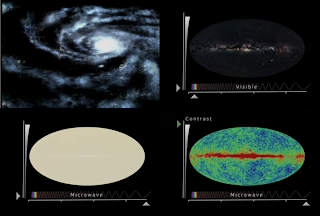
The Universe in Different Frequencies
(*.mov, 7.1 MB)
Wilkinson Microwave Anisotropy Probe mission, map.gsfc.nasa.gov
Astronomy 10 learning goal Q12.4
Illustration of how different forms of electromagnetic radiation are distributed in all directions, and how the cosmic background radiation in the microwave band is nearly isotropic (the "horizon problem"), unless contrast is greatly enhanced.
20070517
Astronomy clicker question: whence cosmic background radiation?
Astronomy 10, Spring Semester 2007
Cuesta College, San Luis Obispo, CA
Astronomy 10 learning goal Q12.4
Students were asked the following clicker question (Classroom Performance System, einstruction.com) at the start of their learning cycle:
[0.3 points.] What is the cosmic background radiation?
(A) Photons that have always existed, even before the start of the big bang.
(B) Photons from the very start of the big bang.
(C) Photons from about 400,000 years after the start of the big bang.
(D) Photons from the end of gravitational deceleration (start of dark energy acceleration).
Correct answer: (C).
It was too hot for protons and electrons to form atoms in the early universe, until approximately 400,000 years after the start of the big bang. Since atoms scatter light less efficiently than separate protons and electrons, when the universe made this "recombination" or "decoupling" transition from an opaque to a much more transparent state, photons were effectively freed from this time forward. However, any photons from earlier, back to the start of the big bang, were effectively lost.
Student responses
Section 5076
(A) : 5 students
(B) : 7 students
(C) : 1 student
(D) : 6 students
Cuesta College, San Luis Obispo, CA
Astronomy 10 learning goal Q12.4
Students were asked the following clicker question (Classroom Performance System, einstruction.com) at the start of their learning cycle:
[0.3 points.] What is the cosmic background radiation?
(A) Photons that have always existed, even before the start of the big bang.
(B) Photons from the very start of the big bang.
(C) Photons from about 400,000 years after the start of the big bang.
(D) Photons from the end of gravitational deceleration (start of dark energy acceleration).
Correct answer: (C).
It was too hot for protons and electrons to form atoms in the early universe, until approximately 400,000 years after the start of the big bang. Since atoms scatter light less efficiently than separate protons and electrons, when the universe made this "recombination" or "decoupling" transition from an opaque to a much more transparent state, photons were effectively freed from this time forward. However, any photons from earlier, back to the start of the big bang, were effectively lost.
Student responses
Section 5076
(A) : 5 students
(B) : 7 students
(C) : 1 student
(D) : 6 students
Subscribe to:
Posts (Atom)