Showing posts with label linear mass density. Show all posts

20191202

Online reading assignment: standing waves

Physics 205A, fall semester 2019
Cuesta College, San Luis Obispo, CA

Students have a bi-weekly online reading assignment (hosted by SurveyMonkey.com), where they answer questions based on reading their textbook, material covered in previous lectures, opinion questions, and/or asking (anonymous) questions or making (anonymous) comments. Full credit is given for completing the online reading assignment before next week's lecture, regardless if whether their answers are correct/incorrect. Selected results/questions/comments are addressed by the instructor at the start of the following lecture.

The following questions were asked on reading textbook chapters and previewing a presentation on standing waves.


Selected/edited responses are given below.

Describe what you understand from the assigned textbook reading or presentation preview. Your description (2-3 sentences) should specifically demonstrate your level of understanding.
"Thick strings have lower fundamental frequencies than thinner strings when they are plucked."

"I understand that the fundamental frequency of a string depends on the wave speed v (which depends on its tension and thickness), and length L. The frequencies that this string will resonate at are then merely integer multiples of the fundamental frequency."

"What I understand is some of the standing waves stuff. I know the equation for getting the fundamental frequency of something. I also understand which things are independent and dependent parameters."

Describe what you found confusing from the assigned textbook reading or presentation preview. Your description (2-3 sentences) should specifically identify the concept(s) that you do not understand.
"I feel like this is more in depth of the previous waves section, this feels similar and not difficult, just more of it."

"Putting all the different parts together, and not mixing up the independent and dependent parameters."

"I'm having trouble understanding resonance and how nodes are created."

"The difference between node and antinode wasnt as clear to me. Will need some more clarification in class."

(Assuming that their tensions are approximately equal), the __________ strings have a slower wave speed.
thicker.   ************************************** [38]
thinner.   *** [3]
(There is a tie.)   ** [2]
(Unsure/lost/guessing/help!)   * [1]

After these same-length guitar strings are plucked (assuming that their tensions are approximately equal), the __________ strings vibrate at a lower fundamental frequency.
thicker.   ************************************ [36]
thinner.   ** [2]
(There is a tie.)   *** [3]
(Unsure/lost/guessing/help!)   *** [3]

After the bass string is plucked, sliding a finger down to decrease its length would __________ the speed of waves along the string.
decrease.   ****************** [18]
not change.   ******** [8]
increase.   ***************** [17]
(Unsure/lost/guessing/help!)   * [1]

After the bass string is plucked, sliding a finger down to decrease its length would __________ the fundamental frequency of the string.
decrease.   *********** [11]
not change.   ********* [9]
increase.   ********************** [22]
(Unsure/lost/guessing/help!)   ** [2]

For standing waves on a string, classify each of these parameters are being "independent" (able to be changed without affecting other independent parameters), or "dependent" (will be changed when independent values are changed).
(Only correct responses shown.)
Wave speed v: independent [59%]
String length L: independent. [43%]
Fundamental frequency f1: dependent. [50%]

Ask the instructor an anonymous question, or make a comment. Selected questions/comments may be discussed in class.
"May we focus on the fundamental frequencies? I did not understand the equation."

"Go over deez."

"Is there a particular reason we left waves and then came back to them later?" (We lost a Monday due to Veteran's Day, so we'll pick it up here just before you do the standing waves lab later today. Also this stuff is not on Quiz 6 or on Quiz 7, but you'll see it on the Final Exam.)

"How was your Thanksgiving?" (Eh, it was okay. The day after Thanksgiving went much better.)

"I'm full from the turkey."

20191113

Physics quiz question: linear mass density of viola string

Physics 205A Quiz 6, fall semester 2019
Cuesta College, San Luis Obispo, CA

Transverse waves travel at a speed of 357 m/s along a viola's A-string, stretched to a tension of 52.9 N[*][**]. The linear mass density of this string is:
(A) 4.15×10⁻⁴ kg/m.
(B) 2.20×10⁻² kg/m.
(C) 0.148 kg/m.
(D) 0.385 kg/m.

[*] theviolaworkshop.com/page16.html.
[**] gamutmusic.com/viola-tensions.

Correct answer (highlight to unhide): (A)

The speed v of transverse waves along the viola string depends on the tension F and the linear mass density (mass per unit length) (m/L):

v = √(F/(m/L)).

Solving for the linear mass density results in:

v2 = F/(m/L),

(m/L) = F/(v2),

(m/L) = (52.9 N)/(357 m/s)2 = 0.000415067988 kg/m,

or to three significant figures, 4.15×10⁻⁴ kg/m.

(Response (B) is (F/v)2; response (C) is F/v; response (D) is √(F/v).)

Sections 70854, 70855
Exam code: quiz06co6O
(A) : 35 students
(B) : 7 students
(C) : 8 students
(D) : 2 students

Success level: 67%
Discrimination index (Aubrecht & Aubrecht, 1983): 0.78

20191106

Online reading assignment: waves

Physics 205A, fall semester 2019
Cuesta College, San Luis Obispo, CA

Students have a bi-weekly online reading assignment (hosted by SurveyMonkey.com), where they answer questions based on reading their textbook, material covered in previous lectures, opinion questions, and/or asking (anonymous) questions or making (anonymous) comments. Full credit is given for completing the online reading assignment before next week's lecture, regardless if whether their answers are correct/incorrect. Selected results/questions/comments are addressed by the instructor at the start of the following lecture.

The following questions were asked on reading textbook chapters and previewing a presentation on waves.


Selected/edited responses are given below.

Describe what you understand from the assigned textbook reading or presentation preview. Your description (2-3 sentences) should specifically demonstrate your level of understanding.
"Waves always create a disturbance and move energy from one place to another. A transverse wave has disturbance perpendicular to travel direction, and that a longitudinal wave has disturbance parallel to travel direction. The general parts of a wave, such as amplitude and period, as well as the equations that the book provided for those parts, also make sense to me."

"The motion of transverse waves is perpendicular to the direction the wave travels in. The motion of a longitudinal wave occurs parallel to its direction."

"Something I understood was waves because I learned it in chemistry. A wave can have a frequency, amplitude, wavelength, time, distance, and periods."

"As for the presentations, I am understanding what equations need to be used. I am better understanding the pendulum problems versus the oscillating springs. However I am having issues with my internet tonight so I can't see any of the GIFs so I am having a hard time with the waves presentation."

"Wavelength is the horizontal distance of a complete cycle of a wave, whereas a period is the time for one cycle to be completed. Amplitude is a measurement of distance between the highest or lowest point of a wave and the undisturbed position. Frequency is equal to one cycle per second, where the seconds represent the period. Since properties of the material/medium in which the wave travels determines the speed of a wave, we can find the speed by taking the square root of the force of tension divided by the mass per unit length."

"There are four different aspects of a wave; wave length, amplitude, frequency, and speed. Wavelength is the length that a wave stretches over itself. Amplitude is the height of a wave. Frequency is the amount of waves present or produced. Speed is the rate at which the waves move."

Describe what you found confusing from the assigned textbook reading or presentation preview. Your description (2-3 sentences) should specifically identify the concept(s) that you do not understand.
"I'm having trouble understanding the independent and dependent parameters in these equations."

"I do not understand the differences between the longitudal, periodic, transverse waves based on the pictures. The equations are also not making sense, mainly because there are so many variables to consider."

"Something that I found confusing was differentiating a period from a wavelength. The book did not do a great job at explaining the stuff."

"I think the most confusing is all these different symbols for each thing we learn. They are getting all jumbled up and it's annoying since I can't focus on what is actually what."

"Maybe it was because I had no available friends at the time of viewing these slides, but the example of the wavelengths being affected by either amplitude or frequency reached an amplitude above my head. Seemingly, the speed and wavelength are unaffected by the amplitude; however, frequency has some affect on those that I am confused about."

"I'm a little confused on how frequency and speed are independent but the wavelength is dependent on frequency and speed."

"From the presentation preview I was confused on the independent and dependent parameters at the beginning but then understood it once reading the what each symbol meant."

A string of a given length has a certain linear mass density (mass/length) value. If this string is cut in half, then its linear mass density will:
decrease.   ************ [12]
remain constant.   ************** [14]
increase.   ************ [13]
(Unsure/lost/guessing/help!)   * [1]

The top and bottom waves have the same frequency, but different amplitudes. Identify which waves have the greater wave parameter.
(Only correct responses shown.)
Faster wave speed v: there is (approximately) a tie. [73%]
Longer wavelength λ: there is (approximately) a tie. [55%]

The top and bottom waves have the same amplitude, but different frequencies. Identify which waves have the greater wave parameter.
(Only correct responses shown.)
Faster wave speed v: there is (approximately) a tie. 38[%]
Longer wavelength λ: top wave (low frequency f). [75%]

This wave travels from the left section to the right section of this apparatus. Identify along which section the waves have the greater wave parameter.
(Only correct responses shown.)
Faster wave speed v: Along the right apparatus. [18%]
Longer wavelength λ: along the right apparatus. [88%]
Higher frequency f: there is (approximately) a tie. [18%]

For transverse waves on a string, classify each of these parameters are being "independent" (able to be changed without affecting other independent parameters), or "dependent" (will be changed when independent values are changed).
(Only correct responses shown.)
Amplitude A: independent. [65%]
Wave speed v: independent. [55%]
Frequency f: independent. [45%]
Wavelength λ: dependent. [65%]

Ask the instructor an anonymous question, or make a comment. Selected questions/comments may be discussed in class.
"How does Newton's second law cause a wall with a string attached to it to pull on the string in the opposite direction of its standing wave in order to make it reflect back the way it came?" (That sounds like Newton's third law to me.)

"I don't really understand the independent and dependent parameters of transverse waves, some review on that would be great."

"I think I just need a brief review of the independent and dependent parameters to verify I am understanding correctly."

"What is the difference between wavelength and period? Also, what are the equations that we will be using?"

"I really like this part of physics."

"Just need to hear you explain this."

"I am still confused about how to apply resonance." (We'll have a lab specifically on that later.)

20181203

Online reading assignment: standing waves

Physics 205A, fall semester 2018
Cuesta College, San Luis Obispo, CA

Students have a bi-weekly online reading assignment (hosted by SurveyMonkey.com), where they answer questions based on reading their textbook, material covered in previous lectures, opinion questions, and/or asking (anonymous) questions or making (anonymous) comments. Full credit is given for completing the online reading assignment before next week's lecture, regardless if whether their answers are correct/incorrect. Selected results/questions/comments are addressed by the instructor at the start of the following lecture.

The following questions were asked on reading textbook chapters and previewing a presentation on standing waves.


Selected/edited responses are given below.

Describe what you understand from the assigned textbook reading or presentation preview. Your description (2-3 sentences) should specifically demonstrate your level of understanding.
"String tension and thickness determine the pitch of the note that the string creates when plucked."

"The frequency of the wave is set by the source. The speed of periodic waves along strings is set by the string tension and thickness. The fundamental frequency of a string depends on the wave speed v and length L."

"Different thicknesses of string vibrate at different fundamental frequencies when plucked. Thinner strings would have a higher fundamental frequency and thicker strings would have a lower fundamental frequency."

"Nodes are where there is no vibration at all and antinodes are the spaces where maximum vibration occurs. The distance between two nodes or antinodes of a standing wave is equal to half of its wavelength."

"Natural frequency is when resonance occurs. Guitar strings that are thicker resonate at a lower fundamental frequency than thinner strings. If a string were oscillated at twice its fundamental frequency, then it results in a pattern that creates a node in the center."

"All strings have their own fundamental frequency and you can have resonate frequencies by multiplying integers to the fundamental frequency."

"I didn't get to it yet."

Describe what you found confusing from the assigned textbook reading or presentation preview. Your description (2-3 sentences) should specifically identify the concept(s) that you do not understand.
"The fundamental frequency equation and the resonant frequencies confused me some. How the fundamental frequency of a string depends on the wave speed v and length L."

"I'm still kind of confused on what a node actually is. Is it the portion that's completely still in the GIF animations? Or is it something completely different?"

"I was a little confused by fundamental frequency. I also found the questions kind of confusing."

"I feel like I understood this all pretty well."

(Assuming that their tensions are approximately equal), the __________ strings have a slower wave speed.
thicker.   ******************************************* [43]
thinner.   [0]
(There is a tie.)   *** [3]
(Unsure/lost/guessing/help!)   [0]

After these same-length guitar strings are plucked (assuming that their tensions are approximately equal), the __________ strings vibrate at a lower fundamental frequency.
thicker.   ********************************** [34]
thinner.   ***** [5]
(There is a tie.)   ******* [7]
(Unsure/lost/guessing/help!)   [0]

After the bass string is plucked, sliding a finger down to decrease its length would __________ the speed of waves along the string.
decrease.   ***************** [17]
not change.   ********* [9]
increase.   ******************* [19]
(Unsure/lost/guessing/help!)   * [1]

After the bass string is plucked, sliding a finger down to decrease its length would __________ the fundamental frequency of the string.
decrease.   *********** [11]
not change.   ******* [7]
increase.   *************************** [27]
(Unsure/lost/guessing/help!)   * [1]

For standing waves on a string, classify each of these parameters are being "independent" (able to be changed without affecting other independent parameters), or "dependent" (will be changed when independent values are changed).
(Only correct responses shown.)
Wave speed v: independent [39%]
String length L: independent. [59%]
Fundamental frequency f1: dependent. [54%]

Ask the instructor an anonymous question, or make a comment. Selected questions/comments may be discussed in class.
"Since fundamental frequency is equal to waves speed divided by 2·L, then wouldn't all of these parameters be dependent of each other because if the fundamental frequency f is changed then wave speed and or length would have to also be different values and vice versa?"

"I am currently learning how to play the guitar so this is cool to talk about!"

"I'm actually from Gig Harbor, Washington, which is on the other end of the Narrows Bridge from Tacoma. Galloping Gertie is a very familiar topic with me haha I have crossed the Narrows a thousand times. We learned about how they changed the structure of the bridge when they built the new one, and when you go to the Narrows Beach (Gig Harbor side) or Titlow Beach (Tacoma side) you can look up at the bottoms of the bridges and see all of the tresses. They had to make the bottom more open so there wouldn't be large solid surfaces to catch the wind the same way they did before. I remember when there was only one bridge that had traffic going both ways from the Harbor to Tacoma, but then there was so much traffic going back and forth that they built another one, and left the green one as east-to-west traffic (Tac to GH), and the new one as west-to-east traffic (GH to Tac). The tolls are still stupidly high, even though the bridge is paid off."

"I hope we go over all this in the lab on Monday better."

"How the length of the string effects the sound it makes."

"I enjoyed the partially/lightly flipped format of your class! Your class policies and procedures are very reasonable. I'm not sure what else to say to help improve your teaching methods; I believe you have done a wonderful job!"

20181115

Physics quiz question: comparing piano string wave speeds

Physics 205A Quiz 6, fall semester 2018
Cuesta College, San Luis Obispo, CA

A D3 piano string[*] has linear mass density of 7.8 g/m, and is stretched with a tension of 626 N. A thicker A0 piano string has a linear mass density of 291 g/m, and is stretched with a greater tension of 1,350 N. The __________ has a faster transverse wave speed.
(A) D3 piano string.
(B) A0 piano string.
(C) (There is a tie.)
(D) (Not enough information is given.)

[*] A. Stulov, "Physical Modelling of the Piano String Scale," Applied Acoustics, vol. 69 (2008) pp. 977–984, cs.ioc.ee/~stulov/appl08.pdf.

Correct answer (highlight to unhide): (A)

The speed v of transverse waves along the piano string depends on the tension F and the linear mass density (mass per unit length) (m/L):

v = √(F/(m/L)).

For the D3 piano string (linear mass density is 7.8 g/m = 7.8×10⁻³ kg/m) the wave speed is:

v = √((626 N)/(7.8×10–3 kg/m)) = 283.2956234332... m/s,

or to two significant figures, 2.8×10² m/s.

The A0 piano string (linear mass density is 291 g/m = 0.291 kg/m) the wave speed is:

v = √((1,350 N)/(0.291 kg/m)) = 68.111491378... m/s,

or to two significant figures, 68 m/s.

Thus the D3 piano string has a faster transverse wave speed than the A0 piano string.

Sections 70854, 70855
Exam code: quiz06POr7
(A) : 44 students
(B) : 6 students
(C) : 2 students
(D) : 0 students

Success level: 85%
Discrimination index (Aubrecht & Aubrecht, 1983): 0.42

20181107

Online reading assignment: waves

Physics 205A, fall semester 2019
Cuesta College, San Luis Obispo, CA

Students have a bi-weekly online reading assignment (hosted by SurveyMonkey.com), where they answer questions based on reading their textbook, material covered in previous lectures, opinion questions, and/or asking (anonymous) questions or making (anonymous) comments. Full credit is given for completing the online reading assignment before next week's lecture, regardless if whether their answers are correct/incorrect. Selected results/questions/comments are addressed by the instructor at the start of the following lecture.

The following questions were asked on reading textbook chapters and previewing a presentation on waves.


Selected/edited responses are given below.

Describe what you understand from the assigned textbook reading or presentation preview. Your description (2-3 sentences) should specifically demonstrate your level of understanding.
" "

Describe what you found confusing from the assigned textbook reading or presentation preview. Your description (2-3 sentences) should specifically identify the concept(s) that you do not understand.
" "

A string of a given length has a certain linear mass density (mass/length) value. If this string is cut in half, then its linear mass density will:
decrease.   []
remain constant.   []
increase.   []
(Unsure/lost/guessing/help!)   []

The top and bottom waves have the same frequency, but different amplitudes. Identify which waves have the greater wave parameter.
(Only correct responses shown.)
Faster wave speed v: there is (approximately) a tie. [%]
Longer wavelength λ: there is (approximately) a tie. [%]

The top and bottom waves have the same amplitude, but different frequencies. Identify which waves have the greater wave parameter.
(Only correct responses shown.)
Faster wave speed v: there is (approximately) a tie. [%]
Longer wavelength λ: top wave (low frequency f). [%]

This wave travels from the left section to the right section of this apparatus. Identify along which section the waves have the greater wave parameter.
(Only correct responses shown.)
Faster wave speed v: Along the right apparatus. [%]
Longer wavelength λ: along the right apparatus. [%]
Higher frequency f: there is (approximately) a tie. [%]

For transverse waves on a string, classify each of these parameters are being "independent" (able to be changed without affecting other independent parameters), or "dependent" (will be changed when independent values are changed).
(Only correct responses shown.)
Amplitude A: independent. [%]
Wave speed v: independent. [%]
Frequency f: independent. [%]
Wavelength λ: dependent. [%]

Ask the instructor an anonymous question, or make a comment. Selected questions/comments may be discussed in class.
" "

20171128

Physics quiz question: increasing string tension

Physics 205A Quiz 6, fall semester 2017
Cuesta College, San Luis Obispo, CA

"Strings [44|365]"
Gala Medina
flic.kr/p/9hXzj1

A C3 piano string[*] has a linear mass density of 10.8 g/m, and is stretched with a tension of 747 N. Increasing the tension would __________ the speed of transverse waves along this string.
(A) decrease.
(B) not change.
(C) increase.
(D) (Not enough information is given.)

[*] A. Stulov, "Physical Modelling of the Piano String Scale," Applied Acoustics, vol. 69 (2008) pp. 977–984, cs.ioc.ee/~stulov/appl08.pdf.

Correct answer (highlight to unhide): (C)

The speed v of transverse waves along the piano string depends on the tension F and the linear mass density (mass per unit length) (m/L):

v = √(F/(m/L)).

Thus increasing the tension F in the piano string would increase the wave speed (but would also not affect the linear mass density).

Sections 70854, 70855
Exam code: quiz06Ho0k
(A) : 1 student
(B) : 12 students
(C) : 32 students
(D) : 0 students

Success level: 71%
Discrimination index (Aubrecht & Aubrecht, 1983): 0.73

20171120

Online reading assignment: standing waves

Physics 205A, fall semester 2017
Cuesta College, San Luis Obispo, CA

Students have a bi-weekly online reading assignment (hosted by SurveyMonkey.com), where they answer questions based on reading their textbook, material covered in previous lectures, opinion questions, and/or asking (anonymous) questions or making (anonymous) comments. Full credit is given for completing the online reading assignment before next week's lecture, regardless if whether their answers are correct/incorrect. Selected results/questions/comments are addressed by the instructor at the start of the following lecture.

The following questions were asked on reading textbook chapters and previewing a presentation on waves.


Selected/edited responses are given below.

Describe what you understand from the assigned textbook reading or presentation preview. Your description (2-3 sentences) should specifically demonstrate your level of understanding.
"Wavelength is dependent on speed and frequency. Fundamental frequency is dependent on wave speed and length. Changing the independent variables changes the dependent variables."

"Again, this is some very nice review of what I learned in high school physics. The concept of waves, periods, and frequency all make sense to me. As well as the way in which they are applied in both physics problems and everyday life."

"The speed, frequency, and amplitude of a wave are independent and can be changed without affecting each other, but wavelength is affected by speed and frequency. Natural frequency is when resonance occurs and if the string is vibrated twice the frequency, the string creates a second harmonic, a third for three and so on."

"Guitar or bass strings that are thicker resonate at a lower fundamentals frequency than thinner strings. This is because of the relationship of mass per length. A thicker string would have more mass meaning that the frequency would have to be lower if the mass was higher."

"Strings of finite length, when disturbed with a period in their fundamental frequency, experience a property called resonance. Different string thicknesses have different fundamental frequencies, which explains how plucking guitar strings makes different sounds. Fundamental frequencies are also affected by string length."

"If a string were to be plucked, it would oscillate at its fundamental frequency. If a string were periodically disturbed at the same fundamental frequency, then it would undergo resonance instead. Then if a string were oscillated at twice the fundamental frequency, then it would result in a pattern that creates a node in the center which is where we get the 'standing' in standing waves."

Describe what you found confusing from the assigned textbook reading or presentation preview. Your description (2-3 sentences) should specifically identify the concept(s) that you do not understand.
"I'm still a little confused when the wave string speed equation and when to use the independent parameters equation when simply determining what is and isn't changing."

"I had some trouble with 'standing waves.' Could you go over this?"

"More elaboration on resonance."

"Nothing."

"I did not find anything confusing."

(Assuming that their tensions are approximately equal), the __________ strings have a slower wave speed.
thicker.   *********************************** [35]
thinner.   ** [2]
(There is a tie.)   *** [3]
(Unsure/lost/guessing/help!)   ** [2]

After these same-length guitar strings are plucked (assuming that their tensions are approximately equal), the __________ strings vibrate at a lower fundamental frequency.
thicker.   **************************** [28]
thinner.   **** [4]
(There is a tie.)   ****** [6]
(Unsure/lost/guessing/help!)   **** [4]

After the bass string is plucked, sliding a finger down to decrease its length would __________ the speed of waves along the string.
decrease.   ******* [7]
not change.   **************** [16]
increase.   ***************** [17]
(Unsure/lost/guessing/help!)   ** [2]

After the bass string is plucked, sliding a finger down to decrease its length would __________ the fundamental frequency of the string.
decrease.   ************ [12]
not change.   ******** [8]
increase.   ***** [20]
(Unsure/lost/guessing/help!)   ** [2]

For standing waves on a string, classify each of these parameters are being "independent" (able to be changed without affecting other independent parameters), or "dependent" (will be changed when independent values are changed).
(Only correct responses shown.)
Wave speed v: independent [50%]
String length L: independent. [62%]
Fundamental frequency f1: dependent. [55%]

Ask the instructor an anonymous question, or make a comment. Selected questions/comments may be discussed in class.
"This reading was very confusing to me."

"Can you explain how string thickness affects speed? I am looking at the formula for a (standing wave) string fixed on both ends and I don't see the math."

"It's cool how these things relate to music."

"I now understand wave parameters better due to the examples we did in class. That was helpful."

"Haven't had as much time as I'd like to review last Wednesday's lecture, but wanted to mention that I am appreciative of the format of this course. Despite how fast-paced it is, I feel the previews of the blog and the repetition involved with the sample questions (initial exposure before the lecture, seeing them worked out during lecture, and trying them again in the post-lecture) is very helpful in cementing understanding. These are the sort of study techniques that are often advised, but I have usually dismissed them as overkill. Being required to follow through has been very conducive to my understanding of this material."

"I have nothing interesting to say :/" (Sometimes that's just the way it is.)

"Do you play an instrument? (In grade school, we learned how to play the most played instrument ever in history.)

20171115

Online reading assignment: waves

Physics 205A, fall semester 2017
Cuesta College, San Luis Obispo, CA

Students have a bi-weekly online reading assignment (hosted by SurveyMonkey.com), where they answer questions based on reading their textbook, material covered in previous lectures, opinion questions, and/or asking (anonymous) questions or making (anonymous) comments. Full credit is given for completing the online reading assignment before next week's lecture, regardless if whether their answers are correct/incorrect. Selected results/questions/comments are addressed by the instructor at the start of the following lecture.

The following questions were asked on reading textbook chapters and previewing a presentation on waves.


Selected/edited responses are given below.

Describe what you understand from the assigned textbook reading or presentation preview. Your description (2-3 sentences) should specifically demonstrate your level of understanding.
"Amplitude is the height between undisturbed position and the crest. It looks like the undisturbed position is in the middle of the wave. Mass divided by length is the linear density."

"For a transverse wave, the disturbance is sideways to the direction of the wave motion, and for a longitudinal wave, the disturbance is along the direction of the wave motion. I also learned about waves, for example, the speed of periodic waves along strings is set by the string tension and thickness, but the frequency of the wave is set by the source. The resulting spatial repeat interval is the wavelength."

"Wavelength depends on speed and frequency. Speed and frequency do not depend on wavelength. Transverse and longitudinal waves can both be periodic waves."

"Transverse waves flow up and down in one direction and longitudinal waves flow forwards-backwards in the same direction. The speed of waves weaken over time and depend on the medium of its flow."

"Again, this chapter was some nice review from what I learned in my high school physics class. I understand waves and the different types of them as well as how each wave differs in look and how to calculate various problems with given information about the waves."

"All waves are traveling disturbances and they all carry energy from one place to another. Two types of waves are longitudinal and transverse with one being where the disturbance is parallel to travel and the other is perpendicular."

Describe what you found confusing from the assigned textbook reading or presentation preview. Your description (2-3 sentences) should specifically identify the concept(s) that you do not understand.
"The difference in waves' motions with different frequencies confused me, also how the waves compare to others with the same speeds but different amplitudes. The formula applications are confusing also."

"I still don't fully understand how a sonic boom is created by a whip with its end moving fast enough to break the sound barrier."

"REVIEW REVIEW REVIEW. It makes sense conceptually, but it will really sink in with reviewing how to apply these concepts to problems. I think just learning how to apply these in the form of equations seems more difficult at home, but when in class it seems clear."

"This seems pretty straightforward... but is it?"

"I wasn't very confused on much, I have had some practice with waves."

A string of a given length has a certain linear mass density (mass/length) value. If this string is cut in half, then its linear mass density will:
decrease.   ********** [10]
remain constant.   ********************* [21]
increase.   *********** [11]
(Unsure/lost/guessing/help!)   [0]

The top and bottom waves have the same frequency, but different amplitudes. Identify which waves have the greater wave parameter.
(Only correct responses shown.)
Faster wave speed v: there is (approximately) a tie. [64%]
Longer wavelength λ: there is (approximately) a tie. [40%]

The top and bottom waves have the same amplitude, but different frequencies. Identify which waves have the greater wave parameter.
(Only correct responses shown.)
Faster wave speed v: there is (approximately) a tie. [38%]
Longer wavelength λ: top wave (low frequency f). [93%]

This wave travels from the left section to the right section of this apparatus. Identify along which section the waves have the greater wave parameter.
(Only correct responses shown.)
Faster wave speed v: Along the right apparatus. [36%]
Longer wavelength λ: along the right apparatus. [86%]
Higher frequency f: there is (approximately) a tie. [19%]

For transverse waves on a string, classify each of these parameters are being "independent" (able to be changed without affecting other independent parameters), or "dependent" (will be changed when independent values are changed).
(Only correct responses shown.)
Amplitude A: independent. [62%]
Wave speed v: independent. [52%]
Frequency f: independent. [55%]
Wavelength λ: dependent. [81%]

Ask the instructor an anonymous question, or make a comment. Selected questions/comments may be discussed in class.
"Are the wave parameters just amplitude, speed, frequency, and wavelength?" (Yes. Although the list looks simple, the relationships between them (independent and dependent) are pretty complicated.)

"Some brief review with numbers would be good for class!" (We have time for that.)

"If we have time, I would be stoked if you could do a little run through the basics/general ideas/key points of this presentation in the next class period. Thanks!"

"Have you seen Kelly Slater's perfect wave pool? It's pretty neat." (And it's in Lemoore, CA, which basically just up Highway 41!)

20170106

Physics final exam question: longer string, more tension fundamental standing wave

Physics 205A Final Exam, fall semester 2016
Cuesta College, San Luis Obispo, CA

A Physics 205A student builds a standing wave experiment with a mass hanging over a pulley to create tension in a string, which has a fundamental frequency of 20 Hz. The length of string used is increased by a factor of two, and the amount of mass hanging off of the string is also increased by a factor of two. (Ignore stretching in the string.) Discuss why the longer string with a greater hanging mass will have a fundamental frequency lower than 20 Hz. Explain your reasoning using the properties of wave speeds, and standing waves.

Solution and grading rubric:
  • p:
    Correct. Understands that:
    1. the fundamental standing wave frequency f1 depends on the wave speed v (set by the tension) and the physical length L of string between the ends; and
    2. the hanging mass increases by a factor of two, increasing the tension F in the string by a factor of, which increases the wave speed v by a factor of √2, and thus increases the fundamental standing wave frequency f1 by a factor of √2; and
    3. doubling the length L between the ends halves the fundamental standing wave frequency f1; such that the overall change in the fundamental standing wave frequency f1 will be such that it is lower, by a factor of (√2)/2, or 0.70 times the original value of f1.
  • r:
    As (p), but argument indirectly, weakly, or only by definition supports the statement to be proven, or has minor inconsistencies or loopholes.
  • t:
    Nearly correct, but argument has conceptual errors, or is incomplete. Only recognizes one of the arguments (2)-(3) as affecting f1.
  • v:
    Limited relevant discussion of supporting evidence of at least some merit, but in an inconsistent or unclear manner. Some garbled attempt at applying standing wave frequency parameters.
  • x:
    Implementation/application of ideas, but credit given for effort rather than merit. Approach other than applying standing wave frequency parameters.
  • y:
    Irrelevant discussion/effectively blank.
  • z:
    Blank.
Grading distribution:
Sections 70854, 70855, 73320
Exam code: finali0w4
p: 11 students
r: 3 students
t: 27 students
v: 7 students
x: 0 students
y: 0 students
z: 1 student

A sample "p" response (from student 0424):

20161127

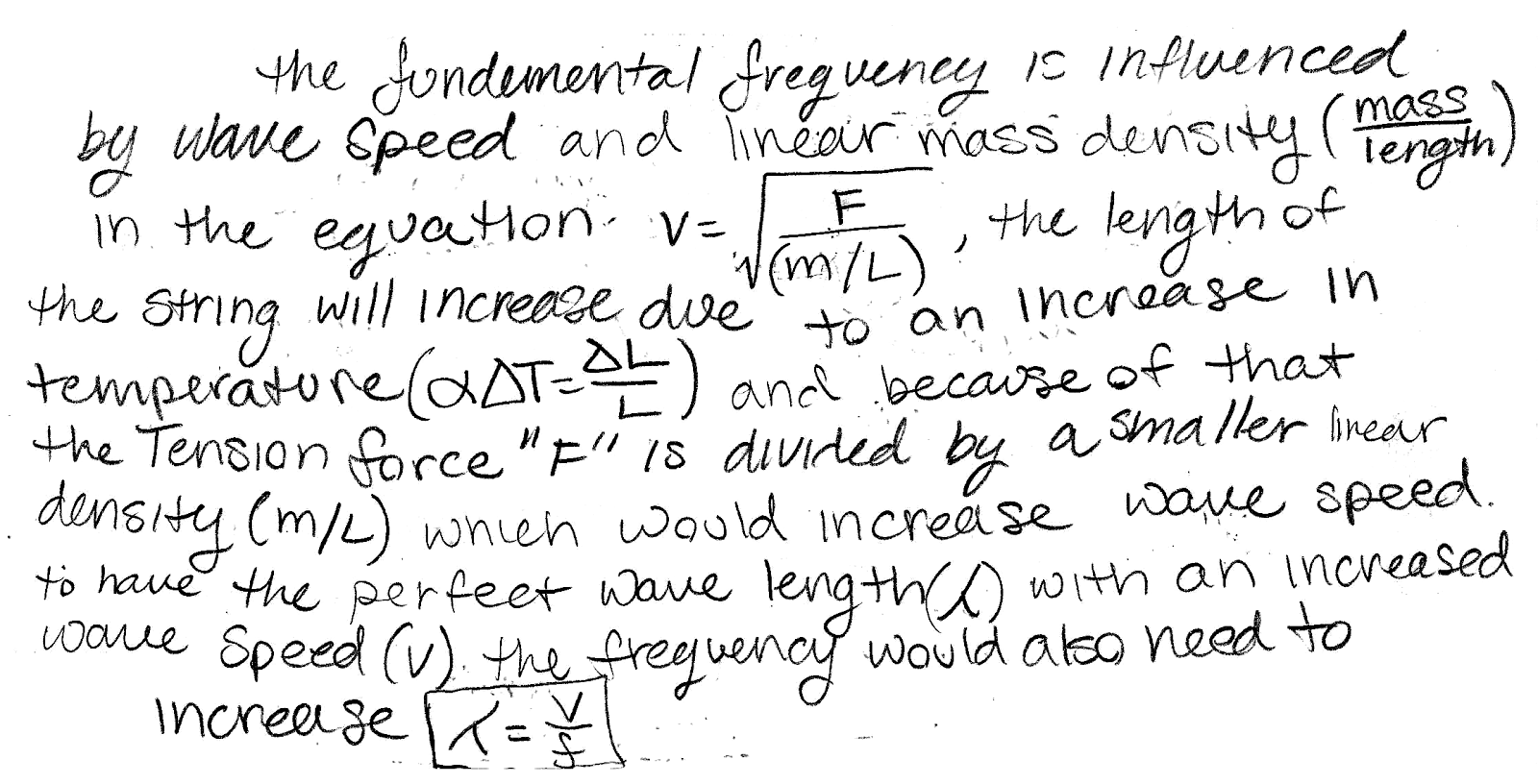
Physics final exam question: standing wave frequency of thermally expanded string

Physics 205A Final Exam, fall semester 2015
Cuesta College, San Luis Obispo, CA

A Physics 205A student builds a standing wave experiment with a string and a mass hanging over a pulley to create tension, and at a certain temperature it has a fundamental frequency of 20.0 Hz. As the temperature increases, discuss why the fundamental frequency will increase. Only consider the thermal expansion of the string. Explain your reasoning using the properties of wave speeds, periodic waves, standing waves, and thermal expansion.

Solution and grading rubric:
  • p:
    Correct. Understands that:
    1. the fundamental standing wave frequency depends on the wave speed and the physical length L between nodes (which does not change);
    2. the wave speed depends on tension (which is set by the hanging mass, and does not change) and linear mass density (which does change);
    3. the linear mass density which depends on the total mass of the string (which does not change) and the overall length of the string (which expands due to the increase in temperature); such that the increase in temperature will decrease the linear mass density, which will increase the wave speed, resulting in a higher fundamental standing wave frequency. (For (1), may instead discuss how the wavelength λ remains constant, being twice the distance from the anchor to the pulley.)
  • r:
    As (p), but argument indirectly, weakly, or only by definition supports the statement to be proven, or has minor inconsistencies or loopholes. Typically does not explicitly discuss how L or λ remains constant in (1).
  • t:
    Nearly correct, but argument has conceptual errors, or is incomplete. Typically does not explicitly discuss how standing wave frequency depends on wave speed in (1), or conflates node-node distance L with overall (expanding) string length L.
  • v:
    Limited relevant discussion of supporting evidence of at least some merit, but in an inconsistent or unclear manner. Some garbled attempt at applying thermal expansion to the dependent wave speed and standing wave frequency parameters.
  • x:
    Implementation/application of ideas, but credit given for effort rather than merit. Approach other than applying thermal expansion to the dependent wave speed and standing wave frequency parameters.
  • y:
    Irrelevant discussion/effectively blank.
  • z:
    Blank.
Grading distribution:
Sections 70854, 70855, 73320
Exam code: final7rUk
p: 8 students
r: 13 students
t: 10 students
v: 28 students
x: 10 students
y: 0 students
z: 1 student

A sample "p" response (from student 0048):