20191022

Astronomy quiz question: Balloon Experimental Twin Telescope for Infrared Interferometry (BETTII)

Astronomy 210 Quiz 3, fall semester 2019
Cuesta College, San Luis Obispo, CA
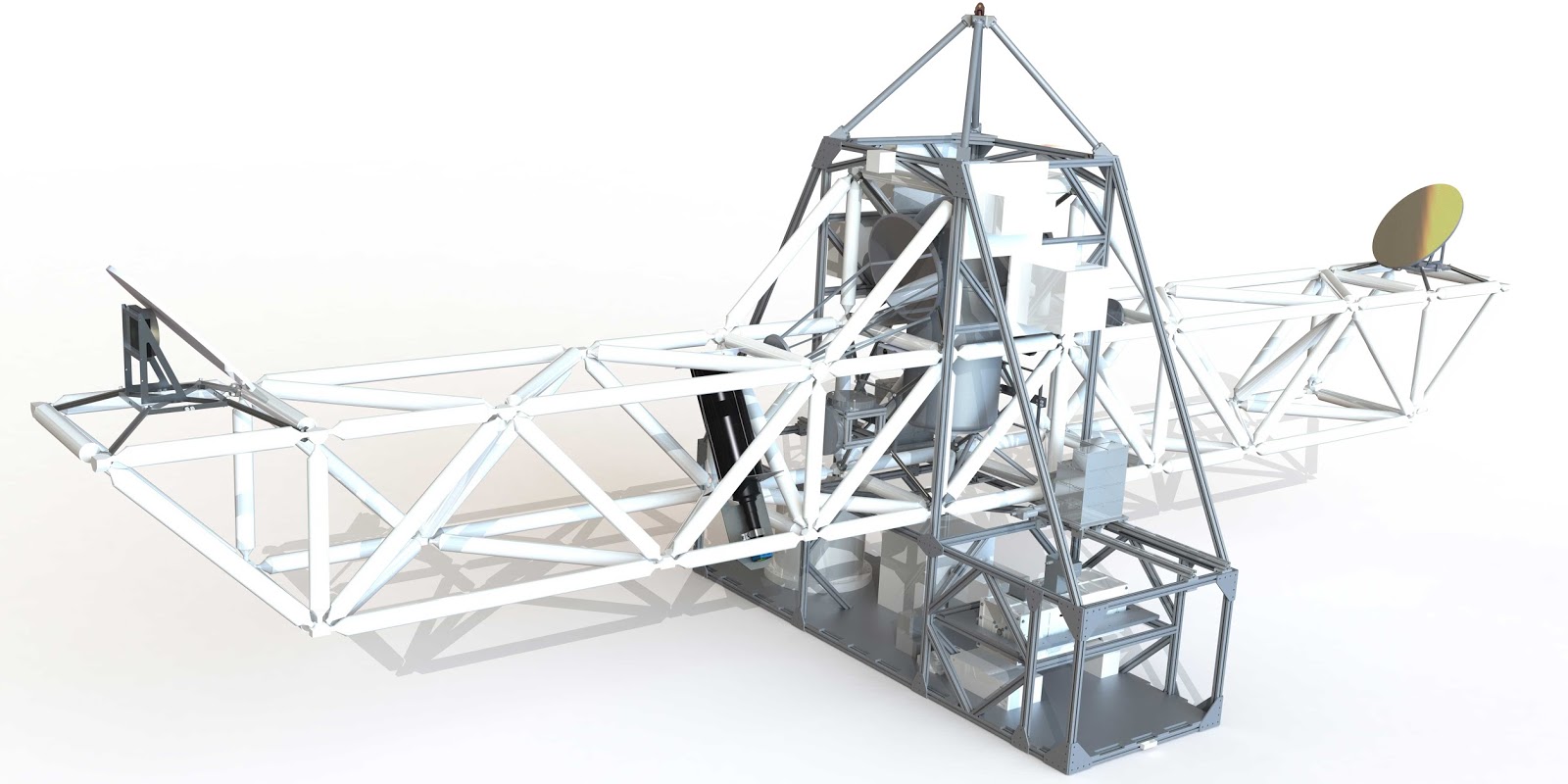
"BETTII3_low.jpg"
NASA Goddard Space Flight Center
asd.gsfc.nasa.gov/bettii/

The two far-infrared reflector telescopes of the Balloon Experimental Twin Telescope for Infrared Interferometry (BETTII)[*] have the same 0.50 m (1.6 ft) diameter, and are separated by a distance of 8.0 m (26 ft) between them. This telescope system is attached to a balloon that ascends to an altitude of 40 km (25 miles) in the upper atmosphere.[**] Taking this far-infrared telescope system into the upper atmosphere improves the light-gathering power due to less __________ at high altitudes.
(A) absorption.
(B) turbulence.
(C) light pollution.
(D) temperature fluctuations.

[*] S. A. Rinehart ; R. B. Barclay ; R. K. Barry ; D. J. Benford ; P. C. Calhoun, et al., "Design and status of the Balloon Experimental Twin Telescope for infrared interferometry (BETTII): an interferometer at the edge of space," Proc. SPIE 8445, Optical and Infrared Interferometry III, 844508 (September 12, 2012), dx.doi.org/10.1117/12.926376.
[**] asd.gsfc.nasa.gov/bettii/.


Correct answer (highlight to unhide): (A)

Far-infrared light entering the top of the atmosphere from space does not make it down to sea level (the bottom edge of the graph), due to absorption of this wavelength by the atmosphere. However, it can still be detected in the upper atmosphere, as has traveled a shorter distance through the atmosphere, where there was less absorption (primarily due to water vapor).

Section 70158
Exam code: quiz03St3M
(A) : 3 students
(B) : 11 students
(C) : 17 students
(D) : 1 student

Success level: 15% (including partial credit for multiple-choice)
Discrimination index (Aubrecht & Aubrecht, 1983): 0.25

Section 70160
Exam code: quiz03Nz6L
(A) : 0 students
(B) : 8 students
(C) : 12 students
(D) : 2 students

Success level: 5% (including partial credit for multiple-choice)
Discrimination index (Aubrecht & Aubrecht, 1983): 0

Astronomy current events question: Venus habitable up until recent resurfacing?

Astronomy 210L, fall semester 2019
Cuesta College, San Luis Obispo, CA

Students are assigned to read online articles on current astronomy events, and take a short current events quiz during the first 10 minutes of lab. (This motivates students to show up promptly to lab, as the time cut-off for the quiz is strictly enforced!)
Jason Daley, "Venus Could Have Been Habitable for Billions of Years" (September 24, 2019)
smithsonianmag.com/smart-news/venus-could-have-been-habitable-billions-years-180973203/
Venus may have had a stable, hospitable climate up until a massive resurfacing event, based on:  
(A) computer simulations.
(B) dry riverbeds and oceans.
(C) organic compound traces.  
(D) ancient Egyptian hieroglyphs. (E) analysis of rock compositions.  

Correct answer: (A)

Student responses
Sections 70178, 70186
(A) : 17 students
(B) : 12 students
(C) : 1 student
(D) : 0 students
(E) : 6 students

Astronomy current events question: TESS tidal disruption event

Astronomy 210L, fall semester 2019
Cuesta College, San Luis Obispo, CA

Students are assigned to read online articles on current astronomy events, and take a short current events quiz during the first 10 minutes of lab. (This motivates students to show up promptly to lab, as the time cut-off for the quiz is strictly enforced!)
Jeanette Kazmierczak, "NASA’s TESS Mission Spots its First Star-Shredding Black Hole" (September 26, 2019)
nasa.gov/feature/goddard/2019/nasa-s-tess-mission-spots-its-1st-star-shredding-black-hole
NASA's planet-hunting Transiting Exoplanet Survey Satellite detected its first tidal disruption event, where:
(A) a star was torn apart by a black hole.
(B) an exomoon escaped from its exoplanet.
(C) gravitational waves trigged a supernova.
(D) the moon's rotation suddenly slowed down.
(E) sea level on Earth rose over one centimeter.

Correct answer: (A)

Student responses
Sections 70178, 70186
(A) : 32 students
(B) : 3 students
(C) : 0 students
(D) : 1 student
(E) : 0 students

Astronomy current events question: exoplanet gas giant GJ 3512b

Astronomy 210L, fall semester 2019
Cuesta College, San Luis Obispo, CA

Students are assigned to read online articles on current astronomy events, and take a short current events quiz during the first 10 minutes of lab. (This motivates students to show up promptly to lab, as the time cut-off for the quiz is strictly enforced!)
Markus Nielbock et al., "When Dwarfs Give Birth to Giants" (September 26, 2019)
mpg.de/13918934/when-dwarfs-give-birth-to-giants
An exoplanet gas giant GJ 3512b orbiting a red dwarf star provides evidence for a gravitational instability model of __________ formation.
(A) protostar.
(B) planetary.
(C) Doppler shift.
(D) gravity waves.
(E) habitable zone.

Correct answer: (B)

Student responses
Sections 70178, 70186
(A) : 2 students
(B) : 29 students
(C) : 1 student
(D) : 2 students
(E) : 2 students

Online reading assignment: fusion, nebulae, star cluster ages (NC campus)

Astronomy 210, fall semester 2019
Cuesta College, San Luis Obispo, CA

Students have a weekly online reading assignment (hosted by SurveyMonkey.com), where they answer questions based on reading their textbook, material covered in previous lectures, opinion questions, and/or asking (anonymous) questions or making (anonymous) comments. Full credit is given for completing the online reading assignment before next week's lecture, regardless if whether their answers are correct/incorrect. Selected results/questions/comments are addressed by the instructor at the start of the following lecture.

The following questions were asked on reading textbook chapters and previewing presentations on fusion, nebulae, and star cluster ages.


Selected/edited responses are given below.

Describe something you found interesting from the assigned textbook reading or presentation preview, and explain why this was personally interesting for you.
"The H-R diagram is great once you know how to read it."

"It was interesting to find out the luminosity, size and temperature for the stars using the H-R diagram."

"Big stars don't last as long as small ones, it makes sense but it just feel more right that because they're big it's a longer time for them to burn out."

"One thing I found interesting about main sequence stars is that the more massive they are, the more luminous they are."

"I had heard of nuclear fusion, but I didn't realize that was what fueled a star. It puts our efforts to replicate it here on Earth into perspective."

"Did not know that there were dust clouds in space that block out stars to where it looks like there is a black blotch."

"That there are different nebula as I was very vaguely informed on what one even was."

"Something that I found very interesting from this presentation was the notion of nebulas. Nebulas look like clouds in space but they serve a much larger purpose."

"How the reflection, emission, and dark nebula get their colors."

Describe something you found confusing from the assigned textbook reading or presentation preview, and explain why this was personally confusing for you.
"Something that I found personally confusing was the part where it talked about fusion, I was confused because the presentation doesn't really go into depth as to how it works. If you could explain it that would be great."

"Cold fusion, I just can't wrap my mind around it. Hydrogen and its isotopes at room temperature dissolve into a specific solid at such a high concentration a strong nuclear force occurs and boom, cold fusion?"

"Lifetime of stars?"

"Interstellar medium. I think I have the base idea about it but I would how we were able to find the interstellar dust in the vacuum of space."

"Is this a trick question? Everything’s confusing before you understand it 🤷‍♂️."

"I personally found all the reading to be a bit of an information overload and hope to have a lot of things clarified by next class."

Rank the luminosities of these main-sequence stars (1 = brightest, 3 = dimmest). (There are no ties.)
(Only correct responses shown.)
Massive: brightest luminosity [100%]
Medium-mass (sunlike): medium luminosity [100%]
Low mass (red dwarf): dimmest luminosity [100%]

Rank the fusion rates of these main-sequence stars (1 = fastest, 3 = slowest). (There are no ties.)
(Only correct responses shown.)
Massive: fastest fusion rate [71%]
Medium-mass (sunlike): medium fusion rate [100%]
Low mass (red dwarf): slowest fusion rate [71%]

Fusion requires high temperatures in order for nuclei to move quickly enough to:
break heavy elements apart.  ***** [5]
create convection currents.  **** [4]
overcome gravity.  ** [2]
overcome repulsion.  *** [3]
(Unsure/guessing/lost/help!)  [0]

Briefly explain why "cold fusion" (producing energy from hydrogen fusion at room temperature) would be implausible.
"Under low pressures and temperatures, hydrogen does not get squeezed very much, and moves too slowly, they won't collide with each other."

"Because nuclear fusion requires high temperatures to overcome the natural forces that normally prevent that kind of thing."

"Due to the fact that nuclei which are positively charge would not collided with each other but would repulse each other so the atoms could not create energy."

"Fusion can't happen in cold temperatures because protons are positively charged and repel each other."

"Have no clue."

"I'm not sure."

Match the three different types of nebulae with their colors.
(Only correct responses shown.)
Emission: pink [86%]
Reflection: blue [86%]
Dark: brown/black [93%]

Match the three different types of nebulae with their composition.
(Only correct responses shown.)
Emission: hydrogen [86%]
Reflection: small dust particles [71%]
Dark: large dust particles [71%]

Rank the lifetimes of these main-sequence stars (1 = shortest, 3 = longest). (There are no ties.)
(Only correct responses shown.)
Massive: shortest main-sequence lifetime [64%]
Medium-mass (sunlike): medium main-sequence lifetime [93%]
Low mass (red dwarf): longest main-sequence lifetime [57%]

If there was an open invitation to a house party (no specific time given), when would you show up?
Early, or on time.  ******** [8]
When the most people should be there.  ***** [5]
After most everyone has left.  * [1]

Ask the instructor an anonymous question, or make a comment. Selected questions/comments may be discussed in class.
"Does interstellar matter dust turn into a planet or a star? Both?" (Yes, either is possible.)

"I found this survey a bit difficult and could really use extra help."

"The picture of the nebulae are cool and I think we show see more of them."

"Nebulae have amazing colors."

"I love learning about stars! They're one of the most fascinating subjects in astronomy for me, given that our star is the only reason we're even alive."

20191021

Physics quiz question: camel spider translational kinetic energy (purported)

Physics 205A Quiz 4, fall semester 2019
Cuesta College, San Luis Obispo, CA

"Mr. Solifugae (probably Eremobates)"
Dallas Krentzel
flic.kr/p/9Ki3kX

Consider the myths listed below[*] as factual for camel spiders (Eremobates pallipes, also known as "wind scorpions"), which are native to California. Ignore friction and drag.
Camel spiders can reach up to 6 inches (15 cm) in length and weigh about 2 ounces (57 grams). Some common myths...are that they can run up to 30 mph (13 m/s) and jump up to 3 feet [1 m] high.
A camel spider that starts from rest and speeds up to 13 m/s will have an increase in translational kinetic energy of:
(A) 0.4 J.
(B) 0.6 J.
(C) 0.7 J.
(D) 5 J.

[*] Jessie Szalay, "Camel Spiders: Facts & Myths" (December 17, 2014), livescience.com/40025-camel-spiders-facts.html.

Correct answer (highlight to unhide): (D)

The change in translational kinetic energy is given by:

KEtr = (1/2)·m·(vf2v02),

KEtr = +4.8165 J,

or to two significant figures, the increase in translational kinetic energy is 5 J.

(Response (A) is (1/2)·m·(vfv0); response (B) is m·g·(yfy0); response (C) is m·(vfv0).)

Sections 70854, 70855
Exam code: quiz04JuR4
(A) : 11 students
(B) : 2 students
(C) : 1 student
(D) : 38 students

Success level: 73%
Discrimination index (Aubrecht & Aubrecht, 1983): 0.56

Physics quiz question: energy changes of a dragged box speeding up a ramp

Physics 205A Quiz 5, fall semester 2018
Cuesta College, San Luis Obispo, CA

A Physics 205A student pulls a 15.0 kg box with increasing speed up a ramp with a rope that is parallel to the slope of the ramp. Friction is not negligible. Ignore drag. For this process, the __________ of the box increases.
(A) gravitational potential energy.
(B) translational kinetic energy.
(C) (Both of the above choices.)
(D) (Neither of the above choices.)

Correct answer (highlight to unhide): (C)

The change in translational kinetic energy is given by:

KEtr = (1/2)·m·(vf2v02).

Since the speed of the box is increasing, vf is faster than v0, and so KEtr is increasing (∆KEtr is positive).

The change in gravitational potential energy is given by:

PEgrav = m·g·(yfy0).

Since yf is higher than y0, then PEgrav also increases (∆PEgrav is positive).

Sections 70854, 70855
Exam code: quiz04JuR4
(A) : 17 students
(B) : 7 students
(C) : 28 students
(D) : 0 students

Success level: 54%
Discrimination index (Aubrecht & Aubrecht, 1983): 0.75

Physics quiz question: "superhero landing" impulse

Physics 205A Quiz 4, fall semester 2019
Cuesta College, San Luis Obispo, CA

"Deadpool | 'Superhero Landing' | Official HD Clip 2016"
20th Century Fox UK
youtu.be/EwUilIo036g

In the movie Deadpool (2016), Angel Dust (portrayed by Gina Carano, mass 66 kg[*]) falls vertically downwards for a "superhero landing," coming to a complete stop from a downwards speed of 34 m/s in 0.24 s as she contacts the ground[**]. Ignore friction and drag. The magnitude of the stopping impulse of the ground on her was:
(A) 0 N·s.
(B) 2.2×10³ N·s.
(C) 9.4×10³ N·s.
(D) 3.8×10⁴ N·s.

[*] imdb.com/name/nm2442289/.
[**] Assuming an initial vertical speed of zero as she steps off the edge of a derelict helicarrier, with a flight deck assumed to be 60 m high above the ground.

Correct answer (highlight to unhide): (B)

From the impulse-momentum theorem, the impulse J on an object causes its initial-to-final change in momentum ∆p:

J = ∆p,

where ∆p = m·(vfv0).

The initial velocity vector is v0 = –34 m/s (traveling downwards), and the final velocity vector is vf = 0 m/s ("a complete stop"). Then:

J = (66 kg)·((0 m/s) – (–34 m/s)) = (66 kg)·(+34 m/s) = +2,244 N·s,

or to two significant figures, the magnitude of the impulse is 2.2×10³ N·s (and the "+" sign indicates that it is in the upwards direction).

(Response (C) is the magnitude of the average stopping force over the 0.24 s stopping time interval; response (D) is the amount of translational kinetic energy dissipated by the landing.)

Sections 70854, 70855
Exam code: quiz04JuR4
(A) : 1 student
(B) : 27 students
(C) : 20 students
(D) : 4 students

Success level: 52%
Discrimination index (Aubrecht & Aubrecht, 1983): 0.73

Physics quiz question: completely inelastic lab cart collision

Physics 205A Quiz 4, fall semester 2019
Cuesta College, San Luis Obispo, CA

Two lab carts initially move towards the right along a horizontal track, and make a completely inelastic collision. Ignore friction and drag during this brief collision.


After the collision, the 0.200 kg cart has a speed that is __________ the speed of the 0.500 kg cart.
(A) slower than.
(B) equal to.
(C) faster than.
(D) (Not enough information is given.)

Correct answer (highlight to unhide): (B)

In a completely inelastic collision, the two colliding objects stick to each other such that they have the same speed (and direction) afterwards.

Sections 70854, 70855
Exam code: quiz04JuR4
(A) : 7 students
(B) : 40 students
(C) : 5 students
(D) : 0 students

Success level: 77%
Discrimination index (Aubrecht & Aubrecht, 1983): 0.48

Physics quiz archive: energy conservation, momentum conservation

Physics 205A Quiz 4, fall semester 2019
Cuesta College, San Luis Obispo, CA
Sections 70854, 70855
Exam code: quiz04JuR4


Sections 70854, 70855 results
0- 6 :   ** [low = 6]
7-12 :   ****
13-18 :   *******
19-24 :   ********************** [mean = 21.9 +/- 6.1]
25-30 :   ***************** [high = 30]