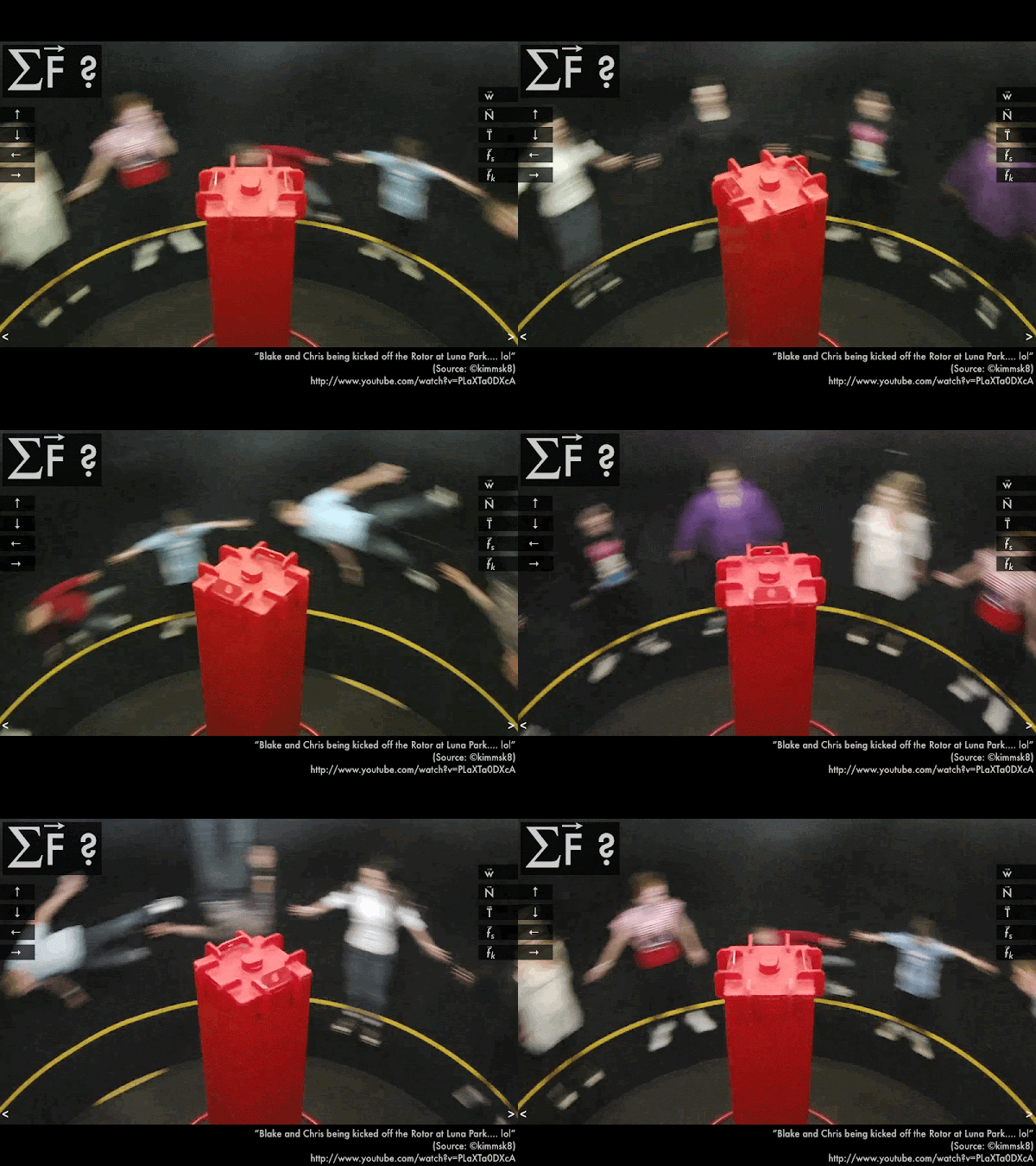
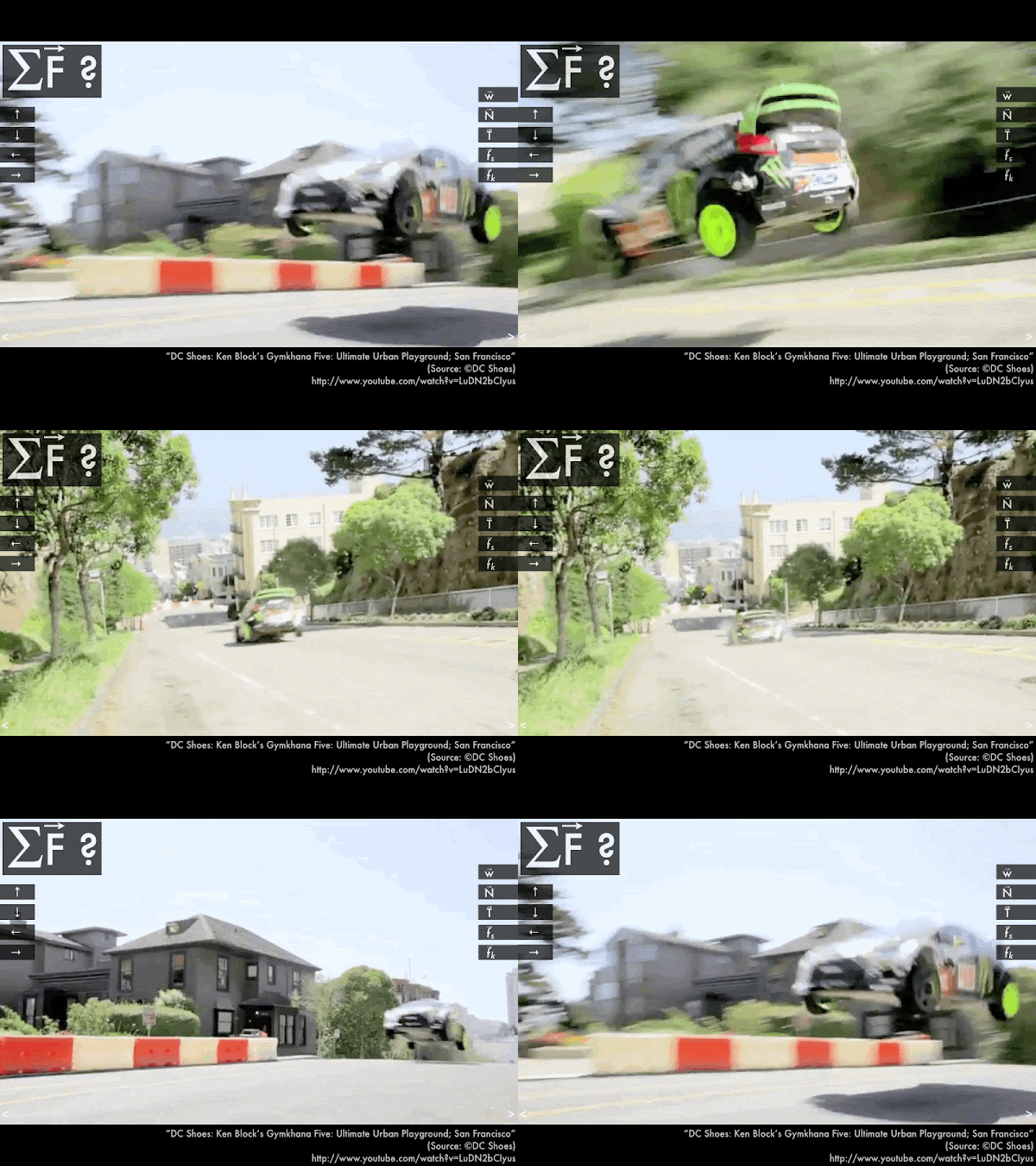
20190922

Astronomy current events question: Northwest Africa (NWA) 11119 meteorite

Astronomy 210L, fall semester 2019
Cuesta College, San Luis Obispo, CA

Students are assigned to read online articles on current astronomy events, and take a short current events quiz during the first 10 minutes of lab. (This motivates students to show up promptly to lab, as the time cut-off for the quiz is strictly enforced!)
Karin Valentine, "Oldest-Ever Igneous Meteorite Contains Clues to Planet Building Blocks" (August 2, 2019)
asunow.asu.edu/20180802-oldest-ever-igneous-meteorite-contains-clues-planet-building-blocks
The Northwest Africa (NWA) 11119 meteorite provides evidence for rocks in our solar system that were able to form before:
(A) the sun's fusion started.
(B) comets began to freeze.
(C) radioactive decay ended.
(D) terrestrial planets were born.
(E) asteroids were captured by the sun.

Correct answer: (D)

Student responses
Sections 70178, 70186
(A) : 6 students
(B) : 3 students
(C) : 1 student
(D) : 26 students
(E) : 2 students

Astronomy current events question: ‘Alopeke speckle imaging

Astronomy 210L, fall semester 2019
Cuesta College, San Luis Obispo, CA

Students are assigned to read online articles on current astronomy events, and take a short current events quiz during the first 10 minutes of lab. (This motivates students to show up promptly to lab, as the time cut-off for the quiz is strictly enforced!)
Peter Michaud and Alyssa Grace, "Exoplanets Can't Hide Their Secrets from Innovative New Instrument" (August 29, 2019)
gemini.edu/node/21236
The Gemini North Telescope on Mauna Kea used the ‘Alopeke speckle imaging system to observe exoplanet Kepler-13b as it __________ the star it orbited.
(A) collided with.
(B) broke away from.
(C) passed in front of.
(D) reflected light from.
(E) gravitationally pulled.

Correct answer: (C)

Student responses
Sections 70178, 70186
(A) : 3 students
(B) : 3 students
(C) : 14 students
(D) : 12 students
(E) : 6 students

Astronomy current events question: asteroid 6478 Gault color change

Astronomy 210L, fall semester 2019
Cuesta College, San Luis Obispo, CA

Students are assigned to read online articles on current astronomy events, and take a short current events quiz during the first 10 minutes of lab. (This motivates students to show up promptly to lab, as the time cut-off for the quiz is strictly enforced!)
Jennifer Chu, "For First Time, Astronomers Catch Asteroid in the Act of Changing Color" (August 29, 2019)
news.mit.edu/2019/asteroid-changing-color-first-0830
The asteroid 6478 Gault is changing color as surface dust is lost due to:
(A) internal heat.
(B) cryovolcanoes.
(C) internal asteroidquakes.
(D) increasing rotation rate.
(E) collisions with micrometeorites.

Correct answer: (D)

Student responses
Sections 70178, 70186
(A) : 13 students
(B) : 1 student
(C) : 0 students
(D) : 19 students
(E) : 4 students

20190918

Online reading assignment: runaway planets, jovian planets, and dwarf planets (oh my!) (SLO campus)

Astronomy 210, fall semester 2019
Cuesta College, San Luis Obispo, CA

Students have a weekly online reading assignment (hosted by SurveyMonkey.com), where they answer questions based on reading their textbook, material covered in previous lectures, opinion questions, and/or asking (anonymous) questions or making (anonymous) comments. Full credit is given for completing the online reading assignment before next week's lecture, regardless if whether their answers are correct/incorrect. Selected results/questions/comments are addressed by the instructor at the start of the following lecture.

The following questions were asked on reading textbook chapters and previewing presentations on runaway planets (Venus and Mars), jovian planets (Jupiter, Saturn, Uranus and Neptune), and the dwarf planets (and the International Astronomy Union classification scheme).


Selected/edited responses are given below.

Describe something you found interesting from the assigned textbook reading or presentation preview, and explain why this was personally interesting for you.
"I thought the reasons for all the differences between the planets are really interesting. Like a planet's distance from the sun, how big it is, its atmospheric composition, it's core temperature, and how geologically active it is."

"Learning about the greenhouse cycle is very interesting for me. Larger planets putting out more greenhouse gas while smaller planets release less makes sense because of the mass of the planet and capacity to outgas. Also that because the strength of gravity on larger planets the greenhouse gases stay together is quite interesting."

"How important mass in relation to a planet's atmosphere and core heat is."

"That there is such a thing as 'frustrated volcanos' on Venus. Perfect GIF animation example btw..."

"I thought it was cool how Mars used to have oceans on its surface. This interests me because the astronomers were able to figure that out."

"The fact that there is hidden water on Mars! Maybe someday astronauts will find evidence that proves the planet was once hospitable."

"I enjoyed re-learning key aspects and characteristics of the planets and finding out new information about them that I hadn't known before."

"The 'bad' greenhouse effect was interesting, I never really knew before that too much could be bad in something like that."

"I find the runaway greenhouse effects of Venus and Mars very interesting. To me, Venus is especially interesting because it seems like it's the worst case scenario apocalyptic wasteland planet. In short, it's 'metal.' Very cool."

"How Jupiter has active weather patterns because it is seen with the colors of the planet."

"I found it interesting that if you took a boat onto Jupiter that you would never actually float, you would continuously sink with the gases just getting thicker and thicker. You would eventually start to sink into a liquid type substance but you would never actually hit a liquid. This is interesting because at first, I thought of putting a houseboat on Jupiter."

"Learning about the different planets and their similarities or slight differences. I also liked learning about what actually makes a planet, a planet. Having a reason behind why things are the way that they are."

"The IAU classification scheme was really interesting. Makes sense why Pluto is no longer considered a planet."

"The reason of why Pluto isn't a planet anymore. I've known that it was a dwarf planet, but I never understood it fully until now."

Describe something you found confusing from the assigned textbook reading or presentation preview, and explain why this was personally confusing for you.
"Never heard of a Cornish hen before. Is that weird or is that just me?"

"The self-maintenance of our Earth versus other planets like Venus and Mars; I think I just need some more explanation."

"I think it's weird that there is water on Mars. I guess I just don't imagine other planets having atmospheres like Earth does so when I think about water on other planets it seems like there would be water in space and that's weird. But when I think about it I guess it makes sense."

"The whole variety of greenhouse effects on different planets is a bit hard to keep track of. I'll probably forget each planet's particular greenhouse effect by tomorrow."

"Something I found confusing was how Venus has so much carbon dioxide. Is all of the water vapor of Venus gone out of atmosphere, or is it still in atmosphere and it is just too hot to condense?"

"Reading about the volcanic resurfacing on Venus was interesting and confusing. How would we be able to figure out how many eruption cycles Venus has had and are we able to predict the future eruptions?"

"I was curious to know if Earth will slowly become more hostile in the future alike Venus and mars. The textbook did not touch on the possibility but introduced the idea that Venus and Mars both were more habitable in the beginning."

"I found a little bit confusing reading about Jupiter's complex atmosphere and the belt-zone circulation."

"I find the jovian planets confusing in that they have no surface and are liquid. Just giant balls of liquid floating in space. Perhaps not so confusing, more strange."

"Whether Neptune or Uranus is the coldest planet. You would think that Neptune would be chillier because it's farthest from the sun, but Uranus has calmer weather patterns."

"I feel like I understood most of the things covered in this chapter, but I guess I don't quite get why Uranus is colder than Neptune. I read the explanation from your blog post, but I guess I just don't understand why its orbit is so tilted. What made it like that? Why isn't Uranus the same temperature as Neptune?"

"I would like more explanation on ice giants because I am having trouble understanding what causes them to be the way they are. More on the Cooper Cooler™ effect?"

"Being able to define a planet and what that is exactly. I understand it, but it's still kind of confusing to me."

"What made scientists change the classifications of a planet? Why did the IAU make Pluto a dwarf planet?"

Identify the relative amounts of these characteristics for Venus, compared to Earth. (Only correct responses shown.)
Interior core heat, today: about the same as Earth [55%]
Geologic activity, today: less than Earth [71%]
Volcanic outgassing, up until now: about the same as Earth [58%]
Heat from the sun: more than Earth [87%]
Amount of atmosphere, today: more than Earth [77%]

Identify the relative amounts of these characteristics for Mars, compared to Earth. (Only correct responses shown.)
Interior core heat, today: less than Earth [94%]
Geologic activity, today: less than Earth [87%]
Volcanic outgassing, up until now: less than Earth [77%]
Heat from the sun: less than Earth [94%]
Amount of atmosphere, today: less than Earth [94%]

Which jovian planet has the coolest interior temperatures?
Jupiter (most massive).   [0]
Saturn (most prominent rings).   ** [2]
Uranus (least active weather patterns).   ******************** [20]
Neptune (farthest from the sun).   ********* [9]
(Unsure/guessing/lost/help!)   [0]

I believe Pluto should be a planet.
Strongly disagree.   ** [2]
Disagree.   ******* [7]
Neutral.   *********** [11]
Agree.   ****** [6]
Strongly Agree.   ***** [5]

Briefly explain your answer to the previous question (whether Pluto should be a planet).
"If pluto were to be included as a planet, it would create argument to include tons of other planets like Eris that fit the plutos qualifications for planethood sometimes better than pluto (its bigger)."

"I think any planet-type object in our solar system should be a planet, but what do I know?"

"It seems funny that in 2006 we lost a planet. We went from nine planets to eight planets. Pluto is still a planet but is in another class called dwarf planet due to its size. In my opinion we need to restore the solar system to its former nine-planet glory."

"I do not have enough information to support a claim on whether or not Pluto should a planet. I am not very familiar with the subject. "

"It's orbit is affected by other planets and does not dominate its own orbit."

"Because, although Pluto has two of the three requirements for a celestial body to be called a planet (namely, (1) it has an orbit around the sun; (2) it is massive enough to be rounded by its own gravity); it doesn't have the third requirement: it hasn't cleared its own orbit path around the sun (it's not gravitationally dominant)."

"Pluto deserves to be a planet ."

"Scientifically I understand why Pluto is considered a dwarf planet instead of a planet, however my nostalgia on remembering Pluto as a planet as a kid gives me a slight bias."

"It is what it is."

"I think that Pluto is an interesting subject, but I'm not really emotionally attached to it. I understand the scientific community's reasons for changing its classification. I do believe that Eris, Ceres and company could all be classified as planets in addition if the accepted classification had been different. I don't have very strong opinions on the subject one way or the other, and I don't think that Pluto's planethood--or lack therof--should detract from our interest in it."

"I always knew Pluto as a planet so I would have to let it stay as a planet for my nostalgia."

"Does it really hurt to just call Pluto a planet? Pluto was always considered a planet when I was a kid, it was taught to me that way. I'll never accept Pluto as anything other than a planet, that deserves to be called one just as much as the other planets!!"

"I can understand why the IAU classified Pluto as dwarf planet because it is so similar in size to other objects in the Kuiper Belt. Some of these ice-body objects have their own moons too, so they are practically Pluto. Most people think of planets as larger than Earth and Pluto is itty bitty in comparison to the other planets in our solar system."

"Honestly, it's more of an emotional planet, because I went through elementary school with it being a part of our solar system (and it was my favorite planet, other than Earth, with Jupiter as my second) and then it was just taken out. Technically and scientifically I understand that it is a dwarf planet, but I'd still like it to be a part of our solar system."

"I actually went neutral since astronomers know why it does not reach the standards of a planet."

"Ever since I was little everyone said Pluto wasnt considered a planet. Till this day I don't care if it follows the definition of a planet, all I care about is that Pluto is still up there next to all the other planets so It should be one just cause its there."

"Classification is important in the sciences. knowing exactly what an object is can put data into context. Arguing over how to classify something is a waste of time and distracts from some of the dwarf-planet's interesting features and traits."

"Pluto orbits the sun and it also has a round shape. This gives it two out of three yes's plus it was already a planet so it should get to be a planet again."

"A planet to clear its orbital may have some relevance to the proximity to the sun when they formed and the Kuiper belt shows the result when a planet doesn't have that proximity. possibly to be defined Kuiper planets."

"I would say so because it was deemed a planet earlier but at the same time their are other planets that had better qualifications than Pluto but were not deemed planets."

"Pluto passes two of the three IAU qualifications. I don't think Pluto has a strong enough gravity to pull in or eject another object like a moon for example. Therefore it cannot be considered a planet despite its rounded shape and rocky characteristics."

"I defer to the IAU on such."

"I believe Pluto should be a planet because it orbits the sun and has an atmosphere when close to the sun."

"Human nature tends to cause us to want bring everything together into a family. This leads to feelings of hurt when a member of the family is dismissed. We often view the planets as our 'solar system family,'" therefore, by excluding a member, the family unit is seen as having been torn apart which tears at heartstrings. Bring Pluto back, he's cute."

"I do think that since Pluto didn't meet all the criteria to be a planet, it shouldn't be called one. It still doesn't make my heart hurt any less that they took it out though."

"I understand why it's not a planet but it does have its own moons. why does it depend so greatly on the planet's size if its considered a planet or not? just because Pluto is a dwarf makes it that much less of a planet?"

"According to the textbook, Pluto isn't considered a jovian or terrestrial plant. It also states that 'an object must be large enough to dominate and gravitationally clear its orbital region or more, or all, other objects.' So according to these standards Pluto maybe cannot be a planet."

"Pluto is classified as a dwarf, so I guess it shouldn't be a planet. However, that was due to recent updates in what classifies a planet and what doesn't, hence why Pluto was considered a planet for more than 70 years."

"Using the current system it doesn't meet the criteria. The classification system may change, and since it is too far for me to realistically visit, it doesn’t affect me that much so I don’t have a lot of emotional investment."

"Pluto should not be classified as a planet because it has little mass and does not dominate its orbit. Similar objects have been found in the Kuiper belt, so it doesn't live up to IAU's planet standards. Poor Pluto."

"After reading the part in the book about Pluto it shouldn't be a planet, it wasn't able to push other things out its orbit with its gravitational pull."

Ask the instructor an anonymous question, or make a comment. Selected questions/comments may be discussed in class.
"I'm relieved to have a break from spatial reasoning, it's obviously not my strong point."

"The concept that a planet needs to be geologically active in order to maintain its habitability is fascinating, and somewhat debatable. Couldn't a greenhouse dome provide conditions on a geologically inactive planet that would make habitation possible?" (Yes, especially since it's not possible to terraform Mars.)

"How come Mars is being investigated for habitability and not Venus?" (There has been some speculation on what would be required to terraform Venus, but Carl Sagan conceded that it is probably too far gone.)

"Venus is pretty stinking hot if our probes can only last a few hours on its surface... Venus is the 'hot lava' game in real life!"

"'Jovian' is a cool word. Really rolls off the tongue, unless I am saying it wrong?"

"Saturn's rings are made of ice particle/chunks. Theoretically, could that be a good water source when/if we become an interplanetary species? Or are there more accessible water sources in solar system?" (Maybe, but Saturn's moons (along with some of Jupiter's moons) have water ice as well.)

"More about the other planets that could have been planets."

"Is it likely that the junk in the asteroid belt or Kuiper belt could attract and become a planet in a few billion years, or is the way planet-making period in this solar system over?" (The asteroid belt will keep on as distributed debris, because of Jupiter's disruptive gravitational influence. Similarly for the Kuiper belt, due to all of the jovian planets.)

"Do you think Pluto should be a planet?" (Eh. It is what it is.)

Online reading assignment: uniform circular motion

Physics 205A, fall semester 2019
Cuesta College, San Luis Obispo, CA

Students have a bi-weekly online reading assignment (hosted by SurveyMonkey.com), where they answer questions based on reading their textbook, material covered in previous lectures, opinion questions, and/or asking (anonymous) questions or making (anonymous) comments. Full credit is given for completing the online reading assignment before next week's lecture, regardless if whether their answers are correct/incorrect. Selected results/questions/comments are addressed by the instructor at the start of the following lecture.

The following questions were asked on reading textbook chapters and previewing a presentation on uniform circular motion.


Selected/edited responses are given below.

Describe what you understand from the assigned textbook reading or presentation preview. Your description (2-3 sentences) should specifically demonstrate your level of understanding.
"In circular motion, there is a net force that produces the acceleration of an object. The centripetal force always points towards the middle of a circle."

"That circular motion is covered by Newton's second law. Even restricted to uniform circular motion Newton's second law still applies."

"I understand that by Newton's second law, there must be some type of force to create centripetal acceleration. It makes sense to me that this force is pointing towards the center of the circle, as if the force pointed outward, the object would drift off its circular path."

"Since the word 'centripetal' means 'moving toward a center,' the centripetal acceleration vector always points toward the center of the circle and continually changes direction as the object moves. For an object in uniform circular motion, the velocity vector has different directions at different places on the circle. Uniform circular motion along the arc of an infinitely large circle entails no acceleration, because it is just like motion at a constant speed along a straight line. An object undergoing uniform circular motion can never be at equilibrium because there is acceleration since the direction is constantly changing. Sometimes the centripetal force consists of a single force such as tension, friction, the normal force or a component thereof or the gravitational force."

"The concept of centripetal force, the net force of an object undergoing circular motion with a specific direction which is in towards the center of the circle and specific magnitude m·v2/r. Centripetal means 'center-seeking.' This is the requirement for uniform circular motion to maintain a constant speed along a circular trajectory with acceleration directed in towards the center."

"Centripetal force! It's like centrifugal force but not. In all seriousness, a sample scenario is a car turning a corner. This change in direction of velocity requires a net force to keep pulling the car into the center of its curve."

Describe what you found confusing from the assigned textbook reading or presentation preview. Your description (2-3 sentences) should specifically identify the concept(s) that you do not understand.
"I don't understand the conceptual understanding of why the net force points towards the center of the circle."

"I'm a little confused on if this is the same or different from 'centrifugal force.'"

"I understand the majority of these situations, but the one about the girl swinging is tripping me up."

"Slightly confused on calculating ALL the net forces during circular motion."

"Friction and how it affects centripetal force (i.e. car driving in a curve along a track)."

"How circular motion works for a car drifting around a turn. I do not understand what direction the net force is going."

"Is centripetal acceleration the acceleration the object is going at each new direction in a circular motion? I'm a little perplexed by that concept."

"I guess I still haven't grasped the idea of vertical circular motion yet."

"I'm pretty sure that I understood everything in the chapter."

For the "drifting" car (skidding around a circular track at constant speed), Newton's __________ law applies to its motion, and the forces acting on it add up to a net force that:
first; is zero.   ****** [6]
second; points to the left.   *************** [15]
second; points to the right.     ************************ [24]
(Unsure/lost/guessing/help!)   * [1]


At the moment when the woman is at the bottom of her swinging trajectory (when the rope is vertical), Newton's __________ law applies to her motion, and the forces acting on her add up to a net force that:
first; is zero.   ****** [6]
second; points upwards.     **************************** [28]
second; points downwards.   *********** [11]
(Unsure/lost/guessing/help!)   * [1]


At the moment when the motor scooter is on the left side of the screen (traveling out at you), Newton's __________ law applies to its motion, and the forces acting on it add up to a net force that:
first; is zero.   ** [2]
second; points to the left.   ************** [14]
second; points to the right.   ************************** [26]
(Unsure/lost/guessing/help!)   **** [4]


At the moment when the car is at the very top of the loop-the-loop, Newton's __________ law applies to its motion, and the forces acting on it add up to a net force that:
first; is zero.   ***** [5]
second; points upwards.   ******* [7]
second; points downwards.     ******************************** [32]
(Unsure/lost/guessing/help!)   ** [2]


At the moment when a person is at the right edge of the screen (traveling out at you), Newton's __________ law applies to his/her motion, and the forces acting on him/her add up to a net force that:
first; is zero.   **** [4]
second; points to the left.   **************************** [28]
second; points to the right.   *********** [11]
(Unsure/lost/guessing/help!)   *** [3]


At the moment when the car is at the very top of its mid-air trajectory, Newton's __________ law applies to its motion, and the forces acting on it add up to a net force that:
first; is zero.   ******** [8]
second; points upwards.   ****** [6]
second; points downwards.   **************************** [28]
(Unsure/lost/guessing/help!)   **** [4]


At the moment when the skateboarder is at the very top of his mid-air trajectory, Newton's __________ law applies to his motion, and the forces acting on him add up to a net force that:
first; is zero.   ****** [6]
second; points upwards.   ****** [6]
second; points downwards.   ******************************* [31]
(Unsure/lost/guessing/help!)   *** [3]


Ask the instructor an anonymous question, or make a comment. Selected questions/comments may be discussed in class.
"I feel like to really grasp what these questions are asking we need a bit more clarification in class because it's easy to get mixed up." (That's okay, just try your best--I need to see how well you do on the first try, so I know how basic or advanced to tailor my lecture for this material. (Spoiler alert: very basic.)

I've got no idea how I did on those last questions. May we go over these questions in class? I think I got all of them wrong."

"How do I know if I got these questions right or not?" (We'll go over these in class, and as part of the next reading assignment, you have a link to click on so you can see these correct answers.)

"Can we go over how to tell which way the net force is pointing when objects are moving in a circle? How do you figure out which way the net force points?" (For objects undergoing uniform circular motion (moving in a circle with constant speed), the net force always points inwards, towards the center of the circle. Always. Points. Inwards.)

"So lost help!!"

"After going over the questions I am really confused on the idea of objects in motion. Do we determine the law at a specific moment in time or the entire sequence?" (At that one moment in time. Then for an entire sequence, it's just a whole bunch of consecutive moments in time, taken one by one.)

"I am still confused about the car and motorcycle skidding around a circular track--if I was to compare the motorcycle to the car, the motorcycle would almost be in a standstill, but compared to an outside frame of reference, they both move?" (Yes, since both the car and motorcycle are accelerating (constant speed, but changing direction), they are not proper inertial reference frames, and they will not be able to properly apply Newton's laws to their motions. As an outside (stationary) observer, you would be in an inertial reference frame, and would be able to properly apply Newton's laws to them as they undergo uniform circular motion.)

"I didn't really understand how when in circular motion we are feeling the forces that may feel like outward but really they are going in." (When you undergo uniform circular motion, you are not in a proper inertial reference frame, and cannot properly apply Newton's laws because you experience "pseudoforces" like something is pulling/pushing you outwards. An outside (stationary) observer would be in an inertial reference frame, and would be able to properly apply Newton's laws and describe the net force as inwards, despite what you (undergoing uniform circular motion) "perceives.")

"Is it still considered uniform circular motion if it is not a perfect circle? What about a racetrack that is an oval in shape?" (If we can approximate part of the oval as a circle (for any small enough section of an oval), then we can apply Newton's second law for uniform circular motion for that section.)

"Do we need to memorize all the weight, normal, tension, static friction, kinetic friction, Newton's laws and ΣF = m·a equations, or are they given on quizzes and exams like the kinematic equations of motion?" (You need to memorize w = m·g, fs, max = μs·N, fk = μk·N, ΣF = m·a, and "POF-OST-ITO." Instead of just giving you those equations on a quiz or exam, I think memorizing those equations will force you understand how and why to use them while applying Newton's laws on free-body diagrams. (Note that the normal force N and the tension force T don't have any equations; their magnitudes have to be deduced, as they vary depending on the particular situation.)

20190917

Online reading assignment: runaway planets, jovian planets, and dwarf planets (oh my!) (NC campus)

Astronomy 210, fall semester 2019
Cuesta College, San Luis Obispo, CA

Students have a weekly online reading assignment (hosted by SurveyMonkey.com), where they answer questions based on reading their textbook, material covered in previous lectures, opinion questions, and/or asking (anonymous) questions or making (anonymous) comments. Full credit is given for completing the online reading assignment before next week's lecture, regardless if whether their answers are correct/incorrect. Selected results/questions/comments are addressed by the instructor at the start of the following lecture.

The following questions were asked on reading textbook chapters and previewing presentations on runaway planets (Venus and Mars), jovian planets (Jupiter, Saturn, Uranus and Neptune), and the dwarf planets (and the International Astronomy Union classification scheme).


Selected/edited responses are given below.

Describe something you found interesting from the assigned textbook reading or presentation preview, and explain why this was personally interesting for you.
"The turkey/Corn hen theory and the core heat example it helped me better understand the function of what mass and core heat have to do with a planet."

"The way Earth is like a giant greenhouse and how it naturally cycles CO2 and keeps the earth running."

"That the further you are from the sun the colder the planet and the closer the hotter the planet. Venus is one of the hottest planets in the solar system."

"Venus's runaway greenhouse effect was extremely interesting and led me to wonder if the addition of water to the planet would counteract this effect."

"I am interested in the history how Venus became a lethal planet and what lead to it becoming the Venus it is today. I am interested in the craters and volcanoes that dot the highlands. I am interested the greenhouse effect that boiled the oceans of Venus and lead to it losing all of its water. One of the things that I am interested is how without plate tectonics Venus is able to gain new crust every half-billion years."

"That there is evidence on Mars that there were large amounts of water flowing."

"The part in the presentation where it talked about jovian planets. especially when it talked about ice giants, I was just amazed on how different on complex all the planets in our solar system are, just imagine what else is out there."

"I found jovian planets presentation interesting because I'm getting to learn about gas giants and ice giants."

"Uranus's insides are cooler then Neptune's even though its closer to the sun. I thought for planets that the closer the sun is the hotter it is."

Describe something you found confusing from the assigned textbook reading or presentation preview, and explain why this was personally confusing for you.
"Outgassing?"

"A part of the presentation that I didn't understand that well was runaway greenhouse, I got a good grasp on it but just need some clarifications. I don't get what happens to venus' greenhouse gasses now that they can escape, where do they go?"

"The greenhouse effect on both the planets Mars and Venus."

"I am confused on Jupiter’s core. I am curious on why Jupiter and other gas giants has liquid cores instead of molten cores. I am curious as to how Jupiter effected the formation of the solar system."

"What I found confusing was the Copper Cooler™ effect."

"Why is Pluto (to some) called a planet? It's the size of a small moon or large asteroid, I know it has its own very tiny moon but there are (I imagine) many like it in the asteroid belt."

Identify the relative amounts of these characteristics for Venus, compared to Earth. (Only correct responses shown.)
Interior core heat, today: about the same as Earth [27%]
Geologic activity, today: less than Earth [40%]
Volcanic outgassing, up until now: about the same as Earth [33%]
Heat from the sun: more than Earth [80%]
Amount of atmosphere, today: more than Earth [47%]

Identify the relative amounts of these characteristics for Mars, compared to Earth. (Only correct responses shown.)
Interior core heat, today: less than Earth [73%]
Geologic activity, today: less than Earth [73%]
Volcanic outgassing, up until now: less than Earth [73%]
Heat from the sun: less than Earth [73%]
Amount of atmosphere, today: less than Earth [80%]

Which jovian planet has the coolest interior temperatures?
Jupiter (most massive).   [0]
Saturn (most prominent rings).   [0]
Uranus (least active weather patterns).   ******** [8]
Neptune (farthest from the sun).   ******* [7]
(Unsure/guessing/lost/help!)   [0]

I believe Pluto should be a planet.
Strongly disagree.   [0]
Disagree.   *** [3]
Neutral.   ***** [5]
Agree.   ***** [5]
Strongly Agree.   ** [2]

Briefly explain your answer to the previous question (whether Pluto should be a planet).
"The IAU is an international group who decides what does and what does not classify a planet. I feel like their rules for classification and fair and just, and Pluto should feel special because they made an entirely new classification for it."

"I think it should be since it is orbiting the sun."

"I chose that decision because Pluto has both the characteristics of a dwarf planet and planet in my opinion."

"I believe it should be a planet because it is out in space and moves like the other planets and it is in space."

"My answer to the previous question is neutral because I don't mind the idea of people suggesting that Pluto should be a planet or that it shouldn't, personally I don’t know much about it or the topic to have an actual opinion."

"I don't know, but I do know it's way smaller than any planet out there and farthest one out there."

"Don't have any real reason to call it a planet and it is smaller than the moon."

"Based on what it says in the book it seems logical that it shouldn't be a planet. The only thing it really has that may make it seem like a planet is a moon but thats not enough."

"I can see the arguments on both sides of the scientific committee. It is too small to be a planet and it is in an orbit with its sister planet Charon."

"Why leave the underdog out of the equation?"

"Pluto was a planet when I was a kid so why change it? And it also orbits around the sun just like the other planets."

"It's an unnecessary argument. The scientists who chose to remove the planet title from Pluto have their own choice and are more qualified to decide."

"I think it should be a planets because there are some points when it comes closer than Neptune to the sun."

"I think that it is too small and it's controlled by [others' gravitational] forces."

Ask the instructor an anonymous question, or make a comment. Selected questions/comments may be discussed in class.
"Can we talk more about Mars and Venus compared to Earth?"

"One thing I found confusing is if Mars is small and cold, how come any liquid boils on the surface of Mars?" (In order to boil a liquid such that it turns into vapor, you have to give the molecules in the liquid energy to free those molecules. If there isn't very much atmosphere outside the liquid, then you don't have to add as much energy to boil the liquid, as it is easier for the molecules to escape into a more empty atmosphere. Mars' atmosphere is so thin and cold that if you had liquid water (which is going to be relatively warmer), its molecules are now very free to escape into the atmosphere, and have enough energy already to do so, and so it will "boil" on its own.)

"So which of the four jovian planets has the coolest temperature? I am guessing it is Neptune as it is the farthest from the sun." (The heat that drives the weather for jovian planets comes from within, so the smaller jovian planets would have the coolest cores.)

"I really don't understand Jupiter. If its made up of gas, how does the gravity work there? Is there a core?" (There is a rocky core that started the process of pulling in gases to build up Jupiter; after a certain point there would be so much gas accumulated that its gravity would come from its gases rather than its rocky core.)

"What does 'jovian' mean?" ("Jove" is another name for "Jupiter" in Roman mythology, and in astronomy a "jovian" refers to a planet that is "Jupiter-like.")

"Why do people think Pluto isn't a planet? I've been told that since elementary school and I've never heard an answer why?" (We'll be discussing that in class on Thursday.)

"Please explain your view on the whole 'Pluto is/isn't a planet' debate. Is it a planet or is it not and why?" (Like Pluto, lots of planets that were planets are no longer planets. Ceres was a planet, but is no longer a planet. Also Pallas, Vesta, and many, many others. We'll discuss how the rules for determining what is (or isn't) a planet have changed several times over history, and the motivation behind this changes.)

"Does the Kuiper belt extend past the edge of our solar system?" (While the Kuiper belt extends from outside Neptune's orbit outwards, the Oort cloud extends a thousand times further out from the sun.)

20190916

Online reading assignment: applications of Newton's laws (friction)

Physics 205A, fall semester 2019
Cuesta College, San Luis Obispo, CA

Students have a bi-weekly online reading assignment (hosted by SurveyMonkey.com), where they answer questions based on reading their textbook, material covered in previous lectures, opinion questions, and/or asking (anonymous) questions or making (anonymous) comments. Full credit is given for completing the online reading assignment before next week's lecture, regardless if whether their answers are correct/incorrect. Selected results/questions/comments are addressed by the instructor at the start of the following lecture.

The following questions were asked on reading textbook chapters on applications of Newton's laws (emphasizing static and kinetic friction).


Selected/edited responses are given below.

Describe what you understand from the assigned textbook reading or presentation preview. Your description (2-3 sentences) should specifically demonstrate your level of understanding.
"There can only be two types of motion: constant and changing. There also only two types of net forces: zero and non-zero."

"Newton's third law of motion isn't necessarily about motion or net force, but the properties of force itself."

"We can use the mnemonic device 'POF-OST-ITO' in order to test if Newton's third law applies or not. POF stands for 'pair of opposite forces,' OST is 'of same type,' ITO 'involving two objects.'"

"Newton's third law relates only two forces of the same type acting on two different objects. However Newton's first law deals with two forces acting upon one object. Additionally, if the POF-OST-ITO test fails, then it is not a N3 scenario, but it is not yet safe to assume it is a N1 scenario either, until you do further investigation."

"Newton's second law shows how the acceleration depends on both the net force and the mass. The magnitude of acceleration is proportional to the net force acting on the object, and inversely proportional to the mass. The net force includes only the forces that the environment exerts on the object of interest. The kinetic friction force opposes the relative sliding motion."

"Everything is effected on by gravity. If something is touching a surface, it will have a normal force acting on it."

"The normal force can only exist when two surfaces are making contact with one another. If two objects are not making contact, then there is no normal force."

"Friction is another component when dealing with the motions of an object. It is a force that is parallel to the surface an object is moving on. Static friction is what makes an object remain stationary even when a force is applied, and only moves when the applied force is slightly greater than the maximum force of static friction."

"Static friction force comes into play when pulling on an object at rest, and if the force applied is small enough static friction will cancel out the applied force resulting in no movement."

"That an object initially at rest interacts with a surface through static friction. As the object moves, after overcoming the maximum static friction, the resistance turns into kinetic friction. Friction is a parallel and normal force is perpendicular to the surfaces in contact."

"Static friction is the friction that a surface has on a object that is resting on the surface and is directly proportional to the normal force on said object. Next, there is kinetic friction which is friction that occurs between two sliding surfaces. Also kinetic friction is typically less than the static friction."

"Static and kinetic frictional forces seem pretty straightforward. Static refers to when there is friction acting on an object but the object is not moving. Kinetic is when there is friction acting on an object but the object is moving."

"Was a little lost, so there isn't much I understand."

Describe what you found confusing from the assigned textbook reading or presentation preview. Your description (2-3 sentences) should specifically identify the concept(s) that you do not understand.
"I feel like I understand Newton's laws from the textbook. However, when it comes to applying the concepts to a free body diagram, I start getting confused with the direction of the forces and how they cancel out especially when things are stacked on top of each other."

"I still have trouble distinguishing between Newton's first law and second law."

"I was slightly confused as to why the pulleys and ropes would have equal tensions for the different worksheet examples in class. But after further research I understood that neither the mass nor acceleration of gravity changed, therefore the tension forces stayed the same."

"I get confused on how to determine which law is being used between Newton's first law or third law. I also don't understand the difference between static and kinetic friction forces and the magnitudes associated with them."

"The difference between static friction and kinetic friction aren't clear to me."

"The coefficient of friction and what it stands for might need some clarification for me."

"I would like some more work in class with problems on kinetic friction and static friction. I understand that static friction is friction for stationary objects, like a box on the ground, and that kinetic friction is friction for moving objects, like a box sliding across the ground. However, I'm still unsure of how this would work in real-world situations."

"I don't know how to put friction in an equation or how to use it to solve for something."

"Why are there no SI units for static/kinetic friction coefficient?"

"For the most part it is pretty easy to visualize friction, since we have all experienced it before."

"Didn't really find anything confusing."

"I understood most of it conceptually, I think it could get more confusing when these concepts are applied in a problem."

"Most of it."

What is the meaning of the "normal" in the "normal force?"
"The perpendicular force applied between two objects contacting each other."

"It just means the force is perpendicular to the surface."

"The 'normal' force refers to the perpendicular direction with respect to the surface."

"Normal means 'perpendicular.'"

"There will almost always be normal force on any given objects in contact, regardless of its state or location? That's what makes it 'normal,' right?

The SI (Système International) units of the static friction coefficient µs and the kinetic friction coefficient µk are:
" Unitless."

The coefficients because the units cancel."

"I do not believe these coefficients have units."

"Newtons?"

"kg·m2·s2?"

"I'm not entirely sure."

Identify the magnitude of the static friction force fs for each of the following situations of a box that is initially stationary on a horizontal floor. (Only correct responses shown.)
No external horizontal forces applied to it, so it remains stuck to the floor:
fs = 0. [77%]

An external horizontal force applied to it, but still remains stuck to the floor:
fs = some value between 0 and µs·N. [83%]

An external horizontal force applied to it, at the threshold of nearly becoming unstuck:
fs = µs·N. [72%]

Identify the magnitude of the kinetic friction force fk for each of the following situations of a box that is already sliding across a horizontal floor. (Only correct responses shown.)
No external horizontal forces applied on it, so it slows down:
fk = µk·N. [21%]

An external horizontal force applied in the forward direction, but not enough to keep the box going so it still gradually slows down:
fk = µk·N. [23%]

An external horizontal force applied in the forward direction, just enough to keep the box going at a constant speed:
fk = µk·N. [43%]

An external horizontal force applied in the forward direction, enough to gradually increase the speed of the box:
fk = µk·N. [58%]

An external horizontal force applied in the backwards direction, such that the box slows down:
fk = µk·N. [32%]

Ask the instructor an anonymous question, or make a comment. Selected questions/comments may be discussed in class.
"Can we go over the friction coefficients? Please explain static friction force and kinetic friction force in detail in class! I could use some review on the equations for the magnitudes of static and kinetic frictional force. Is the friction coefficient different between objects that do not appear smooth. For example, is the constant for ice on ice different than say, bumpy ice on ice?" (Yes, the coefficient will be larger for rougher surfaces than for smoother sliding surfaces.)

"Are there ways to increase of decrease friction?" (Change the smoothness/roughness of the surfaces, or add a lubricant (which is "smooth" on a molecular level; long hydrocarbon chains can align with each other to roll like logs) between the two surfaces.)

"What is it that causes friction? Is it simply objects hooking onto each other at microscopic levels?"

"Does static friction force become kinetic friction force once the object starts moving?" (Yes, once the object is already unstuck.)

"What I found confusing was that static friction force and the applied force on a object are directly proportional, except for the fact that static friction has a maximum amount, as opposed to applied force which can keep increasing indefinitely. If the two are directly proportional, shouldn't the static friction force increase as long as the applied force increases, or shouldn't the applied force also have a maximum if the static friction has one as well?" (You can arbitrarily exert any amount of applied force on an object, but the static friction force will have a maximum amount because at some point your applied force will "unstick" the object so it will then begin to move. I suppose if you stuck together the two surfaces magic superglue, then you could exert an infinite amount of applied force, and the static friction force would then also be infinite, provided the magic superglue still holds the object stationary.)

"I hope I'm understanding this correctly! It seems to make sense so that's either a really good sign or a really bad sign."

"Definitely need some review, this weekend fried my brain."

"I don't like this :("

20190913

Astronomy current events question: gamma ray moonglow

Astronomy 210L, fall semester 2019
Cuesta College, San Luis Obispo, CA

Students are assigned to read online articles on current astronomy events, and take a short current events quiz during the first 10 minutes of lab. (This motivates students to show up promptly to lab, as the time cut-off for the quiz is strictly enforced!)
Francis Reddy, "Moon Glows Brighter Than Sun in Images From NASA's Fermi" (August 15, 2019)
nasa.gov/feature/goddard/2019/moon-glows-brighter-than-sun-in-images-from-nasas-fermi
NASA's Fermi Gamma-ray Space Telescope detected gamma rays produced when __________ collide with the moon's surface.
(A) solar flares.
(B) cosmic rays.
(C) GPS signals.
(D) gravity waves.
(E) micrometeorites.

Correct answer: (B)

Student responses
Sections 70178, 70186
(A) : 4 students
(B) : 29 students
(C) : 0 students
(D) : 3 students
(E) : 3 students

20190912

Astronomy current events question: "rubble pile" Ryugu

Astronomy 210L, fall semester 2019
Cuesta College, San Luis Obispo, CA

Students are assigned to read online articles on current astronomy events, and take a short current events quiz during the first 10 minutes of lab. (This motivates students to show up promptly to lab, as the time cut-off for the quiz is strictly enforced!)
News release, "The Near-Earth Asteroid Ryugu--a Fragile Cosmic 'Rubble Pile'" (August 22, 2019)
dlr.de/dlr/presse/en/desktopdefault.aspx/tabid-10172/213_read-37306/#/gallery/36381
Analysis of images from the German-French MASCOT lander of the asteroid Ryugu indicate that it may have:
(A) water ice.
(B) very little cohesion.
(C) active cryovolcanoes.
(D) valuable mineral deposits.
(E) been one of Earth's past moons.

Correct answer: (B)

Student responses
Sections 70178, 70186
(A) : __ students
(B) : __ students
(C) : __ students
(D) : __ students
(E) : __ students

Astronomy current events question: iron-60 "stardust" found in Antarctica

Astronomy 210L, fall semester 2019
Cuesta College, San Luis Obispo, CA

Students are assigned to read online articles on current astronomy events, and take a short current events quiz during the first 10 minutes of lab. (This motivates students to show up promptly to lab, as the time cut-off for the quiz is strictly enforced!)
Lisa Pietrzyk, "Stardust in the Antarctic Snow" (August 20, 2019)
tum.de/nc/en/about-tum/news/press-releases/details/35654/
__________ found in snow from Antarctica provides evidence that a massive star exploded nearby 40,000 years ago.
(A) Helium-3.
(B) Dark matter.
(C) Unstable iron.
(D) Fossilized mammoths.
(E) Oil and shale deposits.

Correct answer: (C)

Student responses
Sections 70178, 70186
(A) : 5 students
(B) : 0 students
(C) : 28 students
(D) : 1 students
(E) : 5 students