20171205

Online reading assignment: heat transfers

Physics 205A, fall semester 2017
Cuesta College, San Luis Obispo, CA

Students have a bi- weekly online reading assignment (hosted by SurveyMonkey.com), where they answer questions based on reading their textbook, material covered in previous lectures, opinion questions, and/or asking (anonymous) questions or making (anonymous) comments. Full credit is given for completing the online reading assignment before next week's lecture, regardless if whether their answers are correct/incorrect. Selected results/questions/comments are addressed by the instructor at the start of the following lecture.

The following questions were asked on reading textbook chapters and previewing a presentation on heat transfers.


Selected/edited responses are given below.

Describe what you understand from the assigned textbook reading or presentation preview. Your description (2-3 sentences) should specifically demonstrate your level of understanding.
"I understand that the difference in colors changes the amount of radiative heat that is absorbed."

"I understand the three forms of heat transfers: conduction, convection, and radiation."

"The power through a wall is proportional to the temperature difference.As per the zeroth law of thermodynamics, heat flows from high to low temperatures!"

"Convection is the process of fluids carrying heat and conduction is heat passing directly through an object. The power of heat is stronger with a greater change in temperature and minimal resistance. Radiation is energy carried by electromagnetic waves."

"The first thing I learned is that heating chocolate bunnies is extremely funny for some reason. I also learned that convection, conduction and radiation are types of heat transfers that transport heat. Convection uses circulating air, conduction transfers through an object and radiation is in the form of light."

"There are different types of heat transfers conduction, convection and radiation. In conduction, heat is transferred through an object, e.g. when your mom says don’t touch the stove because it’s hot but you really want that mac-n-cheese and you touch it anyway and burn yourself on the stove. In convection, heat transfers with the circulation of air, e.g. old fashioned radiator it takes in cool air at the bottom and produces hot air through the top. In radiation heat is transported in the form of light, e.g. soaking in the sun on a nice beach day (I miss summer)."

"Conduction is when heat is transferred through an object; convection is when heat is circulated in the air; radiation is when heat is transferred as light."

"Insulation thickness makes it more resistant to heat. The conductivity is the opposite, transferring heat faster through the material."

"I have noted and understand the differences between convection, conduction, and radiation. Blackbodies are good absorbers and therefore are good emitters. Emissivity is a dimensionless number between 0 and 1 that is the ratio of the energy an object actually radiates to what it would radiate."

"Black absorbs; white reflects."

Describe what you found confusing from the assigned textbook reading or presentation preview. Your description (2-3 sentences) should specifically identify the concept(s) that you do not understand.
"I found the equations confusing."

"Fourier's law confuses me."

"I am a little confused about conductivity and how it affects thermal resistance. Im sure once its explained in class it will be much clearer."

"I haven't given myself quite enough time to figure out what exactly don't understand because everything seems a little confusing. I do think that maybe i'd like to better understand thermal resistance."

"All and all in made sense. The part that somewhat got confusing was the formulas. More specifically with the applications. What each of the variables mean."

"I found Stepfan's law more confusing. I would appreciate some review on how this works."

"Colors affecting radiative absorption?"

In order to maximize the thermal resistance of these exterior walls, should the following parameters be minimized, maximized (or has no effect)?
(Only correct responses shown.)
insulation thickness d: maximize [82%]
insulation conductivity κ: minimize [64%]
Total surface area A exposed to the outdoors: minimize [61%]

In order to minimize the amount of heat flowing per time through these exterior walls, should the following parameters be minimized, maximized (or has no effect)?
(Only correct responses shown.)
temperature difference ∆T between indoors and outdoors: minimize [63%]
thermal resistance R of the walls: maximize [72%]
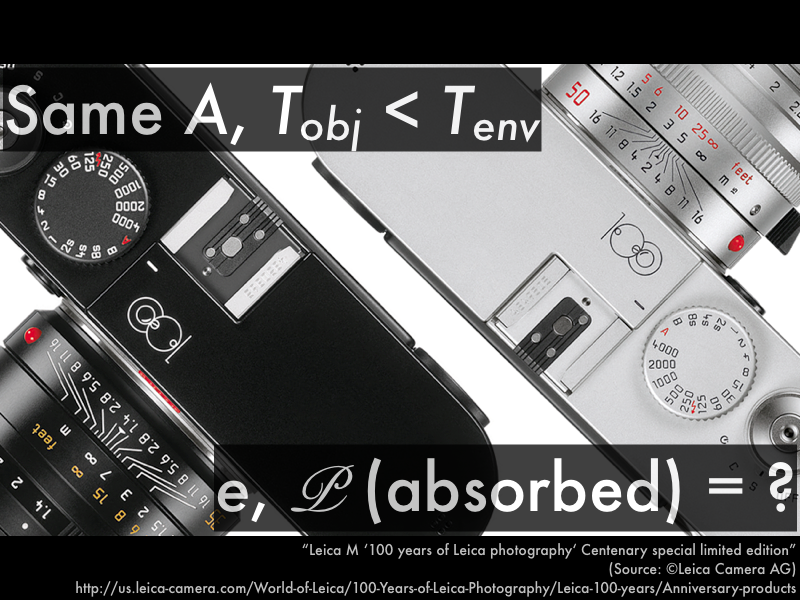
For these two Leica M cameras, if they are both cooler than the surrounding environment, both will begin to heat up by absorbing radiative heat (say, from the sun). The __________ model have a faster rate of heat absorbed per time.
black.  *************************** [27]
silver.  **** [4]
(There is a tie.)  [0]
(Unsure/guessing/lost/help!)  ** [2]

For these snowboarders, if they are warmer than the surrounding environment, they will begin to cool down by emitting radiative heat (say, to the overcast sky and the snowy landscape). The snowboarder wearing the __________ jacket will have a faster rate of heat radiated per time.
black.  ****************** [18]
silver.  *********** [11]
(There is a tie.)  ** [2]
(Unsure/guessing/lost/help!)  ** [2]

Ask the instructor an anonymous question, or make a comment. Selected questions/comments may be discussed in class.
"Everything progressively gets more interesting. I'm excited for Physics 205B!"

"As a welder I work with heat quite a bit."

"Is the zeroth law of thermodynamic is the equilibrium of temperatures?" (Yes. Surprisingly, it is not a trivial law.)

"Does heat always flow from high temperatures to low temperatures?" (Yes, all by itself. However, if you want heat to flow from low temperatures to high temperatures (in order to cool down your refrigerator, or use air conditioning to cool down your house), then you will need to spend energy in the form of work to move heat "opposite of the way it wants to go." Also heat pumps will move heat from low temperatures to high temperatures in order to extract energy from the cool environment to heat your house, but this again requires you to spend energy in the form of work to move heat "opposite of the way it wants to go.")

"You know me just a run down of the formulas would be greatttttt." (Mmmmkay.)

Online reading assignment: Milky Way history, big bang clues (NC campus)

Astronomy 210, fall semester 2017
Cuesta College, San Luis Obispo, CA

Students have a weekly online reading assignment (hosted by SurveyMonkey.com), where they answer questions based on reading their textbook, material covered in previous lectures, opinion questions, and/or asking (anonymous) questions or making (anonymous) comments. Full credit is given for completing the online reading assignment before next week's lecture, regardless if whether their answers are correct/incorrect. Selected results/questions/comments are addressed by the instructor at the start of the following lecture.

The following questions were asked on reading textbook chapters and previewing presentations on the history of the Milky Way and big bang clues, a comic strip adaptation of of Neil deGrasse Tyson's "The Most Astounding Fact" 2008 interview for TIME magazine, and Minute Physics' video explanation of Olbers' paradox.


Selected/edited responses are given below.

Describe something you found interesting from the assigned textbook reading or presentation preview, and explain why this was personally interesting for you.
"The discussion of the big bang theory was interesting because I enjoy listening to different ideas of how things came to be in the universe. It is the biggest mystery after all."

"How elements that make up life are elements of the universe and how it all just connects. I find it interesting because I never really thought about it that way."

"I didn't know that we are made out of star stuff. I found this interesting because it shows that the universe extends to all things not just planets and galaxies and such."

"I just think it's really interesting that the galaxy started off as just a ton of hydrogen gas and then all it took was something to set it off to start making heavier elements."

"How light from Deneb takes 1,400 years to travel to us. We are seeing Deneb in the past 1,400 years ago."

"I thought the big bang was interesting to read about seems kind of crazy to think about."

"That what we are looking at millions of light years away from us is technically in the past. I never thought of the universe like that and it's amazing and confusing at the same time."

"I never really gave it much thought on how we are all made from 'star stuff.' It makes a lot of sense since everything comes from supernova explosions."

"How to explain that the universe is finite is through the gaps that you see in between stars where there are no stars."

"I really like the video about why the night sky is dark. I just assumed it was pitch black because space just seems like empty nothingness other than the stars and galaxies out there but when you break it down and realize that since we are viewing stars in the past when we look to the farthest stars which are redshifted stars it makes sense that even further than that would be infrared stars which we obviously cannot see and also that there is still light left over from the big bang."

"I thought the look back time part of the reading was super cool. The idea that we are looking at something so far in the past because of the time it takes for light to travel."

"The idea of the expansion of the universe not being from a central point. It's interesting because it's hard to understand."

"'Lookback time.' For example you can see the Andromeda galaxy, the farthest object seen with naked eye, but the nearest galaxy to ours. This galaxy is 25.4 million light years away, which means it is 25.4 million years back into time that we are seeing, not how it currently looks. It takes 25.4 million years for the light to reach Earth."

"Globular clusters are so interesting to me. They contain 105 to 106 stars in a region only 10-30 parsecs in diamters. That is extremely crazy to think about. One star alone is already crazy in mass--imagine that many of them!"

Describe something you found confusing from the assigned textbook reading or presentation preview, and explain why this was personally confusing for you.
"Which elements were created by what, and how stars got the elements they have in the first place, because how does heat create everything when we don't know what few elements the universe started with?"

"I don't quite understand how the universe has an edge. I need more explanations on that."

"I personally found that metal-rich and metal-poor concepts to be confusing. Is it really just as simple as old stars are metal-poor whereas new ones are metal-rich?"

"Where does the carbon and calcium come from in our bodies?"

"how did the universe start out as mainly hydrogen."

"I didn't fully get the redshift with the expansion of space."

"I found the video confusing about how it explained how the night sky is both dark and light, I didn't fully understand the explanation."

"I kind of found the whole metal rich thing a bit confusing just because it says stars in the halo are apparently metal poor but stars in the disk are metal rich and some are even more metal rich than others."

"I am still unclear on the telling the difference between population I and II stars."

"How exactly are telescopes time machines?"

"Although I understand the concept of look back time and how the light we see is from the past. I don't understand how the images from a telescope are from the past. It makes sense, but it doesn't."

Indicate how the amount of these elements in the universe have changed over time.
(Only correct responses shown.)
Hydrogen: decreased [43%]
Metals (elements heavier than hydrogen and helium): increased [78%]

The outermost layers of __________ are more abundant in metals (elements heavier than hydrogen and helium).
extremely old stars that formed a long time ago.  ***** [5]
young stars that formed very recently.  ***************** [17]
(There is a tie.)  [0]
(Neither, as stars cannot have metals.)  [0]
(Unsure/guessing/lost/help!)  * [1]

Indicate what produced these elements.
(Only correct responses shown.)
Hydrogen in the sun's core: the very early universe [56%]
Helium in the sun's core: the sun [39%]
Carbon in your body: another star, in the past [35%]
Calcium in your bones: another star, in the past [35%]
Iron in your blood: another star, in the past [35%]
Gold and silver from mines: another star, in the past [26%]

Ask the instructor an anonymous question, or make a comment. Selected questions/comments may be discussed in class.
"How did our performance on the second midterm compare to previous years?" (You did pretty awesome. Keep it up!)

"Can we talk about how 'time travel' is related to things being millions of light years away?"

"Please go over the big bang more and elements in space."

"Since space is always expanding, would that make it impossible for it to get dirty from metals and dust?" (Even if space keeps expanding, on the local scale gravity keeps things together, so the galaxies (and everything else inside of it) stay more or less the same size.)

"Have you ever questioned what our existence is in the universe?" (I often do.)

"I don't believe in the 'big bang theory;' but I'm sure when God created the entire universe and everything in it in one week there was quite a big bang. It's interesting how the heavens declare the glory of God, and the firmament tells of his handiwork."

"Do you believe in the big bang and evolution?" (I think it's fair to say that I understand the evidence for both--and I think it's fair in this class to teach you and test your understanding of the evidence for both.)

20171204

Online reading assignment: internal energy conservation

Physics 205A, fall semester 2017
Cuesta College, San Luis Obispo, CA

Students have a bi-weekly online reading assignment (hosted by SurveyMonkey.com), where they answer questions based on reading their textbook, material covered in previous lectures, opinion questions, and/or asking (anonymous) questions or making (anonymous) comments. Full credit is given for completing the online reading assignment before next week's lecture, regardless if whether their answers are correct/incorrect. Selected results/questions/comments are addressed by the instructor at the start of the following lecture.

The following questions were asked on reading textbook chapters and previewing a presentation on internal energy conservation.


Selected/edited responses are given below.

Describe what you understand from the assigned textbook reading or presentation preview. Your description (2-3 sentences) should specifically demonstrate your level of understanding.
"I understand the concepts of heating and cooling. I am a little confused on the conservation of energy and how that looks/is applied. I am also a little confused on the visual representation of heat flow."

"As molecules move closer together (condensation or freezing), potential energy decreases, or increases as they move father apart (vaporizing, melting). I understanding that heat flows from higher temperatures to cooler temperatures, and that in an insulated system, the decrease in the internal energy of one object is equal to the increase in internal energy of the object(s) it is transferring to."

"Heat is based on the movement of the atoms of an object. Fast being 'hot' and slow being 'cold.' Heat energy can be transferred between two items until they reach temperature equilibrium. Cooling down is a decrease in thermal internal energy and heating up is an increase in thermal internal energy."

"Thermal internal energy of an object depends on atom movement. So if an atom is moving faster, then the thermal internal energy must be higher. Whereas if the thermal internal energy is lower, the atoms move much slower if at all. "

"I understand that if you ignore external factors, much like our other energy transfer equations, you may zero out the left side of the equation."

"This section is just a review for me because I have taken chemistry where we have covered internal energy conservation and the multiple ways to find it."

"I understand the concepts of heating and cooling. I am a little confused on the conservation of energy and how that looks/is applied. I am also a little confused on the visual representation of heat flow."

"The systems are in thermal equilibrium if no heat flows between them when they are connected by a path permeable to heat. Thermal equilibrium obeys the zeroth law of equilibrium."

Describe what you found confusing from the assigned textbook reading or presentation preview. Your description (2-3 sentences) should specifically identify the concept(s) that you do not understand.
"I just covered this material with a student that I am tutoring for general chemistry so thermochemistry is all very fresh!"

"All and all it made sense. I took chemistry last semester so this stuff is very similar to what I have learned."

"This seems straightforward so far. Unsure of the exact relationship between temperature and thermal energy, though."

"Thermal energies can find equilibrium with the objects that it interacts with. How can we find the point of equilibrium between multiple objects?"

"I find the transfer of internal energy a little confusing. I could use some review on thermal energy vs. heat."

"I have a small issue in the difference between in temperature and internal energy and how they're related."

"I do not understand the equations given in this section. Like always, I will review more before class and then come in prepared."

"Honestly there wasn't a lot I didn't understand since I've seen this before."

Two objects that are brought into contact with each other will reach thermal equilibrium when they have the same:
internal energy.   *********** [11]
temperature.   ************* [13]
(Both of the above choices.)   ************** [14]
(Neither of the above choices.)   [0]
(Unsure/lost/guessing/help!)   ** [2]

Raw seafood is placed on a block of salt that has already been heated up. The energy contained in the high-temperature block of salt is then transferred to the seafood, cooking it. While it is being cooked, the internal thermal energy of the seafood __________, while the thermal internal energy of the salt block __________.
increases; decreases.   *********************************** [35]
decreases; increases.   *** [3]
does not change; does not change.   * [1]
(Unsure/lost/guessing/help!)   * [1]

For the seafood cooking on the salt block (ignoring heat transfers with the environment), the object that experienced the greatest amount of change (increase or decrease) in thermal internal energy was the:
seafood.   ************** [14]
salt block.   ***** [5]
(There is a tie.)   ******************* [19]
(Unsure/lost/guessing/help!)   ** [2]

Frozen meat is placed in a water bath, in order to defrost it. At the very start of this defrosting process (where the frozen meat just begins to warm up from its below-freezing temperature, and the ice crystals inside have not yet reached the melting point), the internal thermal energy of the meat __________, while the thermal internal energy of the water __________.
increases; decreases.   ******************************* [31]
decreases; increases.   ******* [7]
does not change; does not change.   * [1]
(Unsure/lost/guessing/help!)   * [1]

For the frozen meat in the water bath (ignoring heat transfers with the environment), the object that experienced the greatest amount of change (increase or decrease) in thermal internal energy was the:
frozen meat.   ********** [10]
water bath.   ****** [6]
(There is a tie.)   ********************* [21]
(Unsure/lost/guessing/help!)   *** [3]

A shot of whiskey is mixed with a pint of beer to make a boilermaker. Assuming that the whiskey and beer have approximately the same temperature before they are mixed together, the internal thermal energy of the whiskey __________, while the thermal internal energy of the beer __________.
increases; decreases.   [0]
decreases; increases.   ***** [5]
does not change; does not change.   ********************************* [33]
(Unsure/lost/guessing/help!)   ** [2]

For the shot of whiskey being mixed with the pint of beer (ignoring heat transfers with the environment), the object that experienced the greatest amount of change (increase or decrease) in thermal internal energy was the:
shot of whiskey.   * [1]
pint of beer.   **** [4]
(There is a tie.)   ******************************* [31]
(Unsure/lost/guessing/help!)   **** [4]

Ask the instructor an anonymous question, or make a comment. Selected questions/comments may be discussed in class.
"I really like all the real-life examples you put in your lecture."

"I feel like this is the physics of cooking. Very cool."

"Whiskey/beer example review."

"Can you explain the whiskey/beer example in class, specifically what happens when two things are the same temperature?"

"Not sure how the whiskey/beer thing works. Is it a chemical reaction?"

"I have nothing interesting to add at the moment."

20171202

Astronomy midterm question: plausible IAU classification of 300163 (2006 VW139) before breaking apart?

Astronomy 210 Midterm 2, fall semester 2017
Cuesta College, San Luis Obispo, CA

An international team of astronomers recently discovered two asteroids with comet-like features orbiting each other in the asteroid belt:
NASA's Hubble Space Telescope helped an international team of astronomers find that an unusual object in the asteroid belt, designated 300163 (2006 VW139), is in fact two asteroids of almost the same mass and size, orbiting each other at a distance of 60 miles. They also have comet-like features, including a bright halo of material, called a coma, and a long tail of dust. Roughly 5,000 years ago, 300163 (2006 VW139) probably broke into these two pieces due to a fast rotation.[*]
Before it broke apart 5,000 years ago, discuss how 300163 (2006 VW139) might have been originally classified, using the International Astronomical Union classification scheme. Clearly state your assumptions about what properties 300163 (2006 VW139) might have had before it broke apart.

[*] J. Agarwal, "Comet or Asteroid? Hubble Discovers that a Unique Object is a Binary," hubblesite.org/news_release/news/2017-32.

Solution and grading rubric:
  • p:
    Correct. Discusses IAU classification scheme to argue that before breaking up 5,000 years ago:
    1. 300163 (2006 VW139) was in the asteroid belt, orbiting the sun, and thus could not have been a moon; and not having been able to gravitationally dominate its orbit by clearing asteroids out or pulling in asteroids into itself, could not have have been a planet (assuming that it had a rounded shape); and
    2. depending on whether its shape was irregular or rounded, it would have either been classified as solar system debris or a dwarf planet.
  • r:
    Nearly correct (explanation weak, unclear or only nearly complete); includes extraneous/tangential information; or has minor errors. May have instead discussed how the two components of 300163 (2006 VW139) today could be categorized in terms of the IAU classification scheme, instead of how it might have been categorized before breaking up 5,000 years ago.
  • t:
    Contains right ideas, but discussion is unclear/incomplete or contains major errors. Explicitly lists IAU requirements, but does not apply them correctly/consistently.
  • v:
    Limited relevant discussion of supporting evidence of at least some merit, but in an inconsistent or unclear manner. Discussion only tangentially related to the IAU classification scheme.
  • x:
    Implementation/application of ideas, but credit given for effort rather than merit. Discussion unrelated to the IAU classification scheme.
  • y:
    Irrelevant discussion/effectively blank.
  • z:
    Blank.
Grading distribution:
Section 70158
Exam code: midterm02Sm5n
p: 35 students
r: 4 students
t: 5 students
v: 2 students
x: 0 students
y: 0 students
z: 0 students

Section 70160
Exam code: midterm02nJv3
p: 23 students
r: 5 students
t: 3 students
v: 0 students
x: 0 students
y: 0 students
z: 0 students

A sample "p" response (from student 0987):

Another sample "p" response (from student 1796):

A sample "r" response (from student 1881), discussing the current classification of 300163 (2006 VW139) today:

Astronomy midterm question: apparent magnitude dimmer than absolute magnitude?

Astronomy 210 Midterm 2, fall semester 2017
Cuesta College, San Luis Obispo, CA

An astronomy question on an online discussion board[*] was asked:
Qu: If the distance to a star is 20 parsecs, and its absolute magnitude is +5.5, what is its apparent magnitude?
day: The apparent magnitude would be dimmer than +5.5.
Discuss whether this answer is correct or incorrect, and how you know this. Explain using the relationships between apparent magnitude, absolute magnitude, and distance.

[*] answers.yahoo.com/question/index?qid=20100615201717AAZwXu7.

Solution and grading rubric:
  • p:
    Correct. Understands difference between apparent magnitude m (brightness as seen from Earth, when placed at their actual distance from Earth) and absolute magnitude (M (brightness as seen from Earth, when placed at the "fair comparison distance" of 10 parsecs away). Discusses how this star with an absolute magnitude value of +5.5 (measured at 10 parsecs) will get dimmer when placed farther away to 20 parsecs, and thus its apparent magnitude will be dimmer than its absolute magnitude of +5.5. Then makes conclusion on correctness of response.
  • r:
    Nearly correct (explanation weak, unclear or only nearly complete); includes extraneous/tangential information; or has minor errors. As (p), but does not explicitly determine incorrectness of response.
  • t:
    Contains right ideas, but discussion is unclear/incomplete or contains major errors. At least discussion demonstrates understanding of relationships between apparent magnitudes, absolute magnitudes, and distances.
  • v:
    Limited relevant discussion of supporting evidence of at least some merit, but in an inconsistent or unclear manner. At least attempts to use relationships between apparent magnitudes, absolute magnitudes, and distances.
  • x:
    Implementation/application of ideas, but credit given for effort rather than merit. Discussion based on garbled definitions of, or not based on proper relationships between apparent magnitudes, absolute magnitudes, and distances.
  • y:
    Irrelevant discussion/effectively blank.
  • z:
    Blank.
Grading distribution:
Section 70158
Exam code: midterm02Sm5n
p: 27 students
r: 7 students
t: 10 students
v: 1 student
x: 1 student
y: 0 students
z: 0 students

A sample "p" response (from student 1027):

Astronomy midterm question: apparent magnitude brighter than absolute magnitude?

Astronomy 210 Midterm 2, fall semester 2017
Cuesta College, San Luis Obispo, CA

An astronomy question on an online discussion board[*] was asked:
Qu: If the distance to a star is 20 parsecs, and its absolute magnitude is +5.5, what is its apparent magnitude?
day: The apparent magnitude would be brighter than +5.5.
Discuss whether this answer is correct or incorrect, and how you know this. Explain using the relationships between apparent magnitude, absolute magnitude, and distance.

[*] answers.yahoo.com/question/index?qid=20100615201717AAZwXu7.

Solution and grading rubric:
  • p:
    Correct. Understands difference between apparent magnitude m (brightness as seen from Earth, when placed at their actual distance from Earth) and absolute magnitude (M (brightness as seen from Earth, when placed at the "fair comparison distance" of 10 parsecs away). Discusses how this star with an absolute magnitude value of +5.5 (measured at 10 parsecs) will get dimmer when placed farther away to 20 parsecs, and thus its apparent magnitude will be dimmer than its absolute magnitude of +5.5. Then makes conclusion on incorrectness of response.
  • r:
    Nearly correct (explanation weak, unclear or only nearly complete); includes extraneous/tangential information; or has minor errors. As (p), but does not explicitly determine incorrectness of response.
  • t:
    Contains right ideas, but discussion is unclear/incomplete or contains major errors. At least discussion demonstrates understanding of relationships between apparent magnitudes, absolute magnitudes, and distances.
  • v:
    Limited relevant discussion of supporting evidence of at least some merit, but in an inconsistent or unclear manner. At least attempts to use relationships between apparent magnitudes, absolute magnitudes, and distances.
  • x:
    Implementation/application of ideas, but credit given for effort rather than merit. Discussion based on garbled definitions of, or not based on proper relationships between apparent magnitudes, absolute magnitudes, and distances.
  • y:
    Irrelevant discussion/effectively blank.
  • z:
    Blank.
Grading distribution:
Section 70160
Exam code: midterm02nJv3
p: 24 students
r: 3 students
t: 3 students
v: 1 student
x: 0 students
y: 0 students
z: 0 students

A sample "p" response (from student 7237):

Astronomy midterm question: more luminous star redder than same-size less luminous star?

Astronomy 210 Midterm 2, fall semester 2017
Cuesta College, San Luis Obispo, CA

An astronomy question on an online discussion board[*] was asked and answered:
RC: Star X is more luminous than star Y, but they are the same size. Is star X redder or bluer than star Y?
BrT: Since they have the same size, because star X is more luminous it will be redder.
Discuss why this answer is incorrect, and how you know this. Explain using Wien's law, the Stefan-Boltzmann law and/or an H-R diagram.

[*] answers.yahoo.com/question/index?qid=20110203173510AAHqejO.

Solution and grading rubric:
  • p:
    Correct. Uses the Stefan-Boltzmann law and/or interprets H-R diagram to demonstrate that in order for two stars to have the same size, the more luminous star X must be hotter than the less luminous star Y, and from Wien's law "redder" corresponds to cooler temperatures, and thus star X cannot be redder than star Y.
  • r:
    Nearly correct (explanation weak, unclear or only nearly complete); includes extraneous/tangential information; or has minor errors.
  • t:
    Contains right ideas, but discussion is unclear/incomplete or contains major errors.
  • v:
    Limited relevant discussion of supporting evidence of at least some merit, but in an inconsistent or unclear manner. At least attempts to use Wien's law, the Stefan-Boltzmann law, and/or H-R diagram.
  • x:
    Implementation/application of ideas, but credit given for effort rather than merit. Discussion not clearly based on Wien's law, the Stefan-Boltzmann law, and/or H-R diagram.
  • y:
    Irrelevant discussion/effectively blank.
  • z:
    Blank.
Grading distribution:
Section 70158
Exam code: midterm02Sm5n
p: 29 students
r: 5 students
t: 9 students
v: 3 students
x: 0 students
y: 0 students
z: 0 students

Section 70160
Exam code: midterm02nJv3
p: 24 students
r: 2 students
t: 5 students
v: 0 students
x: 0 students
y: 0 students
z: 0 students

A sample "p" response (from student 8622), using a graphical "box method" to indicate relative quantities in the Stefan-Boltzmann law:

A sample "p" response (from student 1881), using an H-R diagram:

A sample "p" response (from student 1072), using both an H-R diagram and the "box method":

Physics midterm question: energy transfers for load-lowering winch

Physics 205A Midterm 2, fall semester 2017
Cuesta College, San Luis Obispo, CA

A load is attached to a cable that is wrapped around a cylindrical winch, which begins to rotate freely as the load drops downwards. From when the load is initially stationary to reaching a lower point (where it is moving with a downwards velocity), discuss why the change in gravitational potential energy of the load is:
  1. greater than the change in the rotational kinetic energy of the winch; and
  2. greater than the change in translational kinetic energy of the load.
Ignore friction/drag. Explain your reasoning using the properties of energy conservation.

Solution and grading rubric:
  • p:
    Correct. Discusses/demonstrates that for this initial-to-final process:
    1. the gravitational potential energy of the load decreases (as its final height is lower than its initial height); and
    2. the rotational kinetic energy of the winch increases (as it has a final angular speed, compared to being initially at rest); and
    3. the translational kinetic energy of the load increases (as it has a final speed, compared to being initially at rest); and
    4. since there is no external work done on/by this system (as friction/drag is to be ignored); then
    5. from the transfer/balance energy conservation equation, the change in the gravitational potential energy of the load must be equal to the sum of the changes of the other two energy forms (rotational kinetic energy of the winch and translational kinetic energy of the load), and thus must have a greater change than either of those two forms.
  • r:
    Nearly correct, but includes minor math errors.
  • t:
    Nearly correct, but approach has conceptual errors, and/or major/compounded math errors. At least understands how all three energy forms are related to each other from the transfer/balance energy conservation equation.
  • v:
    Implementation of right ideas, but in an inconsistent, incomplete, or unorganized manner. Some garbled attempt at applying energy conservation.
  • x:
    Implementation of ideas, but credit given for effort rather than merit. Approach other than that of applying energy conservation.
  • y:
    Irrelevant discussion/effectively blank.
  • z:
    Blank.
Grading distribution:
Sections 70854, 70855
Exam code: midterm02bu2Z
p: 37 students
r: 3 students
t: 6 students
v: 4 students
x: 0 students
y: 0 students
z: 0 students

A sample "p" response (from student 7164):

Physics midterm question: tension in cable lowering a boom crane

Physics 205A Midterm 2, fall semester 2017
Cuesta College, San Luis Obispo, CA

A cable anchored to a wall suspends a uniform beam, which can either be held 40° above the horizontal, or 40° below the horizontal. (Calculate all torques with respect to the pivot, located at the base of the beam.) Discuss why there is less tension in the cable when the beam is held 40° above the horizontal, compared to when it is held 40° below the horizontal. Explain your reasoning using diagram(s) with locations of forces and perpendicular lever arms, the properties of torques, and Newton's laws.

Solution and grading rubric:
  • p:
    Complete free-body diagrams with forces and perpendicular lever arms, and discusses/demonstrates:
    1. for either case (40° above or below the horizontal), the ccw cable tension torque = ℓTT and cw weight torque = ℓww; and
    2. since Newton's first law for rotations applies to both cases, the ccw cable tension torque equals the cw weight torque such that ℓTT = ℓww; and
    3. the perpendicular lever arm ℓw and the weight force is the same for both cases, where ℓw = (L/2)·cos40° and w = mg; and
    4. since the cw weight torque is the same for both cases, the ccw cable tension torque is also the same for both cases; and
    5. the first case (40° above the horizontal) has a larger perpendicular lever arm ℓT, such that its tension T has a smaller magnitude compared to the second case (40° below the horizontal), with a smaller perpendicular lever arm ℓT, such that its tension T has a greater magnitude. Must at least clearly draw these ℓT lever arms to compare their relative lengths.
  • r:
    As (p), but argument indirectly, weakly, or only by definition supports the statement to be proven, or has minor inconsistencies or loopholes. May have incorrect or missing cable lever arm.
  • t:
    Nearly correct, but argument has conceptual errors, or is incomplete. Has at least three of the (1)-(5) steps above.
  • v:
    Limited relevant discussion of supporting evidence of at least some merit, but in an inconsistent or unclear manner. Some garbled attempt at applying Newton's first law to torques, forces, and perpendicular lever arms.
  • x:
    Implementation of ideas, but credit given for effort rather than merit. Approach other than that of applying Newton's first law to torques, forces, and perpendicular lever arms.
  • y:
    Irrelevant discussion/effectively blank.
  • z:
    Blank.
Grading distribution:
Sections 70854, 70855
Exam code: midterm02bu2Z
p: 14 students
r: 3 students
t: 20 students
v: 10 students
x: 3 students
y: 0 students
z: 0 students

A sample "p" response (from student 2635):

20171201

Physics midterm question: anchored foam block with rising water level

Physics 205A Midterm 2, fall semester 2017
Cuesta College, San Luis Obispo, CA

A foam block is anchored by a string to the bottom of a container of water. As more water is poured into this container, discuss why the tension in the string increases. (Ignore any stretching of the length of the string, such that the block remains at the same level while the water level rises.) Explain your reasoning using the properties of densities, volumes, forces, Newton's laws, Archimedes' principle (buoyant forces), and free-body diagrams.

Solution and grading rubric:
  • p:
    Correct. Recognizes that:
    1. the block has three vertical forces acting on it:
      Weight force of Earth on block (downwards, magnitude w = mg),
      Tension force of container on block (downwards, magnitude T),
      Buoyant force of water on block (upwards, magnitude FB = ρwatergVsub = ρwaterg⋅(0.50⋅Vblock); and
    2. because the block is stationary in the vertical direction, the sum of the two downwards forces is equal and opposite in direction to the upwards force due to Newton's first law; and
    3. as more water is poured into the container, the volume of the block that is submerged increases, increasing the amount of upwards buoyant force of water on the block from FB = ρwaterg⋅(0.50⋅Vblock) to ρwaterg⋅(0.75⋅Vblock); such that
    4. the downwards tension force of the container on the block must also increase (as the weight force remains constant), in order for the two downwards forces to still balance out the increase in the upwards force on the block.
    May either draw a free-body diagram, and/or discuss these forces and Newton's laws in words.
  • r:
    As (p), but argument indirectly, weakly, or only by definition supports the statement to be proven, or has minor inconsistencies or loopholes. Excludes weight force, or adds extraneous normal force, but still recognizes why buoyant force increases, thus increasing the tension force.
  • t:
    Nearly correct, but argument has conceptual errors, or is incomplete. Excludes weight force and adds extraneous normal force.
  • v:
    imited relevant discussion of supporting evidence of at least some merit, but in an inconsistent or unclear manner. Some constructive attempt at relating the buoyant force to the density of the fluid and volume displaced (Archimedes' principle) and/or Newton's first law.
  • x:
    Implementation/application of ideas, but credit given for effort rather than merit. Appeals to some other properties of fluids and densities other than Archimedes' principle and Newton's laws.
  • y:
    Irrelevant discussion/effectively blank.
  • z:
    Blank.
Grading distribution:
Sections 70854, 70855
Exam code: midterm02bu2Z
p: 30 students
r: 16 students
t: 4 students
v: 0 students
x: 0 students
y: 0 students
z: 0 students

A sample "p" response (from student 1902):

Another sample "p" response (from student 7164):