20141203

Physics presentation: heat transfer applications

Let's now shift gears and preview the various heat transfer phenomena you will be investigating during the last laboratory of this semester: convection, conduction, and radiation.

A Cooper Cooler™, where beverages are spun while being sprayed with ice water:
"The Cooper Cooler™ chills beverages on demand forty times faster than a freezer. So that means you can chill a bottle of wine in six minutes, and your sodas in one minute... And because it's spinning and not shaking your carbonated beverages, you don't have to worry about them exploding."
If you choose, you can investigate whether these claims are valid with an actual Cooper Cooler™! (Video link: "Cooper Cooler - Rapid Beverage Cooler.")

Or Coffee Joulies™:
"Fresh coffee is often too hot to drink when it's first brewed. This is especially true when you throw it in your insulated travel mug and you head out to work, and you're waiting and you're waiting for it to cool down enough and you carry it around and you can't even drink your coffee..."

"[Coffee Joulies™ are] shaped like giant coffee 'beans' made of stainless steel. You just drop these in your hot coffee, one 'bean' for every four ounces of coffee, and it cools right down to 140° in a few seconds, that's the perfect temperature for drinking. Then the Coffee Joulies™ hold your coffee at that temperature so you can take your time and enjoy it."

"The secret is inside--there's a proprietary substance that's encapsulated inside the steel 'beans' and it's called a phase-change material. This one has a melting temperature of exactly 140°, so when you put it in your hot coffee, it absorbs the heat, cooling all the coffee around it, so it's completely liquid inside the steel 'bean.' Then the phase-change material slowly releases that heat back into the coffee until it becomes a solid again. And in our tests, they kept coffee at 140° for two full hours..."
Again, in laboratory, you can choose to investigate these claims--however, not with actual Coffee Joulies™ (they're somewhat pricey), but with packets containing the same phase-change substance (food-grade sodium acetate). (Video link: "Coffee Temperature Regulator.")

And reflective "space blankets," used in emergency survival situations to retain body warmth:
"This thermal sheet functions by reflecting your body heat back to you. If you wrap it around yourself while already freezing, it will be in vain."

"Also when using only a space blanket (with just a tank top and shorts), as the snow lands on your shoulders it will immediately drive the heat from your body. In an actual snowfall, you must have insulation (jacket and pants) between you and the blanket to minimize this."
You can also choose to investigate the most effective use of space blankets. (Video link: "SOL Emergency Heatsheet/Blanket Review in Snow.")

20141202

Online reading assignment: heat transfers

Physics 205A, fall semester 2014
Cuesta College, San Luis Obispo, CA

Students have a weekly online reading assignment (hosted by SurveyMonkey.com), where they answer questions based on reading their textbook, material covered in previous lectures, opinion questions, and/or asking (anonymous) questions or making (anonymous) comments. Full credit is given for completing the online reading assignment before next week's lecture, regardless if whether their answers are correct/incorrect. Selected results/questions/comments are addressed by the instructor at the start of the following lecture.

The following questions were asked on reading textbook chapters and previewing a presentation on heat transfers.


Selected/edited responses are given below.

Describe what you understand from the assigned textbook reading or presentation preview. Your description (2-3 sentences) should specifically demonstrate your level of understanding.
"Conduction is heat transferred through an object, convection is heat circulating through the air, and radiation is heat transported through light."

"It makes sense that heat per time flows from high to low and is inversely proportional to thermal resistance, and proportional to the difference in temperature. The lava lamp made sense to me about the globules moving upwards because the light bulb is at the bottom, and then they come back down because they are wax and they cool down and increase their density which brings them back down."

"I don't understand anything from the reading."

Describe what you found confusing from the assigned textbook reading or presentation preview. Your description (2-3 sentences) should specifically identify the concept(s) that you do not understand.
"The idea of 'radiation.' When I think of this, I think of heat being radiated directly off a surface, such a heat from a spacecraft going into space. But it seems that radiation in this context only refers to heat transfer in the form of light."

"I found emissivity confusing and why e = 0 or why e = 1 and what the constant in the equation for Stefan's law is when we are told what emissivity equals depending on whether it is a blackbody or silverbody."

"Possibly all of the material. I was unable to get to the reading, so I am not completely sure."

"I believe I have understood everything!"

In order to maximize the thermal resistance of these exterior walls, should the following parameters be minimized, maximized (or has no effect)?
(Only correct responses shown.)
insulation thickness d: maximize [80%]
insulation conductivity κ: minimize [52%]
Total surface area A exposed to the outdoors: minimize [59%]

In order to minimize the amount of heat flowing per time through these exterior walls, should the following parameters be minimized, maximized (or has no effect)?
(Only correct responses shown.)
temperature difference ∆T between indoors and outdoors: minimize [70%]
thermal resistance R of the walls: maximize [67%]

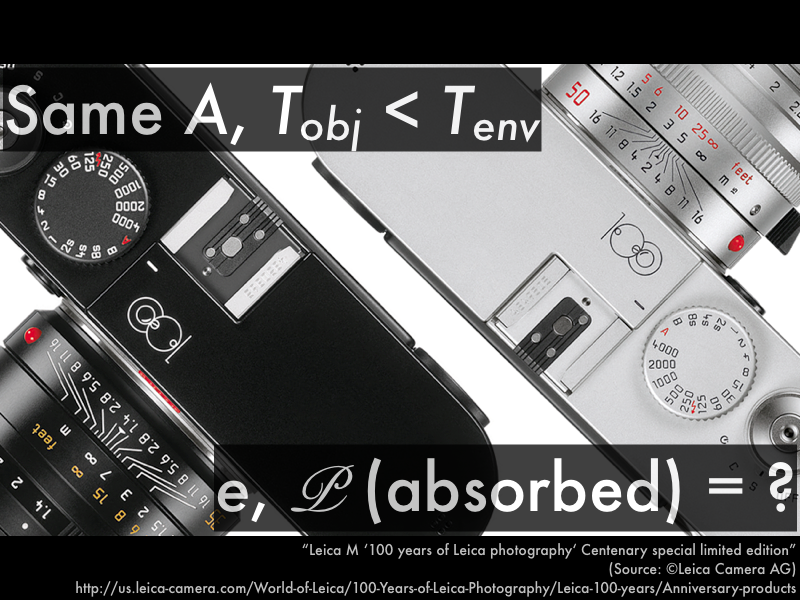
For these two Leica M cameras, if they are both cooler than the surrounding environment, both will begin to heat up by absorbing radiative heat (say, from the sun). The __________ model have a faster rate of heat absorbed per time.
black.  ******************************************** [44]
silver.  ** [2]
(There is a tie.)  ** [2]
(Unsure/guessing/lost/help!)  ****** [6]

For these snowboarders, if they are warmer than the surrounding environment, they will begin to cool down by emitting radiative heat (say, to the overcast sky and the snowy landscape). The snowboarder wearing the __________ jacket will have a faster rate of heat radiated per time.
black.  ************************** [26]
silver.  ************ [12]
(There is a tie.)  ***** [5]
(Unsure/guessing/lost/help!)  *********** [11]

Ask the instructor an anonymous question, or make a comment. Selected questions/comments may be discussed in class.
"Stefan's law looks like one giant cluster of confusion to me." (I will try to unconfuse it for you.)

"Where is there an additional negative sign in Stefan's law?" (In order to make this equation consistent with heat being added to an object when it absorbs light (positive heat flow), and heat being removed from an object when it emits light (negative heat flow).)

"Is power in watts defined the same as electrical watts? (Like, my hair dryer is 1,875 watts, are they the same?)" (Yes, watts measures the output of joules of energy per time. So compare the forced convection heat output of your hair dryer to the radiative output of say, a 100 watt light bulb! Hair gotta dry.)

"Why does color affect absorption so much?" (A silverbody has surface atoms and bonds with few available electron energy level spacings to absorb or give off photons, so there is no way to readily convert light into thermal energy, but this also means that there is no way to readily convert thermal energy into light. A blackbody has surface atoms and bonds with many available electron energy level spacings that can absorb or emit photons, so it can readily convert light into thermal energy, and also readily convert thermal energy into light.)

"Damn, I need to go snowboarding again." (Just don't be one of those snowboarders that sits down in the middle of the run for a smoke break. I hate those guys.)

Online reading assignment: Milky Way history, big bang clues (NC campus)

Astronomy 210, fall semester 2014
Cuesta College, San Luis Obispo, CA

Students have a weekly online reading assignment (hosted by SurveyMonkey.com), where they answer questions based on reading their textbook, material covered in previous lectures, opinion questions, and/or asking (anonymous) questions or making (anonymous) comments. Full credit is given for completing the online reading assignment before next week's lecture, regardless if whether their answers are correct/incorrect. Selected results/questions/comments are addressed by the instructor at the start of the following lecture.

The following questions were asked on reading textbook chapters and previewing presentations on the history of the Milky Way and big bang clues, a comic strip adaptation of of Neil deGrasse Tyson's "The Most Astounding Fact" 2008 interview for TIME magazine, and Minute Physics' video explanation of Olbers' paradox.


Selected/edited responses are given below.

Describe something you found interesting from the assigned textbook reading or presentation preview, and explain why this was personally interesting for you.
"The fact that older stars born a long time ago will be metal-poor, it doesn't confuse but rather makes sense as the older stars will not have hardly any metal to speak of other than the little amount they have themselves while newer stars are born into a rich metal landscape."

"That the atoms in our bodies come from stars."

"That space is dark because of the redshift of stars moving far away."

"The fact that we live in the remains of the big bang is awesome. I used to picture the big bang as occurring in a particular place, but reading the textbook helped me understand how wrong that notion is."

"'The universe is inside us.' I thought that my high school teachers were just saying we were made of stars to keep our interest. But I guess its actually true, in a way."

"How we are technically looking at super-super-old light through telescopes. It's a little confusing though."

"I'm super-interested in the expansion of space without the actual movement of the galaxies because I previously didn't understand how all galaxies could be moving away from each other. This made me science-happy."

"Olbers' Paradox is really cool it really solidifies the beginning of the universe since some light hasn't reached us yet. It's crazy."

Describe something you found confusing from the assigned textbook reading or presentation preview, and explain why this was personally confusing for you.
"Bottom-up model versus the monolithic collapse model because I can't conceptualize the idea of it all."

"The whole idea of metals being the way we found out how old the universe really is was kind of confusing because what started this process of metal fusion and supernovas in the first place?"

"Lookback time."

"The Hubble law--I just don't get it."

Indicate how the amount of these elements in the universe have changed over time.
(Only correct responses shown.)
Hydrogen: decreased [42%]
Metals (elements heavier than hydrogen and helium): increased [81%]

The outermost layers of __________ are more abundant in metals (elements heavier than hydrogen and helium).
extremely old stars that formed a long time ago.  ********* [9]
young stars that formed very recently.  ************** [14]
(There is a tie.)  [0]
(Neither, as stars cannot have metals.)  ** [2]
(Unsure/guessing/lost/help!)  * [1]

Indicate what produced these elements.
(Only correct responses shown.)
Helium in the sun's core: the sun [7%]
Carbon in your body: another star, in the past [46%]
Calcium in your bones: another star, in the past [38%]
Iron in your blood: another star, in the past [54%]
Gold and silver from mines: another star, in the past [31%]

People breaking up a relationship are most likely to update their Facebook status to "single":
on Valentine's Day.  ******* [7]
during spring break.  *********** [11]
just after Thanksgiving.  * [1]
on Christmas Day.  [0]
(Unsure/guessing/lost/help!)  ******* [7]

Ask the instructor an anonymous question, or make a comment. Selected questions/comments may be discussed in class.
"How can we possibly map out our Milky Way galaxy with all the dust we would have to look through?" (We just need to look at infrared and radio waves, which easily pass through interstellar gas and dust.)

"You're most likely to see 'single' FB status updates a few days before the Mid-State Fair starts during the summer."

"So, if we see a star 25 light-years away dying...it technically died 25 years ago?" (Yes. Like if you received a postcard from your significant other breaking up with you, then your significant other actually broke up with you a few days ago.)

"When we die, will the some of the atoms from our body ever go back into space and be part of stars again or will they all remain on Earth?" (They will all remain on Earth. Unless you launch your body into space, or wait long enough for the sun to swallow Earth up as a red giant, and what remains of Earth dissipates outwards as the sun goes through its planetary nebula phase.)

"Do most of your students believe in the big bang?" (Well, I would much rather you all understand how the evidence for the big bang is interpreted, which is something I can test you on; rather than whether you believe in the big bang, which is something I can't test you on.)

20141201

Physics presentation: heat transfers

Oh, chocolate bunny, how do I love thee? Let me count the ways: conduction, convection, radiation. (Video link: "Chocolade Haas (Chocolate Bunny)."

In a previous presentation, we considered what happens to an object when heat is transferred into, or out of it. Here we will look more closely at the transfers themselves, that is, how thermal energy is transferred.

First, conduction, where heat is transferred through an object.

This house is shown in visible wavelengths on the left side of the image, and in infrared wavelengths on the right side of the image, where we can see that while the walls of the house are not allowing much heat to pass through them, there is quite a bit heat exiting the house through the windows.

The power (amount of heat conducted per time, in units of joules/second, or watts) through a wall is proportional to the temperature difference ∆T on either side (as per the zeroth law of thermodynamics, heat flows from high to low temperatures), and inversely proportional to the thermal resistance R of the object, which is a measure of how difficult it is for heat to flow per time through it:

R = d/(κ·A),

where the resistance is proportional to the thickness d of the material, and inversely proportional to the exposed surface area A and the material-dependent conductivity κ (lower-case Greek letter "kappa," in units of watts/m·K), which characterizes how well this material allows (or does not allow) heat to flow through it.

In order to minimize the amount of heat flowing per time through these exterior walls, the thermal resistance R of the insulation installed should be maximized--by having a large or small conductivity κ value? A small or large insulation thickness d? Should the walls be constructed with a small or large surface area A?

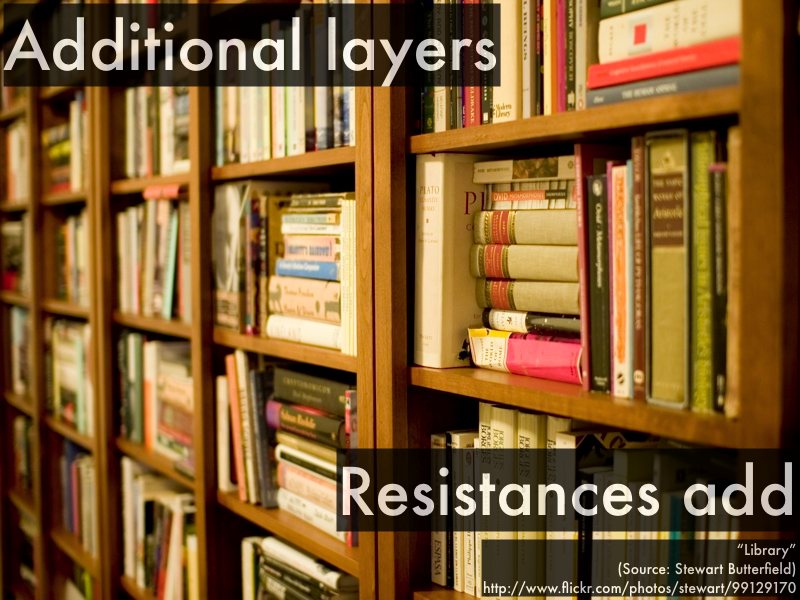
If an additional layer is added to existing insulation, such as this wall-spanning bookcase full of books, then the overall thermal resistance of the bookcase and insulation layer in the wall would be the sum of their individual resistances:

Rtotal = Rwall + Rbooks,

Rtotal = (dwall/(κwall·Awall)) + (dbooks/(κbooks·Abooks)),

where presumably the shared area A of the wall and the bookcase is the same value, but they have different d thicknesses and κ conductivities. The resulting power (heat flow per time) through the book layer and wall insulation is then:

Power = (heat flow)/time = ∆T/Rtotal.

Second, convection, the transport of heat via circulating air. We will just discuss this qualitatively, in contrast to conduction and later, radiation.

Natural convection is where a fluid (liquid or gaseous) will circulate and transport thermal energy from a high temperature to a low temperature region (again, the zeroth law of thermodynamics). In this lava lamp, there is a light bulb heating up these wax globules from below. As the wax globules heat up and expand, their density decreases relative to the clear solvent, and subsequently rise upwards. At the top of the lava lamp, the wax globules cool down and contract, such that their density increases relative to the clear solvent, and subsequently begin to sink. Notice that thermal energy is not being conducted from bottom to top through a static substance, it is being "carried" within the rising globules. (Video link: "080913-1050512.")

You can also transport thermal energy via forced convection, where instead of the fluid circulating naturally due to relative changes in buoyancy, it is forced to carry off thermal energy, typically by blowing across the surface of hot soup.

Third, radiation, where heat is transported in the form of light.

Stefan's law of radiation quantitatively describes the power, or net amount of heat transferred in the form of light to/from an object, which is depends on the difference of the fourth powers of the object's surrounding environment temperature and the temperature of the object itself (in kelvin), the total surface area A of the object, and the emissivity e of the object. Note the obligatory numerical constant σ.

In order to be consistent with all the other definitions of heat flow in this course, a negative sign must be put in to the version of the equation that is given in your textbook. Since a positive heat flow per time is energy being put into the object from the environment, this occurs if the temperature Tenv of the surrounding environment is greater than the object's temperature Tobj. A negative heat flow per time is energy being taken from the object out to the environment, so the temperature Tenv of the surrounding environment must be less than the object's Tobj temperature.

A blackbody is an object that is good at absorbing heat transferred in the form of light. But radiation is a two-way street, so an object that is good at absorbing heat will also be good at emitting heat. This is why objects that are meant to cool off efficiently by radiating (or heat up efficiently by absorbing) light are painted black--here, the entire surface of this SR-71 Blackbird. A perfect blackbody has an emissivity e = 1.

In contrast, a silverbody is an object that is good at reflecting light (and poor at absorbing heat in the form of light). Again, radiation is a two-way street, so an object that is poor at absorbing heat will also be poor at emitting heat. Here this early NASA communication satellite will efficiently reflect light, but will also be very inefficient at radiating heat should it get too hot. A perfect silverbody has an emissivity e = 0.

For these two Leica M cameras, if they are both cooler than the surrounding environment, both will begin to heat up by absorbing radiative heat (say, from the sun). Which will have a faster rate of heat absorbed per time--the black model, or the silver model?

For these snowboarders, if they are warmer than the surrounding environment, they will begin to cool down by emitting radiative heat (say, to the overcast sky and the snowy landscape). Which snowboarder will have a faster rate of heat radiated per time--the snowboarder with the black jacket, or the white jacket?

Online reading assignment: internal energy conservation

Physics 205A, fall semester 2014
Cuesta College, San Luis Obispo, CA

Students have a weekly online reading assignment (hosted by SurveyMonkey.com), where they answer questions based on reading their textbook, material covered in previous lectures, opinion questions, and/or asking (anonymous) questions or making (anonymous) comments. Full credit is given for completing the online reading assignment before next week's lecture, regardless if whether their answers are correct/incorrect. Selected results/questions/comments are addressed by the instructor at the start of the following lecture.

The following questions were asked on reading textbook chapters and previewing a presentation on internal energy conservation.


Selected/edited responses are given below.

Describe what you understand from the assigned textbook reading or presentation preview. Your description (2-3 sentences) should specifically demonstrate your level of understanding.
"The thermal internal energy of an object is based on the movement of the atoms of the object. The faster the atoms move, the higher the thermal internal energy of the object. As objects heat up the bonds that hold the object together can break apart, examples of this are ice melting, or water evaporating. Heat will travel from one object to another in an attempt to create an equilibrium."

"Thermal internal energy is dependent on temperature. If there is no energy transferred into or out of the thermal internal energy of a system, then it is effectively thermally isolated from the environment, and the heat exchanged between the system and the external environment is zero."

"Internal energy conservation, or where chemists and physicists throw down. Physicists are concerned with energy changes due to transfer of energy between systems."

"We went over Q = m·c·∆T. I also learned you could cook seafood on a large and heated salt block."

"Thanksgiving week took a toll."

Describe what you found confusing from the assigned textbook reading or presentation preview. Your description (2-3 sentences) should specifically identify the concept(s) that you do not understand.
"I didn't get how °C and K could be used interchangeably for heat capacity and specific heat. I do not understand the reason of 'only temperature changes are involved.'"

"I am confused about how to use the equations. I understand the concepts of the heat and energy but am confused about how to relate them to their equations."

"I found the transfer/ balance equation to be a little confusing when trying to apply it to the examples in the presentation. The example about seafood, in particular, was confusing because I thought that if the seafood was getting hotter (from the block) then it is gaining internal thermal energy and then the block would be losing it. But why are we not concerned with the energy lost to the environment? And I don't understand how to determine which one loses more energy."

"I am confused on in which object would have the most amount of change when involving two objects at different temperatures. I am pretty sure that they would each have the same amount of internal energy change since they are transferring the energy to each other, but I am not sure if this is the same if two objects have the same temperature."

Two objects that are brought into contact with each other will reach thermal equilibrium when they have the same:
internal energy.   ******** [8]
temperature.   *********************** [23]
(Both of the above choices.)   ********************* [21]
(Neither of the above choices.)   [0]
(Unsure/lost/guessing/help!)   ***** [5]

Raw seafood is placed on a block of salt that has already been heated up. The energy contained in the high-temperature block of salt is then transferred to the seafood, cooking it. While it is being cooked, the internal thermal energy of the seafood __________, while the thermal internal energy of the salt block __________.
increases; decreases.   ************************************************** [50]
decreases; increases.   ** [2]
does not change; does not change.   [0]
(Unsure/lost/guessing/help!)   ***** [5]

For the seafood cooking on the salt block (ignoring heat transfers with the environment), the object that experienced the greatest amount of change (increase or decrease) in thermal internal energy was the:
seafood.   ********************* [21]
salt block.   *** [3]
(There is a tie.)   ************************** [26]
(Unsure/lost/guessing/help!)   ******* [7]

Frozen meat is placed in a water bath, in order to defrost it. At the very start of this defrosting process (where the frozen meat just begins to warm up from its below-freezing temperature, and the ice crystals inside have not yet reached the melting point), the internal thermal energy of the meat __________, while the thermal internal energy of the water __________.
increases; decreases.   **************************************** [40]
decreases; increases.   ********* [9]
does not change; does not change.   ** [2]
(Unsure/lost/guessing/help!)   ****** [6]

For the frozen meat in the water bath (ignoring heat transfers with the environment), the object that experienced the greatest amount of change (increase or decrease) in thermal internal energy was the:
frozen meat.   **************** [16]
water bath.   ************ [12]
(There is a tie.)   ********************** [22]
(Unsure/lost/guessing/help!)   ******* [7]

A shot of whiskey is mixed with a pint of beer to make a boilermaker. Assuming that the whiskey and beer have approximately the same temperature before they are mixed together, the internal thermal energy of the whiskey __________, while the thermal internal energy of the beer __________.
increases; decreases.   ** [2]
decreases; increases.   **** [4]
does not change; does not change.   ******************************************* [43]
(Unsure/lost/guessing/help!)   ******** [8]

For the shot of whiskey being mixed with the pint of beer (ignoring heat transfers with the environment), the object that experienced the greatest amount of change (increase or decrease) in thermal internal energy was the:
shot of whiskey.   ****** [6]
pint of beer.   ** [2]
(There is a tie.)   **************************************** [40]
(Unsure/lost/guessing/help!)   ********* [9]

Ask the instructor an anonymous question, or make a comment. Selected questions/comments may be discussed in class.
"Why is it that the bond internal energy increases when the bonds are broken? And why does it decrease when the bonds are closer? Using the analogy, doesn't a spring have greater elastic potential energy when it's compressed?" (That's true for compressing springs shorter than their equilibrium distance, but starting with the bond distances between atoms at absolute zero, adding energy to these bonds (increasing their temperature) will increase their separation distances. Add enough energy, then these bonds will be stretched enough to break apart.)

"I'm not sure which objects lose or gain more thermal energy. If we ignore the environment will they each have an equal amount of change?" (Yes, if there are only two thermal internal energy terms in the transfer/balance equation.)

"Does thermal energy go down when temperature goes up?" (No.)

"In order to have a change in temperature, there must be a transfer of energy between systems. Considering that, is there a way to absolutely isolate a system to prevent zero energy transfer?" (It is not possible to completely, thermally isolate a system from its environment. But you can get pretty close.)

"How we are supposed to determine which object experiences the greatest amount of decrease in thermal internal energy if we are not given any set numbers?" (With physics. Which we'll do in class today.)

"Heating and cooling is obviously the only way that thermal internal energy can be added or removed right?" (Yes, whether exchanging heat with the environment, or with another object in contact with it.)

"Excited to see how physics is applied to what chemistry has taught me about thermal energy."

"This presentation made me hungry." (My job is done.)

"Is the final cumulative of everything we have learned so far? What concepts will be on the final?" (Yes, but there will only be seven questions, so there will only be seven concepts to study for. Wait until next week for the study guide to be posted.)

"Are we going to do an experiment involving boilermakers this week?" (I already did, last week. After I graded your midterms.)

20141128

Astronomy current events question: CIBER observations of cosmic light

Astronomy 210L, fall semester 2014
Cuesta College, San Luis Obispo, CA

Students are assigned to read online articles on current astronomy events, and take a short current events quiz during the first 10 minutes of lab. (This motivates students to show up promptly to lab, as the time cut-off for the quiz is strictly enforced!)
Kathy Svitil, "Caltech Rocket Experiment Finds Surprising Cosmic Light," (November 6, 2014)
http://www.caltech.edu/content/caltech-rocket-experiment-finds-surprising-cosmic-light
CalTech's Cosmic Infrared Background Experiment (CIBER) mission used suborbital rockets to observe light from:
(A) matter falling into supermassive black holes.
(B) stray stars between galaxies.
(C) the aurora borealis.
(D) active solar flares.
(E) volcanic greenhouse gas emissions.

Correct answer: (B)

Student responses
Sections 70178, 70186
(A) : 6 students
(B) : 21 students
(C) : 4 students
(D) : 6 students
(E) : 1 student

Astronomy current events question: Philae lander in hibernation

Astronomy 210L, fall semester 2014
Cuesta College, San Luis Obispo, CA

Students are assigned to read online articles on current astronomy events, and take a short current events quiz during the first 10 minutes of lab. (This motivates students to show up promptly to lab, as the time cut-off for the quiz is strictly enforced!)
European Space Agency press release, "Pioneering Philae Completes Main Mission before Hibernation," (November 15, 2014)
http://www.esa.int/Our_Activities/Space_Science/Rosetta/Pioneering_Philae_completes_main_mission_before_hibernation
The European Space Agency lander Philae was put into hibernation on Comet 67P/Churyumov–Gerasimenko due to:
(A) not enough sunlight on its solar panels.
(B) burying itself in a snowbank.
(C) an unsuccessful software reboot.
(D) problems with overheating.
(E) impending solar flares.

Correct answer: (A)

Student responses
Sections 70178, 70186
(A) : 28 students
(B) : 2 students
(C) : 4 students
(D) : 1 student
(E) : 4 students

Astronomy current events question: HL Tau protoplanets

Astronomy 210L, fall semester 2014
Cuesta College, San Luis Obispo, CA

Students are assigned to read online articles on current astronomy events, and take a short current events quiz during the first 10 minutes of lab. (This motivates students to show up promptly to lab, as the time cut-off for the quiz is strictly enforced!)
Charles E. Blue, "Birth of Planets Revealed in Astonishing Detail in ALMA's 'Best Image Ever,'" (November 6, 2014)
https://public.nrao.edu/news/pressreleases/planet-formation-alma
The Atacama Large Millimeter/submillimeter Array (ALMA) imaged planets forming around the star HL Tau, using wavelengths longer than visible light that are:
(A) absorbed by young protostars.
(B) emitted by residual photons.
(C) unaffected by Earth's atmosphere.
(D) resistant to redshifting.
(E) not blocked by gas and dust.

Correct answer: (E)

Student responses
Sections 70178, 70186
(A) : 7 students
(B) : 7 students
(C) : 4 students
(D) : 3 students
(E) : 16 students

Physics midterm question: Roman catapulta replica

Physics 205A Midterm 2, fall semester 2014
Cuesta College, San Luis Obispo, CA

Cf. Giambattista/Richardson/Richardson, Physics, 2/e, Comprehensive Problem 6.87

"Huge Roman Catapulta—'Tod's Stuff' was Head of Engineering"
Tod Todeschini
youtu.be/CgNlPOMOps0

A replica of a Roman catapulta was constructed for a TV show[*], using stored elastic potential energy to launch projectiles. From when the projectile is initially stationary to its highest point in its trajectory (where its velocity is momentarily horizontal), discuss why the change in elastic potential energy of the catapulta is (a) larger than the change in gravitational potential energy and also (b) larger than the change in translational kinetic energy of the projectile. Ignore friction/drag. Explain your reasoning using the properties of energy forms and energy conservation.

[*] youtu.be/CgNlPOMOps0.

Solution and grading rubric:
  • p:
    Correct. Discusses/demonstrates that from start-to-finish elastic potential energy decreases, as the catapulta transfers this energy to the both the projectile's translational kinetic energy (as it is moving (horizontally) at the highest point in its trajectory) and the projectile's gravitational potential energy (as it is higher in elevation than when it started), thus the decrease in elastic potential energy is equal to the increase in translational kinetic energy and increase in gravitational potential energy, and thus must have a greater change than either one individually.
  • r:
    As (p), but argument indirectly, weakly, or only by definition supports the statement to be proven, or has minor inconsistencies or loopholes.
  • t:
    Nearly correct, but argument has conceptual errors, or is incomplete. At least understands that elastic potential energy is transferred to translational kinetic energy (in order to move the initially stationary projectile), and that elastic potential energy is also transferred to gravitational potential energy (as the projectile is higher than its starting point), but does not specifically show that these two energy increases together total the decrease in elastic potential energy, such that the change in elastic potential energy is greater than either individual energy change.
  • v:
    Limited relevant discussion of supporting evidence of at least some merit, but in an inconsistent or unclear manner.
  • x:
    Implementation of ideas, but credit given for effort rather than merit. Approach other than that of applying energy conservation.
  • y:
    Irrelevant discussion/effectively blank.
  • z:
    Blank.
Grading distribution:
Sections 70854, 70855, 73320
Exam code: midterm02veR1
p: 25 students
r: 5 students
t: 13 students
v: 22 students
x: 1 student
y: 0 students
z: 0 students

A sample "p" response (from student 5425):

Physics midterm question: tilting up a plywood board

Physics 205A Midterm 2, fall semester 2014
Cuesta College, San Luis Obispo, CA

Cf. Giambattista/Richardson/Richardson, Physics, 2/e, Multiple-Choice Question 8.10, Problem 8.19

A Physics 205A student lifts a plywood board and keeps it stationary, while it is just off of the floor, or when it is nearly vertical. In both cases the student exerts a force perpendicular to the top edge of the board, which can be approximated as a uniform beam pivoted at the bottom edge. Discuss why more force must be exerted to hold it just off the floor, compared to when it is nearly vertical. Explain your reasoning using diagram(s) with locations of forces and perpendicular lever arms, the properties of torques, and Newton's laws.

Solution and grading rubric:
  • p:
    Correct. Complete free-body diagrams with forces and perpendicular lever arms, and discusses/demonstrates:
    1. Newton's first law applies to each case, such that the cw torque of the student equals the ccw torque of the weight;
    2. the weight force is the same in either case, as is the perpendicular lever arm for the student's force;
    3. since the perpendicular lever arm for weight is less for the second case, then the magnitude of the student's force will be less.
  • r:
    Nearly correct, but includes minor math errors. As (p), but typically does not explicitly note that the perpendicular lever arm for the student's force is the same in either case (board length L).
  • t:
    Nearly correct, but approach has conceptual errors, and/or major/compounded math errors. Typically has a different perpendicular lever arm for the student's force in either case.
  • v:
    Implementation of right ideas, but in an inconsistent, incomplete, or unorganized manner. Some garbled attempt at applying Newton's first law to torques, forces, and perpendicular lever arms. May apply Newton's first law to equate weight or student torque in one case to the weight or student torque in the other case.
  • x:
    Implementation of ideas, but credit given for effort rather than merit. Approach other than that of applying Newton's first law to torques, forces, and perpendicular lever arms.
  • y:
    Irrelevant discussion/effectively blank.
  • z:
    Blank.
Grading distribution:
Sections 70854, 70855, 73320
Exam code: midterm02veR1
p: 22 students
r: 9 students
t: 13 students
v: 14 students
x: 8 students
y: 0 students
z: 0 students

A sample "p" response (from student 9950):

A sample "t" response (from student 1991), with the student's lever arm being different for either case, while the torque produced by the weight force remains the same: