Astronomy 210 Quiz 1, fall semester 2013
Cuesta College, San Luis Obispo, CA
Approximately how much time elapses between moonrise and moonset?
(A) An hour.
(B) Several hours.
(C) 12 hours.
(D) 24 hours.
(E) Several days.
(F) One week.
(G) Several weeks.
(H) 28 days.
Correct answer (highlight to unhide): (C)
Earth's rotation causes the moon to rise and to set, and assuming that the moon's revolution around Earth is a much slower rate (a month-long period) compared to Earth's rotation (24-hour period), then the moon will take approximately 12 hours from rise to set.
Section 70160
Exam code: quiz01n9YE
(A) : 0 students
(B) : 0 students
(C) : 26 students
(D) : 2 students
(E) : 0 students
(F) : 0 students
(G) : 0 students
(H): 1 student
Success level: 84% (including partial credit for multiple-choice)
Discrimination index (Aubrecht & Aubrecht, 1983): 0.38
20130915


Astronomy quiz question: time to change moon phases
Astronomy 210 Quiz 1, fall semester 2013
Cuesta College, San Luis Obispo, CA
Approximately how much time elapses between first quarter to third quarter?
(A) An hour.
(B) Several hours.
(C) 12 hours.
(D) 24 hours.
(E) Several days.
(F) One week.
(G) Several weeks.
(H) 28 days.
Correct answer: (G)
The moon will take approximately four weeks to go through all eight of its phases, such that it will take approximately two weeks to go through four phases (starting from first quarter, to go through waxing gibbous, full moon, waning gibbous, to end at third quarter).
Section 70158
Exam code: quiz01S0u7
(A) : 0 students
(B) : 0 students
(C) : 2 students
(D) : 0 students
(E) : 1 student
(F) : 8 students
(G) : 34 students
(H) : 1 student
Success level: 74% (including partial credit for multiple-choice)
Discrimination index (Aubrecht & Aubrecht, 1983): 0.50
Cuesta College, San Luis Obispo, CA
Approximately how much time elapses between first quarter to third quarter?
(A) An hour.
(B) Several hours.
(C) 12 hours.
(D) 24 hours.
(E) Several days.
(F) One week.
(G) Several weeks.
(H) 28 days.
Correct answer: (G)
The moon will take approximately four weeks to go through all eight of its phases, such that it will take approximately two weeks to go through four phases (starting from first quarter, to go through waxing gibbous, full moon, waning gibbous, to end at third quarter).
Section 70158
Exam code: quiz01S0u7
(A) : 0 students
(B) : 0 students
(C) : 2 students
(D) : 0 students
(E) : 1 student
(F) : 8 students
(G) : 34 students
(H) : 1 student
Success level: 74% (including partial credit for multiple-choice)
Discrimination index (Aubrecht & Aubrecht, 1983): 0.50
Astronomy quiz question: moon phase high overhead at sunrise
Astronomy 210 Quiz 1, fall semester 2013
Cuesta College, San Luis Obispo, CA
Which phase will the moon have when it is overhead at 6:00 AM? Clearly circle your answer below.
 Correct answer: (B) (Third quarter moon).
Note that response (F) (first quarter) is the phase that the moon would be in if it is highest overhead at 6:00 PM (noon).
Section 70158
Exam code: quiz01S0u7
(A) : 0 students
(B) : 26 students
(C) : 2 students
(D) : 1 student
(E) : 2 students
(F) : 7 students
(G) : 3 students
(H) : 2 students
(No responses): 2 students
Success level: 57% (including partial credit for multiple-choice)
Discrimination index (Aubrecht & Aubrecht, 1983): 0.50
Cuesta College, San Luis Obispo, CA
Which phase will the moon have when it is overhead at 6:00 AM? Clearly circle your answer below.
 Correct answer: (B) (Third quarter moon).
Note that response (F) (first quarter) is the phase that the moon would be in if it is highest overhead at 6:00 PM (noon).
Section 70158
Exam code: quiz01S0u7
(A) : 0 students
(B) : 26 students
(C) : 2 students
(D) : 1 student
(E) : 2 students
(F) : 7 students
(G) : 3 students
(H) : 2 students
(No responses): 2 students
Success level: 57% (including partial credit for multiple-choice)
Discrimination index (Aubrecht & Aubrecht, 1983): 0.50
Astronomy quiz question: moon highest overhead time
Astronomy 210 Quiz 1, fall semester 2013
Cuesta College, San Luis Obispo, CA
What time is it when the waning gibbous moon is highest overhead?
(A) 12:00 PM (noon).
(B) 3:00 PM (afternoon).
(C) 6:00 PM (sunset).
(D) 9:00 PM (evening).
(E) 12:00 AM (midnight).
(F) 3:00 AM (wee hours).
(G) 6:00 AM (sunrise).
(H) 9:00 AM (morning).
Correct answer (highlight to unhide): (F)
The waning gibbous moon would be highest overhead at 3:00 AM (wee hours).
Section 70160
Exam code: quiz01n9YE
(A) : 0 students
(B) : 3 students
(C) : 1 student
(D) : 5 students
(E) : 4 students
(F) : 18 students
(G) : 1 students
(H) : 3 students
Success level: 59% (including partial credit for multiple-choice)
Discrimination index (Aubrecht & Aubrecht, 1983): 0.89
Cuesta College, San Luis Obispo, CA
What time is it when the waning gibbous moon is highest overhead?
(A) 12:00 PM (noon).
(B) 3:00 PM (afternoon).
(C) 6:00 PM (sunset).
(D) 9:00 PM (evening).
(E) 12:00 AM (midnight).
(F) 3:00 AM (wee hours).
(G) 6:00 AM (sunrise).
(H) 9:00 AM (morning).
Correct answer (highlight to unhide): (F)
The waning gibbous moon would be highest overhead at 3:00 AM (wee hours).
Section 70160
Exam code: quiz01n9YE
(A) : 0 students
(B) : 3 students
(C) : 1 student
(D) : 5 students
(E) : 4 students
(F) : 18 students
(G) : 1 students
(H) : 3 students
Success level: 59% (including partial credit for multiple-choice)
Discrimination index (Aubrecht & Aubrecht, 1983): 0.89
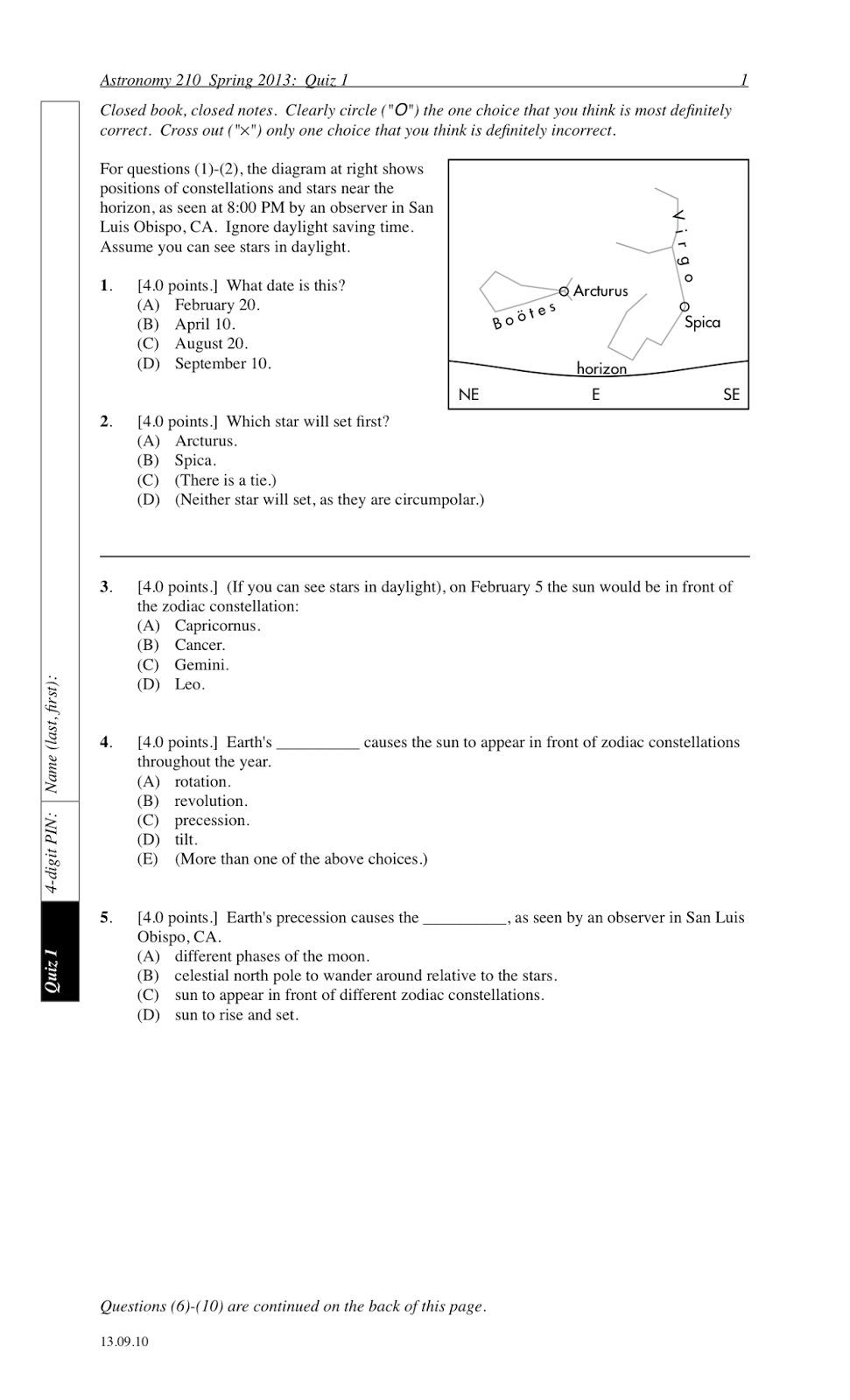
Astronomy quiz archive: stars/sun/seasons/moon phases
Astronomy 210 Quiz 1, fall semester 2013
Cuesta College, San Luis Obispo, CA
Section 70158, version 1
Exam code: quiz01S0u7


Section 70158
Section 70160, version 1
Exam code: quiz01n9YE


Section 70160
Cuesta College, San Luis Obispo, CA
Section 70158, version 1
Exam code: quiz01S0u7


Section 70158
| 0- 8.0 : | *** [low = 7.0] |
| 8.5-16.0 : | ******** |
| 16.5-24.0 : | ************* [mean = 23.1 +/- 8.9] |
| 24.5-32.0 : | ************* |
| 32.5-40.0 : | ******** [high = 40.0] |
Section 70160, version 1
Exam code: quiz01n9YE

Section 70160
| 0- 8.0 : | |
| 8.5-16.0 : | ******* [low = 12.0] |
| 16.5-24.0 : | ******* |
| 24.5-32.0 : | *********** [mean = 25.9 +/- 8.4] |
| 32.5-40.0 : | ***** [high = 40.0] |
Cuesta College North County campus star party

http://www.flickr.com/photos/waiferx/9733608171/
Originally uploaded by Waifer X

http://www.flickr.com/photos/waiferx/9733606985/
Originally uploaded by Waifer X
First quarter moon, September 12, 2013, photographed with a hand-held Panasonic Lumix LZ-8 through an Orion SkyQuest XT8 8" reflector at Cuesta College North County Campus, Paso Robles, CA.

http://www.flickr.com/photos/waiferx/9736835300/
Originally uploaded by Waifer X
Cuesta College Astronomy 210, 210L students and guests at a North County campus star party.
Sights seen:
first quarter moon
Albireo (double star Beta Cygni) Mizar AB, Alcor
20130913
Astronomy current events question: Earth life started on Mars?
Astronomy 210L, fall semester 2013
Cuesta College, San Luis Obispo, CA
Students are assigned to read online articles on current astronomy events, and take a short current events quiz during the first 10 minutes of lab. (This motivates students to show up promptly to lab, as the time cut-off for the quiz is strictly enforced!)
(A) building-block minerals.
(B) radioactive isotopes.
(C) carbon nanostructures.
(D) fossil microorganisms.
(E) chlorophyll residue.
Correct answer: (A)
Student responses
Sections 70178, 70186, 70200
(A) : 34 students
(B) : 5 students
(C) : 11 students
(D) : 8 students
(E) : 1 student
Cuesta College, San Luis Obispo, CA
Students are assigned to read online articles on current astronomy events, and take a short current events quiz during the first 10 minutes of lab. (This motivates students to show up promptly to lab, as the time cut-off for the quiz is strictly enforced!)
Alan Boyle, "'We Are All Martians': Chemist's Otherworldly Claim Stirs Debate," August 28, 2013Researchers speculate that life on Earth first started on Mars before being transported here, based on analysis of __________ in Martian meteorites.
http://www.nbcnews.com/science/we-are-all-martians-chemists-otherworldly-claim-stirs-debate-8C11026339
(A) building-block minerals.
(B) radioactive isotopes.
(C) carbon nanostructures.
(D) fossil microorganisms.
(E) chlorophyll residue.
Correct answer: (A)
Student responses
Sections 70178, 70186, 70200
(A) : 34 students
(B) : 5 students
(C) : 11 students
(D) : 8 students
(E) : 1 student
Astronomy current events question: Sgr A* ejected material
Astronomy 210L, fall semester 2013
Cuesta College, San Luis Obispo, CA
Students are assigned to read online articles on current astronomy events, and take a short current events quiz during the first 10 minutes of lab. (This motivates students to show up promptly to lab, as the time cut-off for the quiz is strictly enforced!)
(A) absorb x-rays.
(B) be ejected outwards.
(C) convert to antimatter.
(D) undergo supernova explosions.
(E) form new spiral arms.
Correct answer: (B)
Student responses
Sections 70178, 70186, 70200
(A) : 10 students
(B) : 40 students
(C) : 4 students
(D) : 1 student
(E) : 3 students
Cuesta College, San Luis Obispo, CA
Students are assigned to read online articles on current astronomy events, and take a short current events quiz during the first 10 minutes of lab. (This motivates students to show up promptly to lab, as the time cut-off for the quiz is strictly enforced!)
J. D. Harrington, Megan Watzke, and Janet Anderson, "NASA's Chandra Observatory Catches Giant Black Hole Rejecting Material," August 29, 2013Observations from NASA's Chandra X-ray Observatory space telescope indicate that most material surrounding Sgr A*, the giant black hole at the Milky Way's center, will:
http://www.nasa.gov/mission_pages/chandra/news/black-hole-rejects-food.html#.UjND1mQ0hUQ
(A) absorb x-rays.
(B) be ejected outwards.
(C) convert to antimatter.
(D) undergo supernova explosions.
(E) form new spiral arms.
Correct answer: (B)
Student responses
Sections 70178, 70186, 70200
(A) : 10 students
(B) : 40 students
(C) : 4 students
(D) : 1 student
(E) : 3 students
Astronomy current events question: Uranus' Trojan asteroid 2011 QF99
Astronomy 210L, fall semester 2013
Cuesta College, San Luis Obispo, CA
Students are assigned to read online articles on current astronomy events, and take a short current events quiz during the first 10 minutes of lab. (This motivates students to show up promptly to lab, as the time cut-off for the quiz is strictly enforced!)
(A) is an escaped moon of Uranus.
(B) will collide with Uranus.
(C) shares Uranus' orbit around the sun.
(D) is opposite the sun from Uranus.
(E) has an unusually high metal content.
Correct answer: (C)
Student responses
Sections 70178, 70186, 70200
(A) : 4 students
(B) : 3 students
(C) : 39 students
(D) : 5 students
(E) : 8 students
Cuesta College, San Luis Obispo, CA
Students are assigned to read online articles on current astronomy events, and take a short current events quiz during the first 10 minutes of lab. (This motivates students to show up promptly to lab, as the time cut-off for the quiz is strictly enforced!)
Charles Q. Choi, "'Trojan Asteroid' Discovered Forming Triangle with Sun, Uranus," August 29, 2013Astronomers at the Canada-France-Hawaii Telescope have discovered asteroid 2011 QF99, which is said to be a Trojan asteroid because it:
http://www.nbcnews.com/science/trojan-asteroid-discovered-forming-triangle-sun-uranus-8C11036226
(A) is an escaped moon of Uranus.
(B) will collide with Uranus.
(C) shares Uranus' orbit around the sun.
(D) is opposite the sun from Uranus.
(E) has an unusually high metal content.
Correct answer: (C)
Student responses
Sections 70178, 70186, 70200
(A) : 4 students
(B) : 3 students
(C) : 39 students
(D) : 5 students
(E) : 8 students
20130911
Whiteboard: lecture notes on forces, interactions
#CuestaPhys205A students: whiteboard #phys101 lecture notes on weight force pic.twitter.com/k1NsOPAU9J
— Patrick M. Len (@Patrick_M_Len) September 12, 2013
#CuestaPhys205A students: whiteboard #phys101 lecture notes on tension, normal forces pic.twitter.com/jafqz8QokD
— Patrick M. Len (@Patrick_M_Len) September 12, 2013
#CuestaPhys205A students: whiteboard #phys101 lecture notes on static/kinetic friction ("Max" is the elephant's name) pic.twitter.com/UImOy97ecH
— Patrick M. Len (@Patrick_M_Len) September 12, 2013
Subscribe to:
Posts (Atom)