Physics 205A Quiz 6, spring semester 2009
Cuesta College, San Luis Obispo, CA
Cf. Giambattista/Richardson/Richardson, Physics, 2/e, Problem 11.9
A metal guitar string has a linear mass density of 3.6 g/m, and is stretched with a tension of 130 N. The speed of transverse waves on this string is:
(A) 5.3×10⁻³ m/s.
(B) 0.68 m/s.
(C) 190 m/s.
(D) 3.6×10⁴ m/s.
Correct answer (highlight to unhide): (C)
The speed of transverse waves along this string is:
v = √(F/(m/L)),
where F is the tension in the string, and (m/L) is the linear mass density (mass per unit length) of the string. Plugging in the given values, where (m/L) must be properly given in units of kg/m:
v = √((130 N)/(0.0036 kg/m)) = 190.0292375 m/s,
or to two significant figures, v = 1.9×10² m/s.
(Response (A) is √((m/L)/F); response (B) is sqrt(F·(m/L)); and response (D) is F/(m/L).)
Student responses
Sections 30880, 30881
(A) : 5 students
(B) : 1 student
(C) : 28 students
(D) : 6 students
Success level: 70%
Discrimination index (Aubrecht & Aubrecht, 1983): 0.62


20090429
Physics quiz question: extending length of pendulum string
Physics 205A Quiz 6, spring semester 2009
Cuesta College, San Luis Obispo, CA
Cf. Giambattista/Richardson/Richardson, Physics, 2/e, Problem 10.58
A 0.50 kg bob is suspended from a 1.6 m string, forming a pendulum. The period of this pendulum is measured. If the mass of the bob is decreased to 0.25 kg while the length of the string is increased to 3.2 m, the period will change by a factor of:
(A) 1.0.
(B) 1.4.
(C) 2.0.
(D) 4.0.
Correct answer: (B)
For a simple pendulum, the period T is given by:
T = 2·π·sqrt(L/g),
where g is the gravitational acceleration constant, and L is the length of the string attached to the pendulum bob, assumed to be an ideal point mass. Increasing the length by a factor of two will increase the period by a factor of sqrt(2.0) = 1.4.
Student responses
Sections 30880, 30881
(A) : 4 students
(B) : 29 students
(C) : 5 students
(D) : 2 students
Success level: 72%
Discrimination index (Aubrecht & Aubrecht, 1983): 0.50
Cuesta College, San Luis Obispo, CA
Cf. Giambattista/Richardson/Richardson, Physics, 2/e, Problem 10.58
A 0.50 kg bob is suspended from a 1.6 m string, forming a pendulum. The period of this pendulum is measured. If the mass of the bob is decreased to 0.25 kg while the length of the string is increased to 3.2 m, the period will change by a factor of:
(A) 1.0.
(B) 1.4.
(C) 2.0.
(D) 4.0.
Correct answer: (B)
For a simple pendulum, the period T is given by:
T = 2·π·sqrt(L/g),
where g is the gravitational acceleration constant, and L is the length of the string attached to the pendulum bob, assumed to be an ideal point mass. Increasing the length by a factor of two will increase the period by a factor of sqrt(2.0) = 1.4.
Student responses
Sections 30880, 30881
(A) : 4 students
(B) : 29 students
(C) : 5 students
(D) : 2 students
Success level: 72%
Discrimination index (Aubrecht & Aubrecht, 1983): 0.50
20090428
Physics quiz question: kinetic energy of SHM object at equilibrium
Physics 205A Quiz 6, Spring Semester 2009
Cuesta College, San Luis Obispo, CA
Cf. Giambattista/Richardson/Richardson, Physics, 2/e, Multiple-Choice Questions 10.11-10.20
[Version 1]
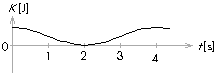 [3.0 points.] A graph of kinetic energy versus time for an object in SHM is shown at right. What is the earliest time that the object will be located at equilibrium?
(A) 0 s.
(B) 1 s.
(C) 2 s.
(D) 3 s.
Correct answer: (A)
An object in simple harmonic motion will be momentarily stationary (and thus have zero kinetic energy) at its x = +/- A amplitude endpoints, and have its fastest speeds as it passes through equilibrium (x = 0). Since the kinetic energy graph already has it maximum value at t = 0 s, that is the earliest time that the object is at equilibrium.
Student responses
Sections 30880, 30881
(A) : 14 students
(B) : 0 students
(C) : 7 students
(D) : 0 students
[Version 2]
 [3.0 points.] A graph of kinetic energy versus time for an object in SHM is shown at right. What is the earliest time that the object will be located at equilibrium?
(A) 0 s.
(B) 1 s.
(C) 2 s.
(D) 3 s.
Correct answer: (C)
An object in simple harmonic motion will be momentarily stationary (and thus have zero kinetic energy) at its x = +/- A amplitude endpoints, and have its fastest speeds as it passes through equilibrium (x = 0). Since the kinetic energy graph does not have its maximum value until t = 2 s, that is the earliest time that the object is at equilibrium.
Student responses
Sections 30880, 30881
(A) : 4 students
(B) : 1 student
(C) : 14 students
(D) : 0 students
"Difficulty level": 70%
Discrimination index (Aubrecht & Aubrecht, 1983): 0.69
Cuesta College, San Luis Obispo, CA
Cf. Giambattista/Richardson/Richardson, Physics, 2/e, Multiple-Choice Questions 10.11-10.20
[Version 1]
 [3.0 points.] A graph of kinetic energy versus time for an object in SHM is shown at right. What is the earliest time that the object will be located at equilibrium?
 (A) 0 s.
(B) 1 s.
(C) 2 s.
(D) 3 s.
Correct answer: (A)
An object in simple harmonic motion will be momentarily stationary (and thus have zero kinetic energy) at its x = +/- A amplitude endpoints, and have its fastest speeds as it passes through equilibrium (x = 0). Since the kinetic energy graph already has it maximum value at t = 0 s, that is the earliest time that the object is at equilibrium.
Student responses
Sections 30880, 30881
(A) : 14 students
(B) : 0 students
(C) : 7 students
(D) : 0 students
[Version 2]
 [3.0 points.] A graph of kinetic energy versus time for an object in SHM is shown at right. What is the earliest time that the object will be located at equilibrium?
 (A) 0 s.
(B) 1 s.
(C) 2 s.
(D) 3 s.
Correct answer: (C)
An object in simple harmonic motion will be momentarily stationary (and thus have zero kinetic energy) at its x = +/- A amplitude endpoints, and have its fastest speeds as it passes through equilibrium (x = 0). Since the kinetic energy graph does not have its maximum value until t = 2 s, that is the earliest time that the object is at equilibrium.
Student responses
Sections 30880, 30881
(A) : 4 students
(B) : 1 student
(C) : 14 students
(D) : 0 students
"Difficulty level": 70%
Discrimination index (Aubrecht & Aubrecht, 1983): 0.69
20090427
Physics clicker question: standing wave on tightened string
Physics 205A, Spring Semester 2009
Cuesta College, San Luis Obispo, CA
Cf. Giambattista/Richardson/Richardson, Physics, 2/e, Problem 11.46
Students were asked the following clicker question (Classroom Performance System, einstruction.com) at the end of their learning cycle:
A guitar's A-string of a length 0.80 m and is stretched to a tension of 40 N. It vibrates at a fundamental frequency of 220 Hz. If the tension in the string is increased by a factor of 2.0, the fundamental frequency of this string increases by a factor of:
(A) 1.4.
(B) 2.0.
(C) 4.0.
(D) (The fundamental frequency remains the same.)
(E) (I'm lost, and don't know how to answer this.)
Sections 30880, 30881
(A) : 19 students
(B) : 7 students
(C) : 4 students
(D) : 0 students
(E) : 1 student
This question was asked again after displaying the tallied results with the lack of consensus, with the following results. No comments were made by the instructor, in order to see if students were going to be able to discuss and determine the correct answer among themselves.
Sections 30880, 30881
(A) : 21 students
(B) : 1 student
(C) : 3 students
(D) : 0 students
(E) : 0 students
Correct answer: (A)
The speed v of transverse waves along a string is:
v = sqrt(F/mu),
where F is the tension in the string, while mu is the linear mass density (mass per unit length) of the string.
The fundamental frequency f_1 for a standing wave on a string is given by:
f_1 = v/(2*L),
where L is the length of the rope. Thus doubling the tension F would increase the wave speed v by a factor of sqrt(2) = 1.4, and thus the fundamental frequency f_1 would also increase by the same 1.4 factor.
Pre- to post- peer-interaction gains:
pre-interaction correct = 61%
post-interaction correct = 84%
Hake, or normalized gain = 59%
Cuesta College, San Luis Obispo, CA
Cf. Giambattista/Richardson/Richardson, Physics, 2/e, Problem 11.46
Students were asked the following clicker question (Classroom Performance System, einstruction.com) at the end of their learning cycle:
A guitar's A-string of a length 0.80 m and is stretched to a tension of 40 N. It vibrates at a fundamental frequency of 220 Hz. If the tension in the string is increased by a factor of 2.0, the fundamental frequency of this string increases by a factor of:
(A) 1.4.
(B) 2.0.
(C) 4.0.
(D) (The fundamental frequency remains the same.)
(E) (I'm lost, and don't know how to answer this.)
Sections 30880, 30881
(A) : 19 students
(B) : 7 students
(C) : 4 students
(D) : 0 students
(E) : 1 student
This question was asked again after displaying the tallied results with the lack of consensus, with the following results. No comments were made by the instructor, in order to see if students were going to be able to discuss and determine the correct answer among themselves.
Sections 30880, 30881
(A) : 21 students
(B) : 1 student
(C) : 3 students
(D) : 0 students
(E) : 0 students
Correct answer: (A)
The speed v of transverse waves along a string is:
v = sqrt(F/mu),
where F is the tension in the string, while mu is the linear mass density (mass per unit length) of the string.
The fundamental frequency f_1 for a standing wave on a string is given by:
f_1 = v/(2*L),
where L is the length of the rope. Thus doubling the tension F would increase the wave speed v by a factor of sqrt(2) = 1.4, and thus the fundamental frequency f_1 would also increase by the same 1.4 factor.
Pre- to post- peer-interaction gains:
pre-interaction correct = 61%
post-interaction correct = 84%
Hake, or normalized gain
20090426
Astronomy quiz question: globular cluster star age
Astronomy 210 Quiz 6, Spring Semester 2009
Cuesta College, San Luis Obispo, CA
The ages of globular cluster stars in the Milky Way halo are determined from:
(A) parallax.
(B) the turn-off point on an H-R diagram.
(C) width of their absorption spectra lines.
(D) their colors.
Section 30676
(A) : 8 students
(B) : 13 students
(C) : 19 students
(D) : 14 students
Correct answer: (B)
The most massive stars left on the main sequence line on an H-R diagram gives the age of the star cluster, because all the stars started their formation at the same time, and the more massive stars have shorter lifetimes (and leave the main sequence line faster) than the less massive stars. Response (A) would determine the distance to stars; response (C) would give an indication of their densities/luminosity class; response (D) would be correlated with the surface temperatures of these stars.
"Difficulty level": 31% (including partial credit for multiple-choice)
Discrimination index (Aubrecht & Aubrecht, 1983): 0.06
Cuesta College, San Luis Obispo, CA
The ages of globular cluster stars in the Milky Way halo are determined from:
(A) parallax.
(B) the turn-off point on an H-R diagram.
(C) width of their absorption spectra lines.
(D) their colors.
Section 30676
(A) : 8 students
(B) : 13 students
(C) : 19 students
(D) : 14 students
Correct answer: (B)
The most massive stars left on the main sequence line on an H-R diagram gives the age of the star cluster, because all the stars started their formation at the same time, and the more massive stars have shorter lifetimes (and leave the main sequence line faster) than the less massive stars. Response (A) would determine the distance to stars; response (C) would give an indication of their densities/luminosity class; response (D) would be correlated with the surface temperatures of these stars.
"Difficulty level": 31% (including partial credit for multiple-choice)
Discrimination index (Aubrecht & Aubrecht, 1983): 0.06
20090425
Physics clicker question: changing tension of a rope wave
Physics 205A, Spring Semester 2009
Cuesta College, San Luis Obispo, CA
Cf. Giambattista/Richardson/Richardson, Physics, 2/e, Multiple-Choice Questions 11.5, 11.6, 11.8
Students were asked the following clicker question (Classroom Performance System, einstruction.com) in the middle of their learning cycle:
Cord tension F = 75 N
Wave speed v = 140 m/s
Frequency f = 20 Hz (from a vibrating source)
Which wave parameter(s) increase if the cord were made more taut?
(A) Wave speed v.
(B) Wavelength lambda.
(C) Period T.
(D) (More than one of above choices.)
(E) (None of above choices.)
(F) (I'm lost, and don't know how to answer this.)
Sections 30880, 30881
(A) : 7 students
(B) : 5 students
(C) : 2 students
(D) : 19 students
(E) : 0 students
This question was asked again after displaying the tallied results with the lack of consensus, with the following results. No comments were made by the instructor, in order to see if students were going to be able to discuss and determine the correct answer among themselves.
Sections 30880, 30881
(A) : 4 students
(B) : 0 students
(C) : 0 students
(D) : 27 students
(E) : 0 students
Correct answer: (D)
The frequency f of a wave is determined solely by the properties of the source, while the wave speed v is determined solely by the properties of the medium (thus frequency and wave speed are said to be the independent wave parameters). For rope waves:
v = sqrt(F/mu),
where F is the tension in the rope, while mu is the linear mass density (mass per unit length) of the rope.
The wavelength is the dependent wave parameter that is determined by both the source and medium, given by:
lambda = v/f or v*T,
where T is the period (which is the inverse of frequency). So if tension F increases, the wave speed v will increase (while the frequency remains constant), and also the wavelength will increase as result of the increase in v.
Pre- to post- peer-interaction gains:
pre-interaction correct = 58%
post-interaction correct = 87%
Hake, or normalized gain = 70%
Cuesta College, San Luis Obispo, CA
Cf. Giambattista/Richardson/Richardson, Physics, 2/e, Multiple-Choice Questions 11.5, 11.6, 11.8
Students were asked the following clicker question (Classroom Performance System, einstruction.com) in the middle of their learning cycle:
Cord tension F = 75 N
Wave speed v = 140 m/s
Frequency f = 20 Hz (from a vibrating source)
Which wave parameter(s) increase if the cord were made more taut?
(A) Wave speed v.
(B) Wavelength lambda.
(C) Period T.
(D) (More than one of above choices.)
(E) (None of above choices.)
(F) (I'm lost, and don't know how to answer this.)
Sections 30880, 30881
(A) : 7 students
(B) : 5 students
(C) : 2 students
(D) : 19 students
(E) : 0 students
This question was asked again after displaying the tallied results with the lack of consensus, with the following results. No comments were made by the instructor, in order to see if students were going to be able to discuss and determine the correct answer among themselves.
Sections 30880, 30881
(A) : 4 students
(B) : 0 students
(C) : 0 students
(D) : 27 students
(E) : 0 students
Correct answer: (D)
The frequency f of a wave is determined solely by the properties of the source, while the wave speed v is determined solely by the properties of the medium (thus frequency and wave speed are said to be the independent wave parameters). For rope waves:
v = sqrt(F/mu),
where F is the tension in the rope, while mu is the linear mass density (mass per unit length) of the rope.
The wavelength is the dependent wave parameter that is determined by both the source and medium, given by:
lambda = v/f or v*T,
where T is the period (which is the inverse of frequency). So if tension F increases, the wave speed v will increase (while the frequency remains constant), and also the wavelength will increase as result of the increase in v.
Pre- to post- peer-interaction gains:
pre-interaction correct = 58%
post-interaction correct = 87%
Hake, or normalized gain
20090424
Physics clicker question: changing frequency of a wave source
Physics 205A, Spring Semester 2009
Cuesta College, San Luis Obispo, CA
Cf. Giambattista/Richardson/Richardson, Physics, 2/e, Multiple-Choice Questions 11.5, 11.6, 11.8
Students were asked the following clicker question (Classroom Performance System, einstruction.com) in the middle of their learning cycle:
A wave has a frequency and wavelength of 200 Hz and 0.75 m, respectively. If the frequency of the wave source is changed, which wave parameters(s) will change as a result?
(A The wavelength.
(B) The speed of the wave.
(C) (Both of the above choices.)
(D) (None of the above choices.)
(E) (I'm lost, and don't know how to answer this.)
Sections 30880, 30881
(A) : 20 students
(B) : 4 students
(C) : 9 students
(D) : 1 students
(E) : 0 students
This question was asked again after displaying the tallied results with the lack of consensus, with the following results. No comments were made by the instructor, in order to see if students were going to be able to discuss and determine the correct answer among themselves.
Sections 30880, 30881
(A) : 25 students
(B) : 2 students
(C) : 6 students
(D) : 0 students
(E) : 0 students
Correct answer: (A)
The frequency f of a wave is determined solely by the properties of the source, while the wave speed v is determined solely by the properties of the medium (thus frequency and wave speed are said to be the independent wave parameters). The wavelength is the dependent wave parameter that is determined by both the source and medium, given by:
lambda = v/f or v*T,
where T is the period (which is the inverse of frequency). So if frequency changes, the wave speed will still remain constant, but the wavelength will as a result change.
Pre- to post- peer-interaction gains:
pre-interaction correct = 59%
post-interaction correct = 76%
Hake, or normalized gain = 41%
Cuesta College, San Luis Obispo, CA
Cf. Giambattista/Richardson/Richardson, Physics, 2/e, Multiple-Choice Questions 11.5, 11.6, 11.8
Students were asked the following clicker question (Classroom Performance System, einstruction.com) in the middle of their learning cycle:
A wave has a frequency and wavelength of 200 Hz and 0.75 m, respectively. If the frequency of the wave source is changed, which wave parameters(s) will change as a result?
(A The wavelength.
(B) The speed of the wave.
(C) (Both of the above choices.)
(D) (None of the above choices.)
(E) (I'm lost, and don't know how to answer this.)
Sections 30880, 30881
(A) : 20 students
(B) : 4 students
(C) : 9 students
(D) : 1 students
(E) : 0 students
This question was asked again after displaying the tallied results with the lack of consensus, with the following results. No comments were made by the instructor, in order to see if students were going to be able to discuss and determine the correct answer among themselves.
Sections 30880, 30881
(A) : 25 students
(B) : 2 students
(C) : 6 students
(D) : 0 students
(E) : 0 students
Correct answer: (A)
The frequency f of a wave is determined solely by the properties of the source, while the wave speed v is determined solely by the properties of the medium (thus frequency and wave speed are said to be the independent wave parameters). The wavelength is the dependent wave parameter that is determined by both the source and medium, given by:
lambda = v/f or v*T,
where T is the period (which is the inverse of frequency). So if frequency changes, the wave speed will still remain constant, but the wavelength will as a result change.
Pre- to post- peer-interaction gains:
pre-interaction correct = 59%
post-interaction correct = 76%
Hake, or normalized gain
20090423
Astronomy quiz question: distant galaxies and lookback time
Astronomy 210 Quiz 6, Spring Semester 2009
Cuesta College, San Luis Obispo, CA
As seen from the Milky Way, a distant galaxy will:
(A) not appear to contain dark matter.
(B) not have absorption lines that are redshifted.
(C) have type Ia supernovae that explode slowly.
(D) appear as it did in its past.
Section 30674
(A) : 2 students
(B) : 3 students
(C) : 2 students
(D) : 25 students
Correct answer: (D)
Due to the finite speed of light, a galaxy that is n light years away will appear to us as it did n years in the past, when that light first left that galaxy.
"Difficulty level": 79% (including partial credit for multiple-choice)
Discrimination index (Aubrecht & Aubrecht, 1983): 0.31
Cuesta College, San Luis Obispo, CA
As seen from the Milky Way, a distant galaxy will:
(A) not appear to contain dark matter.
(B) not have absorption lines that are redshifted.
(C) have type Ia supernovae that explode slowly.
(D) appear as it did in its past.
Section 30674
(A) : 2 students
(B) : 3 students
(C) : 2 students
(D) : 25 students
Correct answer: (D)
Due to the finite speed of light, a galaxy that is n light years away will appear to us as it did n years in the past, when that light first left that galaxy.
"Difficulty level": 79% (including partial credit for multiple-choice)
Discrimination index (Aubrecht & Aubrecht, 1983): 0.31
20090422
Astronomy quiz question: expansion, not explosion
Astronomy 210 Quiz 6, Spring Semester 2009
Cuesta College, San Luis Obispo, CA
__________ is evidence that the universe is not expanding like an explosion.
(A) The finite speed of light.
(B) The night sky is dark, and not blindingly bright.
(C) Galaxy redshifts are proportional to galaxy distances.
(D) Matter and antimatter annihilate to convert into energy.
Section 30674
(A) : 5 students
(B) : 3 students
(C) : 19 students
(D) : 3 students
Correct answer: (C)
In an explosion, debris travels slower as it gets farther from the explosion, which is the opposite of what is actually observed, which is Hubble's law (response (C). Response (A) is the cause of lookback time, and response (B) is Olber's explanation of why the universe cannot be infinite in extent.
A similar version of this question was asked on a Final Exam in Spring 2008.
"Difficulty level": 63% (including partial credit for multiple-choice)
Discrimination index (Aubrecht & Aubrecht, 1983): 0.53
Cuesta College, San Luis Obispo, CA
__________ is evidence that the universe is not expanding like an explosion.
(A) The finite speed of light.
(B) The night sky is dark, and not blindingly bright.
(C) Galaxy redshifts are proportional to galaxy distances.
(D) Matter and antimatter annihilate to convert into energy.
Section 30674
(A) : 5 students
(B) : 3 students
(C) : 19 students
(D) : 3 students
Correct answer: (C)
In an explosion, debris travels slower as it gets farther from the explosion, which is the opposite of what is actually observed, which is Hubble's law (response (C). Response (A) is the cause of lookback time, and response (B) is Olber's explanation of why the universe cannot be infinite in extent.
A similar version of this question was asked on a Final Exam in Spring 2008.
"Difficulty level": 63% (including partial credit for multiple-choice)
Discrimination index (Aubrecht & Aubrecht, 1983): 0.53
20090421
Overheard: radioactive element counting
Astronomy 210, Spring Semester 2009
Cuesta College, San Luis Obispo, CA
(Overheard in lecture during an in-class activity on comparing ratios of radioactive and daughter elements in samples to determine relative radioactive ages.)
Instructor: (Seeing a student quickly counting up all elements on the worksheet) "Look at you--getting all Rain Man on this."
Student 1: "I am an excellent driver."
(Beat.)
Student 2: "You so did not just quote that movie, did you?"
Cuesta College, San Luis Obispo, CA
(Overheard in lecture during an in-class activity on comparing ratios of radioactive and daughter elements in samples to determine relative radioactive ages.)
Instructor: (Seeing a student quickly counting up all elements on the worksheet) "Look at you--getting all Rain Man on this."
Student 1: "I am an excellent driver."
(Beat.)
Student 2: "You so did not just quote that movie, did you?"
Subscribe to:
Posts (Atom)