20070731

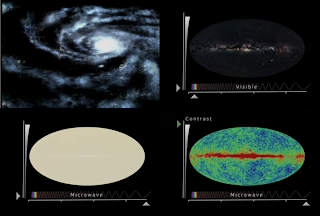
Cosmic background radiation: the horizon problem


The Universe in Different Frequencies
(*.mov, 7.1 MB)

Wilkinson Microwave Anisotropy Probe mission, map.gsfc.nasa.gov

Astronomy 10 learning goal Q12.4

Illustration of how different forms of electromagnetic radiation are distributed in all directions, and how the cosmic background radiation in the microwave band is nearly isotropic (the "horizon problem"), unless contrast is greatly enhanced.

20070730

Valuable lesson learned


Wigu, by Jeffery Rowland
jjrowland.com
June 23, 2007 (excerpt)

Astronomy 10 learning goals Q12.4

Is Blingidium meant to be made of dark matter, dark energy, or something else entirely?

20070727

Education research: SPCI gains (Cuesta College, Summer Session 2007)

The Star Properties Concept Inventory was developed by Janelle Bailey as a pre-test and post-test for introductory astronomy courses. For an overview of how <g> quantifies gains in learning (Hake), see the previous post: Education research: FCI gains (Cuesta College).

The SPCI was administered to Astronomy 10 (one-semester introductory astronomy) students at Cuesta College, San Luis Obispo, CA during the first class meeting, then on the last class meeting. The results below are class averages for the initial and final SPCI scores (given as percentages, with standard deviations), as well as the Hake normalized gain <g>:
Astronomy 10 Summer Session 2007 section 8027
N = 11
<initial%> = 26% +/- 12%
<final%> = 55% +/- 13%
<g> = 0.39
Despite the extremely small number of students in this course, these results are comparable to previous semesters of Astronomy 10 taught by this instructor at Cuesta College, but with a slightly higher gain than is typical.

For earlier results at Cuesta College and further discussion of the SPCI, see previous post: Education research: SPCI gains (Cuesta College, Spring Semester 2006-Spring Semester 2007).

20070726

Astronomy quiz question: metallicity

Astronomy 10 Quiz 11, Summer Session 2007
Cuesta College, San Luis Obispo, CA

Astronomy 10 learning goal Q11.5

[3.0 points.] All elements heavier than hydrogen and helium are considered to be "metals." Which one of the following statements best explains why metal-poor stars are older than metal-rich stars?
(A) Metal-poor stars gradually become metal-rich stars at the end of their main sequence lifetime.
(B) Metal-poor stars have longer main sequence lifetimes.
(C) Metal-poor stars have fewer lines in their absorption spectra.
(D) Explosion debris from metal-poor stars is then incorporated into metal-rich stars.
(E) When metal-poor stars collide, they produce metal-rich stars.

Correct answer: (D)

"Metals" that are produced in the cores of stars are not detectable in their absorption spectra from their exospheres. However, these heavy elements are released during type II supernova explosions, which can then be incorporated into a subsequent generation of stars, which will then have "metals" in their absorption spectra. Thus each generation of stars gets more and more "polluted" by heavy elements in their exospheres.

Student responses
Section 8027
(A) : 2 students
(B) : 2 students
(C) : 3 students
(D) : 1 student
(E) : 2 students

(Compare to previous post: Astronomy clicker question: metal-rich stars.)

20070725

Astronomy clicker question: Milky Way shape (The "High-Maintenance Camper's Dilemma")

Astronomy 10, Summer Session 2007
Cuesta College, San Luis Obispo, CA

Astronomy 10 learning goal Q11.2

Students were asked the following clicker question (Classroom Performance System, einstruction.com) near the beginning of their learning cycle:

[0.3 points.] How do we know that the Milky Way is shaped like a flat disk?
(A) Most other galaxies are shaped like flat disks, therefore the Milky Way must be shaped like a flat disk.
(B) It is possible to visually trace out its flat disk shape if the night sky is dark enough.
(C) Distant stars appear to be dimmer than nearby stars.
(D) (None of the above choices (A)-(C), as the Milky Way is not shaped like a flat disk.)

Correct answer: (B)

This question is asked after an in-class activity where students plot out the most distant stars visible in the Milky Way, and then find that this only represents a very tiny portion of our entire galaxy. This problem posed as the "camping dilemma," where if you had forgotten to bring a mirror with you on a camping trip, then how do you know what you look like? Similarly, with interstellar dust and gas obscuring the majority of the Milky Way, then how do we know the overall shape (and size) of our own galaxy?

Response (A) is analogous to a high-maintenance person looking at the other campers, and asking, "Do I look as bad as they do?" This inference, while plausible, is not necessarily valid, as other galaxies come in various sizes and forms (as would, presumably, the unkempt appearance of other campers). Response (C) is a result of the inverse square law, compounded by interstellar dust and gas, and would be true regardless of the shape and structure of the Milky Way.

Prompt students to recall that under ideal conditions, the Milky Way is seen as a dense band of dim stars across the sky. This is the primary evidence that our galaxy has a thin disk shape, as many stars can be seen in the plane of this disk, while only a sparse distribution of stars are seen in directions above and below the plane of the disk. (While the overall size of the Milky Way cannot be determined solely from this observation, the lack of interstellar dust and gas above and below the plane of the disk does allow for clear views of globular clusters in the halo of the Milky Way, which are used to determine the overall size of the Milky Way.)

Student responses
Section 8027
(A) : 2 students
(B) : 5 students
(C) : 6 students
(D) : 0 students
20070724

Interactive binary star system


Binary Stars Interactive (*.swf)
McGraw-Hill Online Learning Center

Astronomy 10 learning goal Q10.2

Begin with setting M_A = 0.5 solar masses, M_B = 5.0 solar masses, and separation distance = 20 solar radii. Point out that the more massive star B is closer to the center of mass/rotation axis, while the less massive star A is farther away. Ask the students which star will eventually reach the end of its main sequence lifetime first, and why (star B, as it is more massive), and which star will have the larger Roche lobe (star B, as it is both more massive and slower in orbital speed, resulting in less centrifugal force, which counteracts gravity).

If the separation distance is decreased to 7.0 solar radii, the Roche lobes of both stars shrink, as they will both have faster orbital speeds (and thus stronger centrifugal forces, which decreases the volume of space that matter will accelerate in towards either star). The more massive star B still has a larger Roche lobe than star A.

http://highered.mcgraw-hill.com/olcweb/cgi/pluginpop.cgi?it=swf::100%::100%::/sites/dl/free/007299181x/78778/Binary_Nav.swf::Binary%20Stars%20Interactive

20070723

Astronomy quiz question: close-binary mass transfer

Astronomy 10 Quiz 10, Summer Session 2007
Cuesta College, San Luis Obispo, CA

Astronomy 10 learning goal Q10.2

[3.0 points.] Shown at right are the equipotentials of a close pair (mass-exchanging) binary system. Which one of the following choices best describes the transfer of hydrogen in the figure at right?
(A) A giant taking hydrogen from a more massive neutron star.
(B) A giant feeding hydrogen to a more massive neutron star.
(C) A giant taking hydrogen from a less massive neutron star.
(D) A giant feeding hydrogen to a less massive neutron star.
(E) (None of the above choices (A)-(D), as no hydrogen is being transferred.)

Correct answer: (B)

The star on the left has less mass than the star on the right, as the center of mass of the binary star system is closer to the star on the right. The star on the left is in its giant phase, as it has expanded in size to its Roche lobe, and thus is transferring hydrogen to the more massive neutron star on the right.

Student responses
Section 8027
(A) : 3 students
(B) : 6 students
(C) : 3 students
(D) : 1 student
(E) : 0 students

20070719

Batgirl centrifuge

Batman #129 (1960), cover by Sheldon Moldoff and Ira Schnapp
Courtesy Mike's Amazing World of DC Comics

Physics 8A learning goal Q4.5

For the villain's sake, let's hope that Batgirl doesn't start get nauseous while still on that thing...

20070718

Tidal slowing of Earth's rotation

Dinosaur Comics, by Ryan North
www.qwantz.com
July 12, 2007 (excerpt)

Astronomy 10 learning goal Q4.x

Other than the snide remarks regarding reading Professor Science's mail (T. Rex is "not" officially Professor Science), Ryan North nails the science in this comic strip.

Another result of this tidal slowing of the Earth's rotation rate is that since the total angular momentum of the Earth-Moon system must be conserved (even though rotational kinetic energy being lost due to dissipative forces), the Moon will also begin to move out away from the Earth, increasing this distance to compensate for the decreasing rotation.

20070717

Astronomy clicker question: the Stefan-Boltzmann law

Astronomy 10, Summer Session 2007
Cuesta College, San Luis Obispo, CA

Astronomy 10 learning goal Q8.5

Students were asked the following clicker question (Classroom Performance System, einstruction.com) near the beginning of their learning cycle:

[0.3 points.] Why is a white dwarf star smaller than a main-sequence star that has the same white-hot color?
(A) It is less luminous than the main-sequence star.
(B) It is more luminous than the main-sequence star.
(C) It is cooler than the main-sequence star.
(D) It is hotter than the main-sequence star.

Correct answer: not revealed yet (see discussion).

This is the follow-up question after a short lecture (20 minutes) and an in-class activity (20 minutes) on how Wien's law and the Stefan-Boltzmann law describe blackbody radiation. Initial responses below:

Student responses
Section 8027
(A) : 3 students
(B) : 0 students
(C) : 3 students
(D) : 7 students

A leading question for the students: "Which star is hotter, and why?" Some students will have already realized that because these two stars have the same color, then they must be at the same temperature (application of Wien's law), and the class discusses why this must be the case. The same question is asked again, after the students collectively come to realization that both responses (C) and (D) cannot be true.

[0.3 points.] Why is a white dwarf star smaller than a main-sequence star that has the same white-hot color?
(A) It is less luminous than the main-sequence star.
(B) It is more luminous than the main-sequence star.
(C) It is cooler than the main-sequence star.
(D) It is hotter than the main-sequence star.

Correct answer: (A)

Student responses
Section 8027
(A) : 12 students
(B) : 1 student
(C) : 0 students
(D) : 0 students

The Stefan-Boltzmann law states that luminosity is proportional to size (that is, surface area) and temperature (T^4). Since they are the same temperature, then the less luminous star must be smaller in size than the more luminous star, which is larger in size.