20141213

Astronomy midterm question: habitability of Mars forming closer to the sun

Astronomy 210 Midterm 2, fall semester 2014
Cuesta College, San Luis Obispo, CA

An astronomy question on an online discussion board[*] was asked:
Pd: If Mars had originally formed closer to the sun, would it be more habitable today?
qu: Mars closer to the sun would be warmer, but actually less habitable with less water and atmosphere.
Discuss how Mars forming closer to the sun would have less water and atmosphere today, and how you know this. Explain using the properties of planet mass, atmosphere, and geological activity.

[*] answers.yahoo.com/question/index?qid=20141101111207AAt4Wdm.

Solution and grading rubric:
  • p:
    Correct. Discusses why both statements are correct about Mars located closer to the sun and being warmer would result in:
    1. less water, due to warmer temperatures evaporating all available water (or ultraviolet light breaking apart water molecules);
    2. less atmosphere, as warmer temperatures would allow atmosphere molecules to move faster and more easily escape from Mars' weak gravity.
  • r:
    Nearly correct (explanation weak, unclear or only nearly complete); includes extraneous/tangential information; or has minor errors. One of the two points (1)-(2) correct, other is problematic/incomplete.
  • t:
    Contains right ideas, but discussion is unclear/incomplete or contains major errors. Both points (1)-(2) problematic/incomplete, or one is correct while the other is garbled/missing.
  • v:
    Limited relevant discussion of supporting evidence of at least some merit, but in an inconsistent or unclear manner. At least attempts to use relationships between planet location and mass with atmosphere temperature and retention.
  • x:
    Implementation/application of ideas, but credit given for effort rather than merit. Discussion not clearly based on relationships between planet location and mass with atmosphere temperature and retention.
  • y:
    Irrelevant discussion/effectively blank.
  • z:
    Blank.
Grading distribution:
Section 70158
Exam code: midterm02s0vA
p: 10 students
r: 4 students
t: 18 students
v: 10 students
x: 3 students
y: 0 students
z: 0 students

Section 70160
Exam code: midterm02n4Rs
p: 7 students
r: 6 students
t: 15 students
v: 2 students
x: 3 students
y: 0 students
z: 0 students

A sample "p" response (from student 1123):

A sample "x" response (from student):

Astronomy midterm question: distance modulus comparison

Astronomy 210 Midterm 2, fall semester 2014
Cuesta College, San Luis Obispo, CA

An astronomy question on an online discussion board[*] was asked:
??: Two stars have these apparent magnitudes and absolute magnitudes. What can we say about their relative distances from Earth?
m
apparent
magnitude
M
absolute
magnitude
Star X +9 +2
Star Y +4 +6

ba: The relative distances of stars can be determined by subtracting the absolute magnitude from the apparent magnitude. The more positive the answer, the farther away the star. For your example, Star X has a magnitude difference of 9 – 2 = +7, while the difference for Star Y is 4 – 6 = –2.
Discuss whether the technique discussed in this answer is correct or incorrect, and how you know this. Explain using the relationships between apparent magnitude, absolute magnitude, and distance.

[*] answers.yahoo.com/question/index?qid=20090321011229AAwvrJw.

Solution and grading rubric:
  • p:
    Correct. Understands difference between apparent magnitude m (brightness as seen from Earth, when placed at their actual distance from Earth) and absolute magnitude (M (brightness as seen from Earth, when placed 10 parsecs away), and discusses:
    1. that for star X, the brightness it has at its location (m = +9) is dimmer than its brightness when placed 10 parsecs away (M = +2), so its distance is greater than 10 parsecs; while for star Y, the brightness it has at its location (m = +4) is brighter than its brightness when placed 10 parsecs away (M = +6), so its distance is closer than 10 parsecs;
    2. how this is consistent with the method proposed by "ba" (which follows directly from the "distance modulus" (mM) in the relation (mM) = 5·log(d) – 5), as star X has a distance modulus of +7 ("more positive the answer, the farther away the star") and star Y has a distance modulus of –2 (which would indicate that it is closer than star X).
  • r:
    Nearly correct (explanation weak, unclear or only nearly complete); includes extraneous/tangential information; or has minor errors. One of the two points (1)-(2) correct, other is problematic/incomplete.
  • t:
    Contains right ideas, but discussion is unclear/incomplete or contains major errors. Only one of the two points (1)-(2) correct, other is missing, or both are problematic.
  • v:
    Limited relevant discussion of supporting evidence of at least some merit, but in an inconsistent or unclear manner. At least attempts to use relationships between apparent magnitudes, absolute magnitudes, and distances.
  • x:
    Implementation/application of ideas, but credit given for effort rather than merit. Discussion based on garbled definitions of, or not based on proper relationships between apparent magnitudes, absolute magnitudes, and distances.
  • y:
    Irrelevant discussion/effectively blank.
  • z:
    Blank.
Grading distribution:
Section 70158
Exam code: midterm02s0vA
p: 14 students
r: 9 students
t: 12 students
v: 6 students
x: 4 students
y: 0 students
z: 0 students

A sample "p" response (from student 0978):

A sample "t" response (from student 4743):

Astronomy midterm question: doubling star distances

Astronomy 210 Midterm 2, fall semester 2014
Cuesta College, San Luis Obispo, CA

An astronomy question on an online discussion board[*] was asked:
JK: A star has an apparent magnitude of +12.5 and an absolute magnitude of –2.0. If the star is moved twice as far away (distance is doubled), would its apparent magnitude then be –0.5? I don't know if I am correct.
Discuss why this reasoning is incorrect, and how you know this. Explain using the relationships between apparent magnitude, absolute magnitude, and distance.

[*] answers.yahoo.com/question/index?qid=20090216102612AAzRHWy.

Solution and grading rubric:
  • p:
    Correct. Understands difference between apparent magnitude m (brightness as seen from Earth, when placed at their actual distance from Earth) and absolute magnitude (M (brightness as seen from Earth, when placed 10 parsecs away), and discusses how placing a star farther away will affect its apparent magnitude, making it dimmer (a larger positive number than +12.5) instead of brighter (the incorrect value of –0.5).
  • r:
    Nearly correct (explanation weak, unclear or only nearly complete); includes extraneous/tangential information; or has minor errors.
  • t:
    Contains right ideas, but discussion is unclear/incomplete or contains major errors.
  • v:
    Limited relevant discussion of supporting evidence of at least some merit, but in an inconsistent or unclear manner. At least attempts to use relationships between apparent magnitudes, absolute magnitudes, and distances.
  • x:
    Implementation/application of ideas, but credit given for effort rather than merit. Discussion based on garbled definitions of, or not based on proper relationships between apparent magnitudes, absolute magnitudes, and distances.
  • y:
    Irrelevant discussion/effectively blank.
  • z:
    Blank.
Grading distribution:
Section 70160
Exam code: midterm02n4Rs
p: 7 students
r: 6 students
t: 15 students
v: 2 students
x: 3 students
y: 0 students
z: 0 students

A sample "p" response (from student 0500):

Astronomy midterm question: bigger, more luminous stars always cooler or hotter?

Astronomy 210 Midterm 2, fall semester 2014
Cuesta College, San Luis Obispo, CA

An astronomy question on an online discussion board[*] was asked:
Pd: Are the bigger, more luminous stars always the cooler stars?
Sa: You wouldn't be right because "more luminous" means more energy output, which means bigger and hotter.
Discuss why this answer is incorrect, and how you know this. Explain using Wien's law, the Stefan-Boltzmann law and/or an H-R diagram.

[*] answers.yahoo.com/question/index?qid=20141031235350AAd46qs.

Solution and grading rubric:
  • p:
    Correct. Uses Wien's law, the Stefan-Boltzmann law and/or interprets H-R diagram to discuss how a more luminous star does not necessarily have to be both bigger and hotter, by comparing:
    bright/larger/cooler vs. dim/smaller/hotter stars;
    bright/larger/(same temperature) vs. dim/smaller/(same temperature) stars;
    bright/smaller/hotter vs. dim/larger/cooler stars;
    bright/(same size)/hotter vs. dim/(same size)/cooler stars.
  • r:
    Nearly correct (explanation weak, unclear or only nearly complete); includes extraneous/tangential information; or has minor errors. Or as (p), but may instead compare:
    (same brightness)/smaller/hotter vs. (same brightness)/larger/cooler stars;
    brighter/larger/hotter vs. dim/smaller/cooler star;
    thus not sufficiently discussing why the response would not always be correct.
  • t:
    Contains right ideas, but discussion is unclear/incomplete or contains major errors. At last discussion demonstrates understanding of Wien's law, H-R diagram and/or the Stefan-Boltzmann law.
  • v:
    Limited relevant discussion of supporting evidence of at least some merit, but in an inconsistent or unclear manner. At least attempts to use Wien's law, H-R diagram and/or the Stefan-Boltzmann law.
  • x:
    Implementation/application of ideas, but credit given for effort rather than merit. Discussion not clearly based on Wien's law, H-R diagram and/or the Stefan-Boltzmann law.
  • y:
    Irrelevant discussion/effectively blank.
  • z:
    Blank.
Grading distribution:
Section 70158
Exam code: midterm02s0vA
p: 20 students
r: 14 students
t: 6 students
v: 3 students
x: 1 student
y: 0 students
z: 0 students

Section 70160
Exam code: midterm02n4Rs
p: 20 students
r: 7 students
t: 2 students
v: 2 students
x: 2 students
y: 0 students
z: 0 students

A sample "p" response (from student 1327) comparing a bright/larger/cooler star versus a dim/smaller/hotter star:

A sample "p" response (from student 5656) comparing a bright/larger star that has the same temperature as a dim/smaller star:

A sample "p" response (from student 5309) comparing a bright/smaller/hotter star versus a dim/larger/cooler star:

A sample "p" response (from student 1795) comparing a bright/hotter star that has the same temperature as a dim/cooler star:

20141211

Physics quiz archive: temperature, thermal equilibrium, heat transfer

Physics 205A Quiz 7, fall semester 2014
Cuesta College, San Luis Obispo, CA
Sections 70854, 70855, 73320, version 1
Exam code: quiz07cO4t


Sections 70854, 70855, 73320 results
0- 6 :  
7-12 :   **** [low = 9]
13-18 :   *******
19-24 :   ******************** [mean = 24.2 +/- 5.5]
25-30 :   ********************** [high = 30]

Astronomy quiz archive: Milky Way, cosmology

Astronomy 210 Quiz 7, fall semester 2014
Cuesta College, San Luis Obispo, CA

Section 70158, version 1
Exam code: quiz07su4R


Section 70158
0- 8.0 :  
8.5-16.0 :   **** [low = 7.5]
16.5-24.0 :   ******************
24.5-32.0 :   *********** [mean = 25.0 +/- 6.8]
32.5-40.0 :   ****** [high = 36.5]


Section 70160, version 1
Exam code: quiz07n0Lb


Section 70160
0- 8.0 :  
8.5-16.0 :   ******* [low = 11.0]
16.5-24.0 :   ************* [mean = 22.4 +/- 7.4]
24.5-32.0 :   ******
32.5-40.0 :   ****** [high = 36.5]

20141203

Physics presentation: heat transfer applications

Let's now shift gears and preview the various heat transfer phenomena you will be investigating during the last laboratory of this semester: convection, conduction, and radiation.

A Cooper Cooler™, where beverages are spun while being sprayed with ice water:
"The Cooper Cooler™ chills beverages on demand forty times faster than a freezer. So that means you can chill a bottle of wine in six minutes, and your sodas in one minute... And because it's spinning and not shaking your carbonated beverages, you don't have to worry about them exploding."
If you choose, you can investigate whether these claims are valid with an actual Cooper Cooler™! (Video link: "Cooper Cooler - Rapid Beverage Cooler.")

Or Coffee Joulies™:
"Fresh coffee is often too hot to drink when it's first brewed. This is especially true when you throw it in your insulated travel mug and you head out to work, and you're waiting and you're waiting for it to cool down enough and you carry it around and you can't even drink your coffee..."

"[Coffee Joulies™ are] shaped like giant coffee 'beans' made of stainless steel. You just drop these in your hot coffee, one 'bean' for every four ounces of coffee, and it cools right down to 140° in a few seconds, that's the perfect temperature for drinking. Then the Coffee Joulies™ hold your coffee at that temperature so you can take your time and enjoy it."

"The secret is inside--there's a proprietary substance that's encapsulated inside the steel 'beans' and it's called a phase-change material. This one has a melting temperature of exactly 140°, so when you put it in your hot coffee, it absorbs the heat, cooling all the coffee around it, so it's completely liquid inside the steel 'bean.' Then the phase-change material slowly releases that heat back into the coffee until it becomes a solid again. And in our tests, they kept coffee at 140° for two full hours..."
Again, in laboratory, you can choose to investigate these claims--however, not with actual Coffee Joulies™ (they're somewhat pricey), but with packets containing the same phase-change substance (food-grade sodium acetate). (Video link: "Coffee Temperature Regulator.")

And reflective "space blankets," used in emergency survival situations to retain body warmth:
"This thermal sheet functions by reflecting your body heat back to you. If you wrap it around yourself while already freezing, it will be in vain."

"Also when using only a space blanket (with just a tank top and shorts), as the snow lands on your shoulders it will immediately drive the heat from your body. In an actual snowfall, you must have insulation (jacket and pants) between you and the blanket to minimize this."
You can also choose to investigate the most effective use of space blankets. (Video link: "SOL Emergency Heatsheet/Blanket Review in Snow.")

20141201

Physics presentation: heat transfers

Oh, chocolate bunny, how do I love thee? Let me count the ways: conduction, convection, radiation. (Video link: "Chocolade Haas (Chocolate Bunny)."

In a previous presentation, we considered what happens to an object when heat is transferred into, or out of it. Here we will look more closely at the transfers themselves, that is, how thermal energy is transferred.

First, conduction, where heat is transferred through an object.

This house is shown in visible wavelengths on the left side of the image, and in infrared wavelengths on the right side of the image, where we can see that while the walls of the house are not allowing much heat to pass through them, there is quite a bit heat exiting the house through the windows.

The power (amount of heat conducted per time, in units of joules/second, or watts) through a wall is proportional to the temperature difference ∆T on either side (as per the zeroth law of thermodynamics, heat flows from high to low temperatures), and inversely proportional to the thermal resistance R of the object, which is a measure of how difficult it is for heat to flow per time through it:

R = d/(κ·A),

where the resistance is proportional to the thickness d of the material, and inversely proportional to the exposed surface area A and the material-dependent conductivity κ (lower-case Greek letter "kappa," in units of watts/m·K), which characterizes how well this material allows (or does not allow) heat to flow through it.

In order to minimize the amount of heat flowing per time through these exterior walls, the thermal resistance R of the insulation installed should be maximized--by having a large or small conductivity κ value? A small or large insulation thickness d? Should the walls be constructed with a small or large surface area A?

If an additional layer is added to existing insulation, such as this wall-spanning bookcase full of books, then the overall thermal resistance of the bookcase and insulation layer in the wall would be the sum of their individual resistances:

Rtotal = Rwall + Rbooks,

Rtotal = (dwall/(κwall·Awall)) + (dbooks/(κbooks·Abooks)),

where presumably the shared area A of the wall and the bookcase is the same value, but they have different d thicknesses and κ conductivities. The resulting power (heat flow per time) through the book layer and wall insulation is then:

Power = (heat flow)/time = ∆T/Rtotal.

Second, convection, the transport of heat via circulating air. We will just discuss this qualitatively, in contrast to conduction and later, radiation.

Natural convection is where a fluid (liquid or gaseous) will circulate and transport thermal energy from a high temperature to a low temperature region (again, the zeroth law of thermodynamics). In this lava lamp, there is a light bulb heating up these wax globules from below. As the wax globules heat up and expand, their density decreases relative to the clear solvent, and subsequently rise upwards. At the top of the lava lamp, the wax globules cool down and contract, such that their density increases relative to the clear solvent, and subsequently begin to sink. Notice that thermal energy is not being conducted from bottom to top through a static substance, it is being "carried" within the rising globules. (Video link: "080913-1050512.")

You can also transport thermal energy via forced convection, where instead of the fluid circulating naturally due to relative changes in buoyancy, it is forced to carry off thermal energy, typically by blowing across the surface of hot soup.

Third, radiation, where heat is transported in the form of light.

Stefan's law of radiation quantitatively describes the power, or net amount of heat transferred in the form of light to/from an object, which is depends on the difference of the fourth powers of the object's surrounding environment temperature and the temperature of the object itself (in kelvin), the total surface area A of the object, and the emissivity e of the object. Note the obligatory numerical constant σ.

In order to be consistent with all the other definitions of heat flow in this course, a negative sign must be put in to the version of the equation that is given in your textbook. Since a positive heat flow per time is energy being put into the object from the environment, this occurs if the temperature Tenv of the surrounding environment is greater than the object's temperature Tobj. A negative heat flow per time is energy being taken from the object out to the environment, so the temperature Tenv of the surrounding environment must be less than the object's Tobj temperature.

A blackbody is an object that is good at absorbing heat transferred in the form of light. But radiation is a two-way street, so an object that is good at absorbing heat will also be good at emitting heat. This is why objects that are meant to cool off efficiently by radiating (or heat up efficiently by absorbing) light are painted black--here, the entire surface of this SR-71 Blackbird. A perfect blackbody has an emissivity e = 1.

In contrast, a silverbody is an object that is good at reflecting light (and poor at absorbing heat in the form of light). Again, radiation is a two-way street, so an object that is poor at absorbing heat will also be poor at emitting heat. Here this early NASA communication satellite will efficiently reflect light, but will also be very inefficient at radiating heat should it get too hot. A perfect silverbody has an emissivity e = 0.

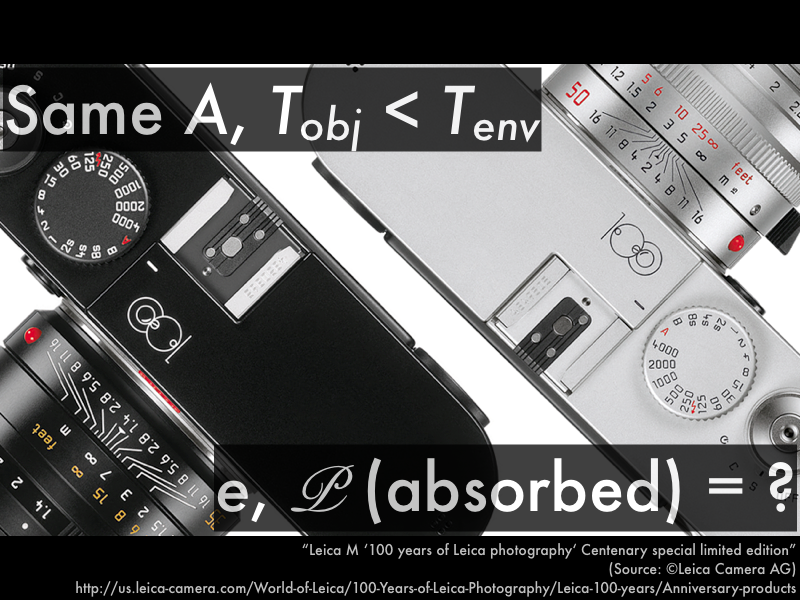
For these two Leica M cameras, if they are both cooler than the surrounding environment, both will begin to heat up by absorbing radiative heat (say, from the sun). Which will have a faster rate of heat absorbed per time--the black model, or the silver model?

For these snowboarders, if they are warmer than the surrounding environment, they will begin to cool down by emitting radiative heat (say, to the overcast sky and the snowy landscape). Which snowboarder will have a faster rate of heat radiated per time--the snowboarder with the black jacket, or the white jacket?